
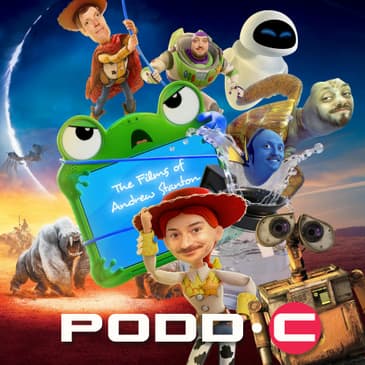




Surprise! In a first for Blank Check, we’re dropping a bonus main-feed episode featuring a conversation with the Academy Award-winning director of the films we just covered. The great Andrew Stanton joins us for a delightful conversation about Pixar, what happened to scatting, and how Elmo messed everything up for everyone. He answers many questions from Griffin (the Pixar nerd formerly known as FlikLover98), and goes in depth on the ending of WALL-E. Enjoy!
Sign up for Check Book, the Blank Check newsletter featuring even more “real nerdy shit” to feed your pop culture obsession. Dossier excerpts, film biz AND burger reports, and even more exclusive content you won’t want to miss out on.
Join our Patreon for franchise commentaries and bonus episodes.
Follow us @blankcheckpod on Twitter, Instagram, Threads and Facebook!
Connect with other Blankies on our Reddit or Discord
For anything else, check out BlankCheckPod.com
Learn more about your ad choices. Visit megaphone.fm/adchoices
[00:00:01] [SPEAKER_05] Blank Check!
[00:00:50] [SPEAKER_04] I took the R. Oh, there you go! Got here in 25. That's a workman-like train. You know, the R, she's nobody's favorite. It was 30 seconds from my apartment and then about 25 seconds from the stop here to get in.
[00:01:07] [SPEAKER_03] The R just trundles along though. Like, you're never on the R like, great, we're about to pick up speed.
[00:01:12] [SPEAKER_02] The R does yeoman's work.
[00:01:13] [SPEAKER_03] It's a yeoman's work train by a long shot. Free boroughs, local all the way.
[00:01:17] [SPEAKER_02] You often say that the queue is kind of default the best train. The queue's a great train. Not your personal favorite, but that is- Not my personal favorite. It's a great train.
[00:01:24] [SPEAKER_03] Why is the queue? Oh, it's an express. Oh yeah, yeah. And I think that the line it goes down in Brooklyn is very attractive. Like, it's very nice sort of- Oh, the curves of that queue. No, it's outside. The outside is really nice. It's a special, if you want me to get really nerdy, there's not a lot of parts of the subway that are like the queue because the queue was a very, very old steam railroad. So it's just open cut in the ground. So it's not elevated, which, you know, is cute, but like you gotta go up and down these stairs, you know, and it's not underground.
[00:01:54] [SPEAKER_03] It's fairly nice, the Brighton line. Simms is a fan of the New York transportation system. I'm a New York kid! I love the subway!
[00:01:59] [SPEAKER_04] Did you know before they put the subway system in there was a pneumatic tube system between postal stations? Yes, yes. They inaugurated it with a live cat. A live cat?
[00:02:08] [SPEAKER_03] Yeah. To make sure the cat like didn't die? Yeah, exactly. That I didn't know.
[00:02:11] [SPEAKER_02] Yeah. The cat was like the, the Leica was like the animal sent through. Like they put it in a little cage, like a box and shot it down the tube. Wow.
[00:02:18] [SPEAKER_03] And then the other guys were like, we got her! That's what they say. That's what they say. Okay. I think we should go back to pneumatic tubes. I do too. They're fast. Yeah. Okay, Griff doesn't have a take on it. No, I'm thinking. Does anyone still use them? I think a lot of places still use them.
[00:02:33] [SPEAKER_04] We did, when we were building the studio for Pixar in the late 90s, we did, Wired Magazine was kind of au courant at the time and they did a whole thing about how pneumatic tubes actually still exist and Boeing uses them in like a huge scale and advanced technology, send engine parts like half a mile down their property. So we were like, let's put that in the building. And Steve was like, no, no, no, no. And then we got whittled down to like, can we just have one loop? One little tube. And then it just goes nowhere and we just pay the receptionist to like put an envelope
[00:03:01] [SPEAKER_04] into a tube and shoot the capsule and then just do it every 15 minutes.
[00:03:05] [SPEAKER_02] And does it go back down to her? Yeah, exactly. Okay, it's amazing. Can we just have that? Yeah.
[00:03:09] [SPEAKER_01] I was in Chicago recently and I bought weed. The weed shop used to pneumatic tubes. Isn't that cool?
[00:03:16] [SPEAKER_02] You know what? That actually makes a lot of sense. I do think that's how we bring the pneumatic tube back. It makes sense to go hand in hand with the legalization of weed. Yeah. Those stores shouldn't be pulling a thing out of a drawer.
[00:03:28] [SPEAKER_04] Right.
[00:03:28] [SPEAKER_02] Or going in the back.
[00:03:29] [SPEAKER_04] Yeah.
[00:03:30] [SPEAKER_02] Even if it's just a guy blowing a thing through a tube from the back, that's what it should be.
[00:03:35] [SPEAKER_04] Pixar is in the Bay. Where's Pixar? Pixar is in technically in Emeryville. Right. Like north of Oakland. Which is an industrial piece of real estate that's about a mile, maybe a quarter of a mile high and maybe a mile wide. And it connects Oakland and Berkeley. So if you go across the Bay Bridge from San Francisco, there's a right below it is a big Ikea store. And right behind that is us. Is that good being far away from Hollywood? Like, quote unquote, far away. That's further away. That's part of the secret sauce. Yes. That you guys were sort of insulated.
[00:04:05] [SPEAKER_04] Yeah. And it's a lot of other factors, but it also kept and still does keeps most of the employees grounded because when you leave, the waiter's not trying to sell a script or run a roll. You know, you're not meeting other people in the business. I mean, it's become kind of tech bro everywhere. But there's nobody trying to make movies. So it kind of keeps you appreciative of what you get to do every day.
[00:04:33] [SPEAKER_02] We're here with Andrew Stanton, who and this is a fact, is the director that we have been covering for the last six weeks. That's so true. Six films, correct?
[00:04:41] [SPEAKER_04] Yeah. Just six features. I should have opened with this, but explain to me. Can I just. Yeah, please. Can I just say can for the rest of this episode, can I call you flick lover 98? Absolutely. Because that. Wait, you listen to a Patreon episode?
[00:04:57] [SPEAKER_03] That's sick. That cracked me. I'm sorry I wasn't a big bucks life fan.
[00:05:00] [SPEAKER_02] I was big into it. Yeah. Sorry I was anti-buck's life. I think he's a great character. You should have led with that when you met me, Griffin. A gentleman's character.
[00:05:08] [SPEAKER_04] We should establish the back story here. At first I thought there were 97 lovers of flick, but then I realized, oh, it was the
[00:05:15] [SPEAKER_02] year you made it. Right. Right.
[00:05:19] [SPEAKER_03] It was also. The year the film came out.
[00:05:20] [SPEAKER_02] It was the year the film came out. Yeah. Yeah. Yeah. I needed that flick lover 98. You can indeed call me. You're the one person who's allowed to call.
[00:05:27] [SPEAKER_03] Let's clear the air on this. You're the co-director of that film.
[00:05:30] [SPEAKER_02] Yes.
[00:05:30] [SPEAKER_03] Oh, that's a good question. That does mean you are not the director because like some people will sort of say like, well, why won't you cover this film? They're a co-director. And I'm like, I think that title like it means. Signifies that you're not the director. Exactly. Right.
[00:05:42] [SPEAKER_04] The way explain is we came up with it because that's my beer. And then that question. Um, because during Toy Story, the team that had been doing commercials together was John, a last repeat doctor and myself. And John and I just really clicked. And like, I was a really good Jiminy Cricket, like a good conscience for him. I was always say I'm like the devil on his shoulder and Joe ramps who God bless him was like angel on his shoulder.
[00:06:13] [SPEAKER_04] But I was able to kind of always help him keep thinking in the right direction or avoid the wrong direction. And so I kind of was invisibly that role, uh, without knowing it. Cause we didn't, we were all learning what the roles were on Toy Story. So after it was over, we said, can we make this official? And so I said, well, let's, let's make sure it's not a Disney only new dual directors. I was going to say, but we didn't know when we didn't, we didn't want to make up a title that was new.
[00:06:41] [SPEAKER_04] So we just said, we just know what the role means. Co-director means deputy. And you're just there to be help the director be in two places at once. Like if you do the role, right, if somebody talks to me and say, what should we do? I'm not pushing my vision. I'm pushing the vision of the director and I'm helping keep moving along.
[00:07:00] [SPEAKER_03] But it's sort of a little different from like an assistant director, which is a very defined.
[00:07:03] [SPEAKER_04] No assistant director is a very, very, very, very different role.
[00:07:06] [SPEAKER_03] And so, uh, so that's unique to Pixar. It's just, it's something that people get hung up on to this day, but I think because of the uniqueness.
[00:07:14] [SPEAKER_04] Right. But we've always been consistent since the first movie that like, sometimes we there and I'm the same way. Like I found out on Nemo, I worked better having Lee Unkrich who had always had as an editor to confer with when John was busy to have him at the ready. So he came on board like the last year and a half.
[00:07:34] [SPEAKER_03] Does every Pixar project have a co-director? Right. It's so it's the director's choice. Right.
[00:07:39] [SPEAKER_04] It's, it's lit. There is not a stamped way it's done. And, uh, it's more like we are very individual, visionary based, like filmmaker based, and we do whatever will make that filmmaker work better. So I, the one beef I have that you guys fall accidentally into, it's my only beef and it's for the greater good. When you use the word they for Pixar, it's like, you don't do that with Nolan.
[00:08:08] [SPEAKER_04] You don't say they for the universal studios or like, yes, there is no star chamber of people going, you've got to do this. And everybody wants there to be even internally picks up people want that to be with Disney, but there isn't. It's like we are, we take the high risk we take is we invest in that visionary filmmaker. Yes. And then we will support them or kind of sometimes cast them and put a group around them so that
[00:08:36] [SPEAKER_04] they will succeed because we can't afford to fail. But we also can't afford not to follow a singular artist vision. We learned that from the first movie. So it's Toy Story is a John Lasseter movie, you know, it's always bugs life. Toy Story three is a, is a Lee Unkrich movie. Uh, Toy Story four is the Josh Kuhl movie. There's no, they it's not like Pixar had nobody knew that they were going to make a two. Nobody knew we were going to make a three. There isn't a great map. There's one of the great wisdoms of growing up and getting older is realizing nobody's flying
[00:09:05] [SPEAKER_04] the fucking plane. And you go, oh, and so we're just trying to make the best smart decisions we can at the time and maybe hopefully not pay for it later.
[00:09:15] [SPEAKER_03] You know, but it's your victims of your own success. I mean, the reason people, including us are like, well, Pixar is because Pixar's run was so unique. So it's treated more like a sports team. I know it's a dynasty. Right.
[00:09:27] [SPEAKER_04] And so I know I'm, I'm fighting a losing battle, but I just, the idea that like, there is a, it is a group sport to make a movie, but that's still everybody believes when live action, that there is a one person that is running that movie. The Barbie's a Greta Gerwig movie. Yes. And so, so are the pick. I can't speak for any other animation studios, but I can speak for Pixar and going that individual was the director and visionary of that film.
[00:09:52] [SPEAKER_02] But, but also that's why, you know, we covered you and we're not a podcast going like, let's do a 25 film series on Pixar.
[00:09:59] [SPEAKER_03] Well, that's true. And we did right. We did Ron Clements and John Musker. And we did Brad Bird. And we did Brad Bird. Yeah. We've done like, and Clements and Musker. Oh, and I know, I know you get it. Right. No, but we're in the trap. But you fall into the trap. Using the trap of they. Absolutely. Okay. But here's my big question. Why was Red's dream never in front of a movie? Like what the hell? David brings us up every day. Why can't Red have his moment?
[00:10:19] [SPEAKER_04] Everybody was probably, I can't speak cause I, why? You can speak for Red. No, I just, I wasn't there when it was made. Okay. Fair enough. It's a really old one. I have a feeling it was because it was a downer ending. It is a downer ending.
[00:10:33] [SPEAKER_03] That they were stuck in the bike shop.
[00:10:34] [SPEAKER_04] You still have to convince Disney who has the money and the distribution that you, this is the great, the best choice to put as a short in front of them. Cause I get people amped up. They put all the classic shorts. Nobody wants to depress the audience right before you start rolling. It's a good call.
[00:10:49] [SPEAKER_02] Fair point. Cause that's your favorite. Did we realize that?
[00:10:51] [SPEAKER_04] Look at, we loved it on its own, but as a lead in to tee up something. Yeah.
[00:10:56] [SPEAKER_03] It was just something that I saw at a young age for some reason. It must've been on some compilation. Yeah. I don't know why. Tiny toy stories. That I was very taken with. Yeah. Well, that just shows you were, you were destined for art house movies. Seriously. It's true. It's like the, the French sort of. Yeah. It's very much. Existential movie that, uh, the sparked for me. Yeah. Yeah. I just, but you didn't, you didn't even work on red stream. So I won't hound you about red stream.
[00:11:21] [SPEAKER_02] But you were, you were the second employee. Is that correct? Or the second anime?
[00:11:24] [SPEAKER_04] The animation department. I was the second, the ninth employee, second anime. So what was the first thing you worked on? I was hired with this thinking that we had no idea that there would be, uh, a future of film. We just thought that this is this new thing that they were the inventors of, which is called CGI, which is like, what the heck does that mean? It means computer graphics. All I knew is it could look photo realistic at the time. We thought it did now our eyes so trained, it looks like crap.
[00:11:49] [SPEAKER_04] Um, but we were, uh, the first of maybe only two other houses, uh, that could do that medium for possible advertising was the only way to make an income. So they had, uh, I got hired to animate and think up commercials. And so my first thing was a Trident commercial with a ice cube that played jazz while a mint leaf scat sang on the top of the 90s.
[00:12:15] [SPEAKER_03] This was when we did, we did have it figured out. God damn it. What happened to saxophones? The 90s. What happened to scatting? The 90s, everything was just like, there needs to be a saxophone in this commercial, in this, you know, the WB is going to launch all jazz.
[00:12:30] [SPEAKER_02] Why isn't there a blue M and M and why isn't he voiced by John Goodman? We had it figured out. I, I now pay if I can just grind an ax for a second. I pay for every option I get to remove ads from any streaming service. If the ads were still the ads from the nineties, I pay extra to get them back.
[00:12:48] [SPEAKER_03] Yeah, that's true. Yeah. If it was the, what's the commercial where they need the air conditioner? I'll call now. What's that one? Sears? You know, I don't remember this one. I'll show you later.
[00:12:59] [SPEAKER_04] I'm always, I've wanted to pitch this to Disney. Like they own ABC. I don't know about the ads of it, but wouldn't it be great if you could just pick a year and just watch ABC with the commercial cuts, like the actual content. Like I would watch that all the time.
[00:13:13] [SPEAKER_02] A streaming service where it's just, this is June 21st, 1984.
[00:13:16] [SPEAKER_03] Show me TGIF, 1997. Yes. I want to, right. The block.
[00:13:21] [SPEAKER_04] I want the whole experience of just having it on. That would be a profitable thing to do.
[00:13:30] [SPEAKER_02] It would be incredible. Yeah. I used to, yes. I mean, I used to tape movies off of TV and watch them over and over again. I rediscovered them when my parents moved those VHS's and I put it in and immediately knew every word of every commercial. Isn't that crazy? It's incredible. Now, okay. Are you a baseball fan? This is all I care about these days.
[00:13:47] [SPEAKER_04] Fair weather, but I was, you're going to hate me because I'm a Sox fan. That's fine. I'm a Mets fan. I don't care.
[00:13:52] [SPEAKER_03] I was just wondering, cause you're, you're up in Oakland, you know, if you feel for the A's, but no, you don't really.
[00:13:57] [SPEAKER_04] Many people I work with are still in mourning. Yeah. Yeah. And don't want to talk about it. Rip A's.
[00:14:03] [SPEAKER_03] Okay. Yeah. All right. Can I...
[00:14:08] [SPEAKER_02] Ben Hosley's here. Hey there. Looking great, by the way. Thanks, Ben. I haven't seen you in a while, but he's looking particularly good.
[00:14:13] [SPEAKER_03] Right. For the listener, this is our first time seeing Griffin since the end of June or whatever.
[00:14:19] [SPEAKER_02] Six weeks since the Stan series started. Yeah. I mean, I saw you on... We recorded them all. I went away. I come back. We're ending it.
[00:14:24] [SPEAKER_03] Mm-hmm.
[00:14:24] [SPEAKER_02] Mm-hmm.
[00:14:27] [SPEAKER_03] And Andrew's joining us. Toy Story 5 has come out. Come and went. Now it's done great. It's all about Spider-Man right now. It is so funny that you just made a cash billion dollars and it's like a month later, it's like Spider-Man and the Odyssey! Who cares?
[00:14:41] [SPEAKER_02] Who cares? You did get to be the highest grossing film of the year. So far. Yes. I mean, it's not going to be that at the end of this thing. But you got to be... For a while. It was anointed.
[00:14:51] [SPEAKER_04] Sure. Yeah. That's fine. I have nothing to complain about. Nothing to complain about. It seems the movie did... Nothing to complain about.
[00:14:58] [SPEAKER_03] Beyond Expectations.
[00:14:59] [SPEAKER_02] Totally beyond expectations. It did terrific. Highest grossing Toy Story film.
[00:15:02] [SPEAKER_03] Yeah.
[00:15:03] [SPEAKER_04] Before inflation. Yeah.
[00:15:05] [SPEAKER_03] Made my daughter very sad. Really? Yeah, in a way that she couldn't articulate because she's only five. Oh, well, I don't count five as movie going yet. Well, fair enough. I guess she can go. Just a dark theater can be traumatizing for a child. In my child's defense, she's a very experienced theater goer. We see lots of movies together. And usually when we exit the theater, she's just kind of like, best movie. Great. Loved it. Every minute was great, obviously, because we're seeing things like Super Mario or what were some anime? Goat.
[00:15:35] [SPEAKER_03] The great sports drama, Goat. Toy Story 5, she was just upset. She was like, I want mom. Like, she was just like clearly thrown by it. I think because of the friendship stuff, you know, just because it was about interpersonal relationships. Kid drama. And most of the things she sees are more about interpersonal kind of like Star Fox or Mario drama, minion drama.
[00:15:57] [SPEAKER_02] She's very wrapped up in the Star Fox drama.
[00:15:59] [SPEAKER_03] Flippy frog. And like the emotions in Toy Story 5 are subtler and like are... I'm not, you know, I'm not trying to like tell you something you don't know here. He's not trying to like bill you for therapy. I'm more investigating like my... It's like my kid walks out of, you know, Star... Super Mario and it's like, I like that Luigi's scared. Like she gets that, you know, it's just a very loud emotion. Like I think Toy Story 5, she was like trying to process it all. Like what was going on with Bonnie.
[00:16:24] [SPEAKER_04] Hopefully they'll watch the movie again when they're older and it'll be different for him.
[00:16:27] [SPEAKER_03] No, it's great. This is a compliment.
[00:16:30] [SPEAKER_04] She liked it.
[00:16:31] [SPEAKER_03] It's just intense.
[00:16:32] [SPEAKER_02] I said flippy frog instead of slippy toad.
[00:16:34] [SPEAKER_03] Andrew, here's Jesus.
[00:16:36] [SPEAKER_02] I know. I just need to correct myself before I'm fired from this podcast. Here's a Redstream related question. And then I want to get more focused on things.
[00:16:43] [SPEAKER_03] What's Redstream?
[00:16:45] [SPEAKER_02] Redstream? You cited the Pixar short.
[00:16:48] [SPEAKER_03] Oh, Redstream. I'm sorry. I was hearing Redstream. Yes, Redstream.
[00:16:51] [SPEAKER_02] Can we get the shorts back in front of the movies?
[00:16:53] [SPEAKER_03] Oh yeah, sure. The movies are a little longer, I feel like. The Pixar movies have inflated in length.
[00:16:59] [SPEAKER_04] There was a period of time where we had a lot more being made and just the theatrical experience was a little more for sure. And then I think between having to make things for less and being in a questionable still space of theatrical, although it's starting to feel like a good year. It's just feeling good. It may come back, but that's a lot. They're not cheap to make. Yeah.
[00:17:25] [SPEAKER_04] And they take a year and a half to make a short. And that's longer than some live action movies are to take. So it's harder and harder to justify.
[00:17:36] [SPEAKER_03] Wasn't it obvious? Sorry. Wasn't it often the idea that like with the shorts you're testing some sort of... Sometimes. Sometimes.
[00:17:43] [SPEAKER_04] But we're at a place now where it's kind of... Now you can use to... I mean, the stuff we could do... Like I was away for 10 years or eight years, but 10 if you count going in... Like when last time I was like in production at... And I thought we could do everything looks wise back then in 2014, 15. And now I just like as a kid in a candy store working on this one, I was just like, wow, we can do anything.
[00:18:11] [SPEAKER_02] I think WALL-E still looks incredible, but it is wild when we do this podcast. I often will go back and read the reviews from the time. And at the time everyone went, well, they've cracked it. It's never going to look better than this. Every single thing has technically been accomplished now on this film.
[00:18:26] [SPEAKER_04] Yeah. Yeah. I'm of the belief that like about... Yeah, maybe 10 years, maybe a little longer. It's all still costly, just manpower wise. But you can... If you can think of it, you can make it. It's just in the eye of the beholder now. It's... If you don't like the look of something, you got to blame the artist, not the paints.
[00:18:47] [SPEAKER_03] Was it weird though? Like coming back 10 years later? Or was it freeing or fun or like cool to open up the old toy box? Like... It was fun. Toy box.
[00:18:57] [SPEAKER_04] It was fun to be in the production of it. It was fun to work. I love... I mean, I love production. I love working with other artists. I've always been that kid that loved putting on a show in the backyard, kind of equivalent or making our movies with your super eight. And so that's the drug. What I knew I wouldn't love and was confirmed only about two years in was I don't like how long it takes. I was like, I don't know. I'm not going to give you anything away. You're 40. I am. No, no.
[00:19:26] [SPEAKER_04] Time gets faster at 40 and then it gets even faster at 50. And so four years at 60 is just too long because then suddenly half a decade is practically over. And I can count on one hand how many more times I could do this. Like it's time that's made me kind of anti animation at this point.
[00:19:48] [SPEAKER_03] Here's a kind of... And you don't think children should have fun or be happy too. So you're anti animation for that reason.
[00:19:54] [SPEAKER_04] No, I think children should have a lot of fun. But I'm not worried about being the bearer of that. Fair enough.
[00:19:58] [SPEAKER_02] It's not your responsibility anymore.
[00:20:00] [SPEAKER_04] No, I'm making films for myself.
[00:20:02] [SPEAKER_02] The press you did, the press runs for the two movies you had this year. You talked about this a lot and how growing up you never specifically were interested in animation in a singular way. That was never the exclusive goal of what you wanted to do and how you feel like this might be your last animated film because of the time issue. This is maybe a very stupidly broad question, but how did you realize you had the capacity
[00:20:28] [SPEAKER_02] to do animation because it is the kind of thing, unlike live action directing, where it starts with needing to have some facility at doing the technical?
[00:20:37] [SPEAKER_04] It's easy to look back to 2020 now and go, I was jack of all trades and master of none. Like I love... I was going to be an actor. I was going to be a musician. I was going to be an artist. I could do all three of those things and none of them went great to such mastery in my teens that I knew that this was calling me. And I didn't... But I liked doing all of them. And I definitely love the arts. And I went to the movies like frickin' church every... It was... And you're in Massachusetts?
[00:21:05] [SPEAKER_04] So it's like what sports are for sometimes to bond parents and the kids and the family. Movies were that. Our whole family would jump into the station wagon, go up what we said up the line to the movieplex. And we didn't even think about what was that playing. We would just go see it.
[00:21:21] [SPEAKER_02] And you worked at an art house theater as well, right?
[00:21:24] [SPEAKER_04] By the time I got old enough to be employed. And so all of that I didn't want to give up. And so it's because I found out... And this is... You've got to remember, this is so far before the internet, before knowledge of anything. They have handbooks. It was the only way you could find out about colleges or somebody went somewhere and told you about something. And so it was my junior year of high school and my guidance counselor had to meet me to say what I'm going to do with my life. Where am I going to go? I didn't know. And he was late to the office.
[00:21:52] [SPEAKER_04] I sat there and I stared at this bookcase and there was this binder with a fluorescent, a hot fluorescent orange binder. And I pulled it out and it was for CalArts. And I learned, oh my God, they teach animation. I draw, which is sort of like acting. I like to act. It's all about timing and I've got good rhythm. I like music and it's ultimately on film. And I love film. And I was like, suddenly I was like, I don't have to give up any of this.
[00:22:19] [SPEAKER_02] It was literally all in that one.
[00:22:20] [SPEAKER_04] It was, it was all in that one. And then I became like devil's tower. Like I had to go. And because I had fucked off most of my high school and I was really bad student, I didn't get in. And so I spent the next year, I got into one school. It was a Hartford. Hartford art school, which is basically a business school. And there's this one little oasis that took me and I learned and it kicked my ass foundations wise. I was probably their best student because I was trying to make a portfolio to just get the hell out. And so the next year I got into CalArts. So I have the rejection letter from one year and stuff.
[00:22:49] [SPEAKER_04] But then the conclusion to that story is you jumped to 2003. Nemo comes out. CalArts wants to give me an award at the Red Cat Theater. My suite mate for one year was Don Cheadle. Don Cheadle's doing well. And so Don starts to, presents me with the award. And I give this same speech about how I found out about CalArts. And then I say at the end of it, I said, so whoever in 1982 in the admissions department decided to make the binder fluorescent orange, thank you. And this guy in the back went, that was me.
[00:23:19] [SPEAKER_04] Wow. So it was very nice closure. Because he knew him pop. Full circle.
[00:23:24] [SPEAKER_03] Cheadle, what was he doing? Acting program. Yeah.
[00:23:26] [SPEAKER_04] CalArts is like fame. And I don't know if that means anything to anybody.
[00:23:30] [SPEAKER_02] Are you aware I dropped out of CalArts? He dropped out of CalArts. How long did you go? I went for nine months. Just enough to be pregnant at the school. And what made you drop out? What made me drop out? I went for live action film directing, which I think was the wrong choice for me and school. And I also think I didn't want to be in school. Who was running the program then? Steve Anker.
[00:23:52] [SPEAKER_04] Sandy McKendrick was running it when I was there.
[00:23:55] [SPEAKER_02] Can you believe that? I mean, who was... The sweet smell of success. Monty Hellman was teaching at the time. I never did Hill Mob. I never did Hill Mob. And James Benning. It was like an incredible faculty. You also didn't drive. So getting around was quite challenging for you. That's a problem in California. Andrew, it was maybe 50% of the reason I dropped out.
[00:24:15] [SPEAKER_03] Why didn't you go to school in the North? Like why didn't you go to film school over here?
[00:24:19] [SPEAKER_02] Because I didn't like the idea of going to a school where I could come back home and hang out with the same people on the weekend.
[00:24:24] [SPEAKER_03] I get that.
[00:24:25] [SPEAKER_02] I grew up here and almost everyone I knew was doing that. And I was feeling very defiant about I'm going to go somewhere different. I'm going to make a new life for myself. And I got locked onto CalArts because I thought I wanted to be animating. And I had some facility for it, but I didn't have the discipline I found, ultimately. I think I could have done experimental. But I had locked into character.
[00:24:55] [SPEAKER_02] And then when I felt like I'm not good enough at this, then I shifted to live action. And then when I was there, I started going, I feel like I want to act. And so it was also at a weird transitional time in my life. But I'm very familiar with all of the places you're listing and also who the alumni are. Ed Harris, David, also went to CalArts. Pee Wee Herman. Yes, Paul Rubens. Yes.
[00:25:20] [SPEAKER_04] I know CalArts. Who roomed for a hot minute with David Hasselhoff. Really? Yeah, that's true. These pairings are incredible. I know. Somebody should write a book.
[00:25:29] [SPEAKER_03] Yes. Really? Yeah. And I know it's just like, what was it like?
[00:25:31] [SPEAKER_02] My roommate was Joss Glenny Smith, who is an actor. He's still a working actor. Great. Should we just stick on this? No, absolutely not. Okay. But you're calling out a thing that I think isn't discussed enough, which is how much of animation is acting.
[00:25:48] [SPEAKER_04] Yeah. No, I always have to explain to the actors that I'm working with that you're half the equation, you know, and that I'm going to have a conversation with what I call the shy actors, which are the animators not in front of the camera. And but they have to be cast as appropriately as anybody, you know, that old adage of if you can get the script and the casting rights for a movie, then you're halfway there. Uh, it's kind of true also for your animators.
[00:26:17] [SPEAKER_04] Uh, you know, they, they have the things that their strengths are and, and are, and aren't. And, uh, and it's almost a little tougher because you have to, you usually have a team. So like, there's not one person animating Woody or one person animating Jesse. It's, it's a group of people. So, uh, we adopted at the very beginning of the whole studio was, uh, what Disney did, which, uh, you have dailies every morning where all the animators watch everybody's
[00:26:45] [SPEAKER_04] work in the middle of their project, the middle of their working on it. So that if there's notes from me, uh, about what I would think the character would or wouldn't do, everybody hears it. So they all think the same. And, but that's also a chance to be inspired and you, and you get a little competitive. You're like, wow, look at what they did with the smarty pants in that shot. I never knew you could do that with the handle and that you could make it look like he's, you know, flipping them off or something. And that would inspire them to like go.
[00:27:13] [SPEAKER_04] And so it's just a win win. And so there's this sort of, it's almost like summer stock. Like everybody's got to learn all the roles. Yeah. And, uh, but it's actors. You talk to them just like actors. This is your mark. This is where you're coming from. This is where you're going to. And, uh, and you're not trying to get into it too much, you know, cause you don't want to get too much into their head.
[00:27:33] [SPEAKER_02] This is something that I feel like is a defining aspect of your films in particular is, and maybe it goes back to that kicking yourself in the ass year at Hartford, but by design, giving yourself characters who are going to be incredibly difficult to animate. I feel like there's a lot of self-imposed challenges of like you go to the, the double A gang in Toy Story five is three characters that do not lend themselves to animation.
[00:28:00] [SPEAKER_02] There are characters that don't have traditional limbs, you know, two of them don't, or one of them doesn't have a traditional face. Uh, Wally and Eve, certainly. Um, you talked a lot about with Nemo, not wanting to cheat.
[00:28:11] [SPEAKER_04] Yeah.
[00:28:12] [SPEAKER_02] And, and kind of personize them more. And then I feel like sometimes in the opposite direction, you have a character like, like Hank, where the challenge is. A whole different one.
[00:28:21] [SPEAKER_04] Yeah.
[00:28:22] [SPEAKER_02] Yeah. Yeah. Yeah. Of extremity, but that's not a thing you consciously sort of throw at yourself.
[00:28:26] [SPEAKER_04] I, I, not, I'm not in the, I mean, I, I'm sure there's an element of challenge that I just want for anything. Um, I think I'm a little bit more, it's, it's more that I'm just not afraid of it. Uh, I just go with what logically makes sense to, I, I, I, I look at, I was charmed like everybody else, at least that was around at the time that they first saw that Luxo lamp. I was like, there's so much personality in this simple lamp. Do it with this mic right now.
[00:28:53] [SPEAKER_04] And I felt seen cause I felt like I had been anthropomorphizing everything as, since I was a little kid. Like my bike was cold in the rain, as far as I was concerned. And my, that leaf falling was afraid of heights when it fell. Like that just was how I thought I didn't like learn that. And so I realized I had a tribe and these are, these are my people. And I also was lucked out that I was the first generation Sesame street kids that came out in 69. I was four years old. And to me, the Muppets just always existed.
[00:29:23] [SPEAKER_04] Yeah. I learned everything entertainment and timing wise. And, and, and, and if you go back and watch on YouTube, any of the original first season, like they were little adults. There was nothing kidified. Like I always have this theory that Elmo fucked it up for everything because it started to do a kiddie voice and everything had to be young. And everybody started thinking about the kids and I'm like, nobody thought about the kids, at least entertainment wise. And it's still good without him. It was clever. Like, and so like, guys are opening. They were tired New Yorkers. Yes. And they're opening up their jackets saying like, you want to buy a cue? You know?
[00:29:53] [SPEAKER_04] I mean, we're talking about Shifty. It's a great character. Yeah. But anyway, what I was quickly going to connect to was how much personality came of just doing an open mouth with your hand. Yeah. Just a hand puppet, like just taking a napkin and like, and like, so I just was raised going, I'm seeing a million subtleties of acting and reactions from just a hand puppet. So I've never thought you couldn't do it with under extreme limitations.
[00:30:19] [SPEAKER_02] You logically just run there. I just like, it's always existed.
[00:30:21] [SPEAKER_04] And so I've never really thought about it, but I do have arguments with, or not arguments, but I have to like convince animators sometimes that I realize, oh, they don't all think like that. They, they have to logic it out. And I'm, I'm clearly, I'm clearly more right brained than left brain because people want to go down rabbit holes about like, well, if they did this, why did they do that? And I just go, well, I'm already starting with a story that fish are talking.
[00:30:47] [SPEAKER_03] So can we, I'm not going to, I'm not going to left brain this. It's an illness though, about Pixar that people are like, well, I want to impose reality on it. And it's like, but we're outside of reality.
[00:30:58] [SPEAKER_04] And it makes me realize maybe they're right and I'm wrong, but like, I never think like that. So I'm not going to start thinking like that. I just want to have fun and I want to just not be distracted while I'm watching it. And I feel really bad for somebody that is, that's a curse because I, I just want to go along for the ride or any movie I'm watching. So I'm just going like, all right, there, there, look at one of the arguments. Some of these people are sickos. Are you kidding me? People on the internet? I'm always fascinated because like there's an Aesop's fable of, that starts out there once was a sausage and a bird and a mouse and it lives in a house. And you go, and it was amazing.
[00:31:27] [SPEAKER_04] If you start that way, everybody goes, okay. Okay. Right. And, and, and, and you're like, and so like, so it just shows you that if you made, if you made people have questions about it, then you're just telling the story badly. This is what I always say. It's not the story is bad. You're just telling it badly.
[00:31:43] [SPEAKER_03] I think what Pixar movies sometimes do. And again, I am using Pixar monolithically here. So feel free to yell at me, but right. But it doesn't pose some logic, which is part of the fun, right? It's like, let's, but let's, let's expand out the world. Exactly. Like we live in a, we're inside of a child's, you know, brain. Like let's, what would, what could that look like? We're, you know, we're inside of the axiom or, you know, like whatever, like let's, there'll be some logic, but you need to, you know, embrace the fantasy as well.
[00:32:11] [SPEAKER_04] I can't, I, you guys can speak better to this, but I can only surmise that because the gaming world is so immersive and thorough that you will want that same truth to be on any movie you want. I've been thinking about this a lot.
[00:32:25] [SPEAKER_03] Look, I mean, Cars is the one I think that broke everyone's brain.
[00:32:27] [SPEAKER_02] But no, but I've, I've been thinking about this a lot that I do think there is as games became more cinematic and less their own art form entirely, they start working more of the language of films into them. And people have control and autonomy within that. Yes. Yes. Nolan did this interview recently. I just saw that. The Chinese interview. It's fucking incredible. Where he said, like, I think there is this problem of people feel like if they're able to recognize a trope of storytelling that invalidates it.
[00:32:55] [SPEAKER_04] Yes. That's such a weird, I mean, I, that's sad.
[00:32:58] [SPEAKER_03] Yeah. But it's so true. And it's such a sickness in sort of modern media of now that we can slow everything down and look everything a million ways. And, you know, like, you know, I can look at YouTube at any clip I want. Yes. I can show you patterns and then you'll be smart. You'll see the patterns like I see the patterns. And it's like, there's nothing interesting about you seeing the patterns. Of course there's patterns to storytelling.
[00:33:20] [SPEAKER_02] And when you're playing the patterns, you compliment them if they work properly. Yes. Because you go, that's fun that this pattern challenged me and I beat it.
[00:33:27] [SPEAKER_03] Look, I said this on Blue Sky like an idiot. You know, I made a social media post. Slap your hand. Even though I don't really do that anymore. Where I was just like, if you're a critic, the least interesting thing that any, the last thing anyone wants to hear from you is I'm smarter than the movie. Like, that's not criticism. That's just you talking about yourself. Who cares? Like, I don't care if you're smarter than the movie. I want you to tell me what this movie means either to you or to the culture or to what you maybe perceive in the filmmaker. You know, like, that's fine.
[00:33:54] [SPEAKER_03] I don't care that you you're like, well, this is these are tropes I know. So I'm smart. You know, like that's not you're not telling anyone an interesting story. That's all. I agree with that. Yeah, sure.
[00:34:04] [SPEAKER_02] Great. I guess I'll get out of here. This is the okay. If I if I can put my my flick lover 98 hat back on because we had we had, you know, there was the argument of whether or not to include a bug's life. And a lot of it for me was just I wanted to cover bugs life. Right.
[00:34:17] [SPEAKER_04] I mean, you could you could almost get away with it because we John was very gracious and we were a team on that even more so. But at the end of the day, you know, I it's it was it's his movie.
[00:34:29] [SPEAKER_02] I it was not to discredit that, but it was more that I thought it was an important step in your arc in sort of the the journey of screenwriter. Yeah, it was a second step.
[00:34:43] [SPEAKER_06] Yeah, because you sort of fall into it.
[00:34:46] [SPEAKER_04] I mean, bugs life was a chore for you or for everybody for all of us only in comparison to how it what's fascinating is we all I remember during a bug's life is complaining like I wish I was as dumb and as eager as I was making Toy Story because we knew nothing. And so we kept saying we were like the young engineers that put a man on the moon at NASA. We just didn't know you couldn't do it. Yeah. And that got us through. That was our fuel.
[00:35:14] [SPEAKER_04] So even though I bet you on paper it was harder to make Toy Story than a bug's life. It felt funner because we were just young and like we're making a movie like we didn't think we'd do anything more than that. And it was came from such a natural inspiration like the well of like what like I remember us and the story changed five different ways after this, but this didn't.
[00:35:40] [SPEAKER_04] It was what if I was your favorite toy on a top of bed and suddenly a new toy got brought in for a birthday and it got thrown off like just that sense like you suddenly realized the it evoked such feelings of of empathy about jealousy and and how that felt when you're in your next sibling came in when a new kid came on the playground like it just was so organic and natural.
[00:36:04] [SPEAKER_04] It was like literally striking oil. And so we never had that on a bug's life. It was a intellectual exercise. Like what if we turned the ant in the grass up around its head? It could go a little seven samurai could go a lot of all these things, but like just that was an intellectual left brain didn't have the emotion and the emotions. And I learned and so it was we we got there, but it was always like trying to draw water out of a stone.
[00:36:31] [SPEAKER_04] So I learned that like, oh, it's to our benefit, especially if we're going to work on it for three to four years and you're going to get out of bed with it not working most days. You got to be ideally on top of a well of something that is more natural of a geyser of emotion and or not do it, not do it yet. Yeah. So that's why a lot of our movies sometimes take forever before we really start committing to them because we haven't found that well.
[00:36:55] [SPEAKER_03] I'm not going to want to spend five years on this. Yeah, exactly. And then Toy Story 2 you guys made in like five minutes, right? That was a notoriously easy one.
[00:37:02] [SPEAKER_04] You know, the more the more I look back at that, I realize that the perfect storm of that was they had tried so many other versions that there was about 30 percent of the movie that was worth keeping. Not in linear, but like pieces. Yeah, little bits. And then the other was we literally got, had two versions, two other versions of Toy Story we'd thrown out, like two other, not like wholesale ones. But there was so much in the costume box left from the first.
[00:37:30] [SPEAKER_04] And then the biggest factor was we got literally the band back together. We got everybody back from stem to stern that had made the first one. So we were psychic. So you just put us in. We had a costume box of leftover material. We had building blocks that made a lot of sense. But I looked, I was cleaning out my email last year. Like it goes all the way back to 92. But like it's less and less because we weren't using it so much then.
[00:38:01] [SPEAKER_04] And I was freaked myself. Like I'm talking about it's November of 98. I'm doing post at Skywalker on Bugs Life, but I'm being asked to help do the outline for this monster movie that he's doing. So I'm doing that on the side. By December, there's rumblings in the email that something's amiss across the street or the other production. By the holidays, John's calling me into like we got to talk.
[00:38:29] [SPEAKER_04] By the January, we're like we are going to have to take it all over. By the end of February, I've written the whole thing. By March, I'm off. And I'm starting to help this thing that's now called Monsters Incorporated. And I have this idea for a fish like that. And I had two kids. I had two little kids. And I look under like and I just go, I wouldn't have believed it if I hadn't.
[00:38:55] [SPEAKER_04] I like I always put all those things in that era, but not so tightly together.
[00:39:00] [SPEAKER_02] And just to clarify for the listener, Toy Story 2 comes out November of that same year you're describing. Like of 99. Yeah, right.
[00:39:06] [SPEAKER_04] It's made like we I was writing pages on a Monday. It was delivered to story by the end of Monday, like top of the day Monday, Tuesday morning at the latest. By Wednesday, Thursday, it's cut in. By Friday, it's being refined. And like, so it was just is insane. I don't know how we did.
[00:39:22] [SPEAKER_02] It is my default. It's incredible that the movie is so good.
[00:39:25] [SPEAKER_03] Like it just doesn't really make sense that the movie is so good.
[00:39:27] [SPEAKER_04] Again, it's like if you said you all had the shorthand. A band went on tour and played so hard and then left and do something else. And they said, come back and do exactly what you did before and just keep it going.
[00:39:40] [SPEAKER_02] That's why. I mean, it's not only my favorite Toy Story movie. It's maybe my favorite movie. I often default to that as my answer. I answered this recently when the five drunk finance bros in Madrid asked me, you like movies? What movie you like? And then proceeded to drop three beers while I answered. But I think I've always pinpointed is that there is a feeling of mania to that movie. Well, that's also a reflection of us because we were left.
[00:40:06] [SPEAKER_04] Disney said basically go with God. Yeah. Let you. And nobody was there to stop us. That's us left alone. That was the core original group. And all we cared about was cracking each other up. We cared about the film. We cared about emotion, but not ever at the expense of cracking each other up. So like entertainment mattered greatly to us. Everything went through an entertainment filter. So even if we're doing this sad moment.
[00:40:30] [SPEAKER_04] And by the way, the Jesse being sad is to emulate what it's like to be empty nester. Fascinating. So that's why you don't get with it right now. Is John the empty nester at that point? Like who's who's that drawing from? Well, there was a range of people of ages. Yeah. We had we had people that were already grandparents, people that were not single. That was all over the map. But we were just going with the truth of the arc of life of giving up your kid and having
[00:41:00] [SPEAKER_04] to see them go away.
[00:41:01] [SPEAKER_03] My my kids not going anywhere. She's going to. You just keep telling yourself. She's going to go to our joke in the family is like she'll go to Meg Revers, which is like the community college down the street, basically. It's like, yeah, no, she can move there. She's going to go to Sims University. Yeah, exactly. Like, I know she can go to college. You can go to college like one neighborhood over. Max hilarious. Yeah. The twins, I'll just they'll live in the basement, right? They'll just I don't know.
[00:41:24] [SPEAKER_02] We got to bring up the twin connection.
[00:41:25] [SPEAKER_03] Oh, what's that?
[00:41:27] [SPEAKER_02] Because I brought up to you, David, having twins. I have you have twins.
[00:41:31] [SPEAKER_03] I have twins. Yeah, I have three kids. I have three kids. I have an older daughter and younger sons. And how old are the sons? They just turned two.
[00:41:38] [SPEAKER_04] OK, so my younger brothers are identical twins.
[00:41:42] [SPEAKER_03] Oh, so and you're so what happened to me happened to your family.
[00:41:45] [SPEAKER_04] And what's going to happen to your daughter? I'm telling you now is that we're going to look back at photos. Yeah. When they're little and toddlers, you're twins. And you're not going to be able to say who is who. Right. And she will. Yeah, that's fast. Like you always knew your siblings. I can still look at photos with just the back of their heads. And I go, that's my brother. That's my brother, Nathan.
[00:42:03] [SPEAKER_03] Wait, so what's the age difference between five years? OK, yeah. So you really my daughter was like three and a half. Like the other thing that's fast.
[00:42:10] [SPEAKER_04] I don't know what the minutes apart, but my brothers were born 10 minutes apart. And that might as well been 10 years apart. So whenever there was a lineup of us, the pecking order was who came out first, who came out last. It's crazy.
[00:42:21] [SPEAKER_03] My kids were born one minute apart. Wow. And yet there's a C-section, you know, just one and the other. And it is nonetheless crazy that the younger one is the baby. You refer to him as the baby. Of course he's the baby. But my baby in every way is littler. He's like, you know, whatever. And they do.
[00:42:40] [SPEAKER_04] My brother, one brother has all the signs of the baby brother. One has all the signs of middle child.
[00:42:44] [SPEAKER_03] I don't understand it. It's very strange so far. But yes, no, the older one is the alpha. Yeah. Well, your parents survived, though? They barely survived. Yes. Yeah. I get that. I hear that.
[00:42:56] [SPEAKER_04] And there was a story once where they figured out in their separate cribs how to one to push their cribs across the room. And my mother came in and the dresser drawers had been used like steps. And they got into the Vaseline and baby powder. And it was just like tar and feather. Like the combined intelligence. And that was when they would speak baby talk to each other. And you could hear in the inflections that they were actually having a back and forth conversation. My kids do that.
[00:43:23] [SPEAKER_03] Yeah. It's fascinating. It's weird. It's right. They babble stuff at each other. And you're like, oh, right. This is like communication that we will never understand. It's very strange having twins. Twin parents get at me always. Is that in the family in any? Not at all. On either side? No. We always joke, right? Because it's like, I should wear a t-shirt. Like, not in the family. We didn't do IVF. You know what I mean? Because those are the questions. It's the same thing as when someone says like, oh, I'm sick. Right? And you're like, oh, I'm so sorry. So do you smoke a cigarette?
[00:43:52] [SPEAKER_03] You know, people immediately are like, is it going to happen to me? What happened to you? You know, they just nicely start to ask questions. And is it genetically? Like, do you guys have that? And it's the same with the twins. People are like, does it run in your family? Nope. It just happened. We're older parents. Like, you know, it was an old. Apparently, it's more common the older you get. Because your body basically just sort of starts, you know, getting rid of all the eggs. Not to be like biological about it. But yeah, that's all. I don't know.
[00:44:18] [SPEAKER_03] There's a part of Africa where people eat a certain yam that makes twin pregnancies incredibly common. I learned that.
[00:44:26] [SPEAKER_04] You're just making shit up now. I'm not.
[00:44:27] [SPEAKER_03] I can send it to you. Wow. Yeah, what's the yam? How do I get something?
[00:44:30] [SPEAKER_02] What? You want twins?
[00:44:32] [SPEAKER_03] I know. It's working out really well for you. It's working out okay. They're crazy. Yes. Parts of Africa, particularly the Yoruba people in Nigeria, have a diet rich in native yams. And those have hormones called phytogestrogens, which some people stimulate multiple egg production. Anyway, we have interest in here. We have. We're talking twins.
[00:44:57] [SPEAKER_02] We're talking twins. Not the movie.
[00:44:59] [SPEAKER_03] Not the movie. Okay. Okay. So we talked Bugs Life. We talked. We're saying the. Oh, the crunch of. Right. Right.
[00:45:05] [SPEAKER_02] Yeah. A Bugs Life, you're consciously coming in as a screenwriter from the get go.
[00:45:10] [SPEAKER_04] I get like. Yeah. I learned screenwriting by watching Josh Whedon do it for the year and a half he worked with us. Right. And he was sort of at the top of his powers. He was a boy. He was sort of a boy genius. He was rising fast. He was still rising, but it was obvious because we had had scriptwriters before that failed miserably. And so we were getting a lesson on what good screenwriting was.
[00:45:37] [SPEAKER_04] And what would be fascinating is we'd sit in a room together, the four or five of us, including Josh, and we'd spitball something and we'd play it out for ourselves. He'd nod. He'd go off into a room, play soundtrack music really loud for a while and then come back out and you'd read these two or three pages and the way they were written. You were just compelled to see it exactly the way we had talked about it. It wasn't. And it was. And it sucked you in. Like it inspired me like, oh, there is a way to do. I called it cinematic dictation.
[00:46:05] [SPEAKER_04] Like, oh, I failed in English in high school. So I thought that writing was for smart people. No offense. But then I realized, oh, it's cinematic dictation. Yeah. It's like I've always seen the movie. There's just a way to do it that makes other people see it the way you want to see it. And it can be done. And if it's done poorly, you don't see it the way that they want, even though you had it in your head. So that's what I just became determined to be good at that. And I and I was honest with somebody recently.
[00:46:33] [SPEAKER_04] I said some of it was self-preservation because there was no guarantee this company was going to last and that we were going to be beyond. We were such a startup. So we didn't know how the movie was going to do at the time. And I was like, I need to learn a trade I can use somewhere else. So I thought screenwriting is applies to other places beyond just learning how to computer animate. And so I just started doing it without anybody asking.
[00:47:01] [SPEAKER_04] Nobody was asking me to be the writer after Joss left for the last year. And by the time it was done, they weren't going to give me credit. So I went to the current script of everything and I highlight everything that I they had kept. And it was 75 percent of the script was what I did. And so I convinced them. And then that then they said, OK, so Bugs Life was like the first time they officially OK that I could play that role.
[00:47:26] [SPEAKER_02] And from the beginning.
[00:47:27] [SPEAKER_03] Yeah. Yeah. Yeah. And then right. Because you're credited on Toy Story. You're credited on Monsters, Inc as a writer. Right. That was that just you and Pete or no Daniel Gerson. Right. OK. Isn't the legend on Monsters, Inc?
[00:47:38] [SPEAKER_04] Monsters was basically Daniel Gerson and let's see, Jim, Jill Colton, Jeff Pidgeon, Ralph
[00:47:45] [SPEAKER_03] Eggleston. I'm just looking at the credits here.
[00:47:47] [SPEAKER_04] There's a lot of story by because there's a lot of rebuilding by. And I just was part of their helping. I mean, I didn't I wasn't the founder of any of that movie. Was there a moment where you were supposed to direct that idea in a different form? No. OK. They had real trouble at the beginning outlining it and getting it to have an engine. Yes. And the only thing I can really take credit for. The engine is screams.
[00:48:07] [SPEAKER_02] Well, David, that's what it is. That's what it really is.
[00:48:10] [SPEAKER_04] I came up with I said you need a motivation that creates greed and all the emotions that happen in the real world. And so scream is got to. What if you put scream in there so that it's treated like oil is in this country? What was the movie before that?
[00:48:26] [SPEAKER_03] Because that does feel foundational to you. Like, well, why the monsters do this? You're right. Right.
[00:48:30] [SPEAKER_04] But you're smarter right now than any of us. But I have hindsight. We were all in our 20s just learning how to do it. So it was a new story. It wasn't a buddy film. And we just had to learn how to, you know, I was we were still reading every screenwriting book, going to McKee classes like we were just we were. You're you're watching us learn as you watch those first three movies.
[00:48:51] [SPEAKER_02] I mean, a lot of what why I watch those movies incessantly and also why I think people sometimes will ask because I dropped out of CalArts. Like, where did I learn story structure stuff when I ran away from academia trying to teach me that kind of thing? And so much of it is from watching all of the DVDs that you guys put together, the talks that you guys have done, the commentary. I think we were so excited to learn.
[00:49:18] [SPEAKER_03] Yeah, you guys were real.
[00:49:19] [SPEAKER_04] We wanted to pass it on. Because that's for a long time, for like almost the first 20 years, but definitely the first 15. It just felt like we just got to continue film school. And so we just promoted that atmosphere and anything we did.
[00:49:36] [SPEAKER_02] Maybe this is a dumb question, but you talking about the the identification of the oil spring that you had from the beginning with Toy Story that you felt like you couldn't find with A Bug's Life for a while. How do you know when you found it? Is it just from the reaction from other people? Is it within yourself? You just go, I the story now kind of explains itself.
[00:49:57] [SPEAKER_04] You can definitely tell. You just feel it. It usually evokes an involuntary response from not only yourself, but when you put the peanut butter with the chocolate and you pitch just the basics to somebody else, even in its rarest golden book form, you see investment happening from the person you're pitching to. And that tends to be the proof is that there's gold in the hills.
[00:50:21] [SPEAKER_02] Because you talked about in this recent press tour that Toy Story is one of those things where if you sit in a room for an hour, you start coming up with new ideas of what could happen in that universe. And it does feel like it's an infinitely fertile playground for story. It can be.
[00:50:39] [SPEAKER_04] One of the reasons I think I get pulled in is because they've skipped the ABCs. Like they've gone straight to like other letters in the alphabet. And they've just made, understandably, they're trying to be different or trying to be interesting or trying to go. They think literally going to new territory will give us new ideas. And I'm like, what was free in the beginning was just the fact that toys came to life. Like just like that was like, wow. And I get to witness that. And you can do a million things with it. And you have to.
[00:51:07] [SPEAKER_04] And now we've kind of, from that movie on, messed up for generations. Everybody thinks toys come to life. Like there's no wow factor for watching a Toy Story movie. It's a given now. So the other thing that's behind that, that I have to remind them on, is that the secret sauce is in the mundane. I said, if you take collectively the hours spent watching Toy Story movies, even if you put five with it now, it's about what? Six hours? Maybe seven?
[00:51:37] [SPEAKER_04] That's seven hours of a toy's life. If that's one day. And they have spent, if there are toys in your life, like for five years or six years or maybe even eight in your house, that's a lot of hours in the day not accounted for. I used to like, I remember thinking there'd be a lot of humor when we were trying to come up with the first movie of like just the boredom of being in the room while the kid's gone and making it, treating it like jury duty. And we had a joke of like, if I have to read Pokey the Little Puppy one more time, I'm
[00:52:06] [SPEAKER_04] going to kill somebody. And like, just put like, that's where the humor starts to come from is like the mundane and seeing it from that perspective. A hundred percent.
[00:52:16] [SPEAKER_01] Look how disrespectful we're being right now. Yeah. I'll put them all in the ad.
[00:52:19] [SPEAKER_03] Like you could do a whole sequence just about being trapped in that Ziploc bag. It's why those movies make people dizzy sometimes, right? Because these are intellectually developed conscious creatures that are basically little grownups living in a child's room, kind of bored all day. Right. And then one day they might be trash or they might be in a box or, you know, yeah.
[00:52:40] [SPEAKER_02] The way people describe seeing Star Wars in theaters for the first time and seeing the runner go over and feeling like the world has exploded. Like my mind explosion moment was Woody starting the meeting in the first Toy Story. Yeah. Like there's something that just activated in me and, oh, they're acting like grownups. This isn't for me.
[00:52:58] [SPEAKER_04] We did a sequence early on before we had all, whether we had that scene where we thought we'd start with the birthday party, but because this had recently happened at Pixar, there had been two layoffs a couple of years prior. So everybody was kind of very savvy now to what layoffs felt like in the company and it was getting the ax. And so we treated, we did a scene of introducing Woody in Andy's bedroom with everybody going, is it me? You know, who am I going to, you know?
[00:53:25] [SPEAKER_04] And, and we suddenly loved like that we were capturing something about adult life, but the metaphor of what it's like for the toys. And it made complete sense. And we were told it was too juvenile by Disney at the time. So we had to ax it. And everybody knows about the Black Friday and it not going well and everything like that. And that's whenever that was year, uh, you know, months of going down to what was supposed to be like adult humor or savvy humor.
[00:53:56] [SPEAKER_04] And when we had to like rescue the film and to save our asses and we had like two weeks to like try to resurrect it, we went back to that layoff scene and we said there's something muppety and just really, which is now we all know is Toy Story now. But we said that we, we think our gut was right on that mojo and we're going back and it became Woody's meeting. Classic corrosion awareness.
[00:54:19] [SPEAKER_02] I mean, all that stuff, which is just not, none of it is inappropriate. And even as a small child, I recognized there was something funny in why are the cartoon characters talking like my parents?
[00:54:29] [SPEAKER_03] Right, right, right. Yeah. Uh, that there, yeah, that there, there is a kind of clock in clock out vibe. Should we ask about Finding Nemo? Should we ask about the movies he's directed? I mean, geez.
[00:54:39] [SPEAKER_02] We're asking a lot of general, but yes, Finding Nemo is a perfect movie in my opinion.
[00:54:45] [SPEAKER_04] Yeah. I was just downhill from after that.
[00:54:47] [SPEAKER_02] Not true. Yeah. You followed it up with WALL-E.
[00:54:49] [SPEAKER_04] What were you thinking? That, you know, piece of junk. You would have thought, you would have thought I had at the time. Was that the feeling? Uh, at the previous screening.
[00:54:58] [SPEAKER_03] For WALL-E? There was a lot of anxiety. It got the lower marks. And like Pixar generally, right, tended to, I mean, and you'd had. And that's when I had to swap. I was going to say, it's before you do the final act change. Yeah.
[00:55:12] [SPEAKER_04] And, you know, again, learning curve. Wait, wait, remind me. I'm sorry. I'm sure we discussed this on the other side. Well, I'll let you explain. Oh, sure, sure. You directed the film WALL-E. It pretty much scene-wise played out similar, but it was missing two things. We kept treating WALL-E in the third act like he had to be the hero. And so he rescued Eve. And we thought Eve wasn't going to be alive. And then he put her together at the end.
[00:55:42] [SPEAKER_04] Or no, no, no. He still got smashed by the time he got to the Lido deck. But we also didn't have him. Like losing his personality. Lose his personality.
[00:55:53] [SPEAKER_03] Which is the true kind of like, oh my God, like in your stomach.
[00:55:58] [SPEAKER_04] So we knew it. You could feel it. And so, but I was at a, I was just, you know, it was three and a half years or four years by now. And I was just beat down. I didn't know. It just felt like I'd come up, tried everything. And, uh, but it was the same guys that I'd always had in the room to like cover my ass before. And so we really just stayed in the room and thought and hammered it out until we realized, oh, uh, WALL-E's more like Chaplin. Like he changes everybody else. And then you have to have the payoff of that.
[00:56:27] [SPEAKER_04] And then losing his identity at the end. It all seems obvious now. No, it does.
[00:56:33] [SPEAKER_03] The losing his identity thing, it feels so obvious that, um, it's so, it's Mickey movies is crazy. Cause like you telling me that wasn't always part of the movie. I'm like, I can't believe that.
[00:56:41] [SPEAKER_04] Well, but, but at the, if you think about it, when you start writing a movie, nothing was in the movie. Right. And so it's just, that's why I always equate writing to an archeological dig. And it's very ethereal where you just feel like you're, you're saying that the story already exists out there. But I really do believe that it's, it's very much like the angel in the marble and Da Vinci or when, uh, Michelangelo chipping it away and letting it fly.
[00:57:09] [SPEAKER_04] And, uh, he always saw it in the cube of marble. And, uh, and I've just seen that happen so many times, uh, at Pixar where you've uncovered these bones. You're just digging all the time, trying to build this dinosaur that you claim is in the ground or the story. And then you don't have a say for what you find and when you find it, you can only give yourself credit for digging in the right place and for how hard you're working at digging things up.
[00:57:37] [SPEAKER_04] But you have to be sort of open-minded to like, the answers don't come when you want them to. You just got to be ready to do something about it when they do.
[00:57:44] [SPEAKER_02] I saw, uh, Rashida Jones was doing press for the invite and she cited something that you said to her, uh, the mountain metaphor, but it was something to the extent of your, your job in constructing a story or finding what the story is, is exploring every possible way.
[00:58:00] [SPEAKER_03] When you're trying to figure out the path around the mountain, you're going to go up it, around it, down it, whatever, just move the mountain. Like sometimes you just have to restructure and let something go. Oh yeah, yeah, yeah.
[00:58:08] [SPEAKER_04] Like sometimes you're like, why are we, why did we put this mountain here? Right. Let's just go somewhere else.
[00:58:14] [SPEAKER_03] And it's like, right, you're a writer. You can just be like, you know what? The magic is in a different place. Yeah.
[00:58:19] [SPEAKER_04] Yeah. You can easily trick yourself into thinking like that's cheating or that you're a failure for not, uh, acquiescing to the story gods that like, oh, there was a different path that I just wasn't thinking about.
[00:58:29] [SPEAKER_02] Here's a question I have for you. Your animated films have started with your idea, right? John Carter, you write, but it's an adaptation, obviously. And in the blink of an eye starts with a script from Colby Day. And there are the other live action films that you've been attached to over the years, which were almost always scripts that were out there in the ether. Have you ever tried sitting down and starting a live action script on your own? Yeah. Is there a reason you feel like you're more attracted to or is that just the nature of how things... Because it's so fucking hard. I've shaken out.
[00:58:59] Yeah.
[00:59:00] [SPEAKER_04] All I've known my career mostly is stuff that I either was a party to vary from the get-go or was mine. And everything that gets criticized, everything that gets changed, everything that, you know, because it's, you take it personally, even when you think you're not, you debate whether you're a failure, whether you're right. It just takes so much out of you emotionally. And once I found out you could actually...
[00:59:29] [SPEAKER_04] And I said, wait a minute, some of my favorite directors never wrote what they worked on. And I realized, oh, I don't have to like die on this hill every time I make something. And so I started looking at things. Some of it was television. Some of it was scripts. And there were a lot of scripts I tried to get made that were other people that never got picked up. And just kind of did the more traditional route of like, I would love to see this film. I could totally see how this film should be made.
[01:00:00] [SPEAKER_04] And it was still hard, but it was so much... It was so easy not to make it about me. It was so easy to be objective. Does TV feel particularly liberating in that sense? It is in the just that I enjoy the doing. Right. Just the muscles. I enjoy being on set. I enjoy the making of... The older you get, the less you're like, I'm not here to like talk about my career or look it back. Like I've got this much time left while I'm still standing. I'm still healthy. And I love playing.
[01:00:28] [SPEAKER_02] Sorry for making you look back at your career.
[01:00:29] [SPEAKER_04] I apologize. No, but you know what I mean? Like I love the doing. And I was like, it takes four years. And then I finally, you know, in the same building with the same people, like it can get a little maddening and you feel like time stands still. And I just love the camaraderie and the summer camp put on a show that you get on. And I love the brevity. I mean, in two months, I've gone away to do TV, which is about two to three months max.
[01:00:59] [SPEAKER_04] And I've come back to Pixar and nobody knew I left. Like that's happened several times. And I equate it to being a session player. Like, oh, I get it. I'm basically somebody else's album. This is how they want or this is how they want to play it. And they're asking me to come in as a session player and play on this one song out of their all their tracks. And I thrive because I just feel so unshackled and unburdened by is it about me? What does it say about me? What do I think?
[01:01:29] [SPEAKER_04] Like I just you're doing the opposite. It's right. It must be so easy. It's not even easy. But it's enjoyable. It's taking a lot of things that I thought were burdensome and making them enjoyable because I realized telling the joke for me is half the fun, not just having to write the joke. So a lot of times it's freeing. And I get to use my muscles and I get to get outside to just work on a TV show. Try different stuff. Yeah. Yeah. Are you going to do any more of that? Yeah.
[01:01:58] [SPEAKER_04] I'm going to be on one this fall. I can't talk about right now. Fair enough. But I wasn't looking for, but it's one of my favorite shows. So I was like psyched. And so I don't know if I'll do them more, but because it's also no life for two months, three months.
[01:02:14] [SPEAKER_03] Because it's just. Yeah.
[01:02:16] [SPEAKER_04] Whereas animation, to be fair, it's banker's hours, nine to six, nine to five. You can be. Got to go to the doctors that day. You can be like, but it's for three or four years.
[01:02:26] [SPEAKER_03] Yeah. And not only that, there just must be a frustration and like, oh, I want to fix this. Okay. Well, yeah. That's going to take a while. Versus like, hey, you give an actor direction and the next take they do it different or whatever.
[01:02:37] [SPEAKER_04] And this is mean, but they're on a hard, on a day where I'm frustrated with another show, I'm going like, you kind of have no excuse not to fix this, guys. You have all the time in the world. So let's put a time limit on like, if you haven't gotten somewhere by the end of the month or the end of the week, like, but that's the other thing that I took back to toy, like Toy Story five is the fastest we've ever made a movie outside of Toy Story two, which was under duress. Yeah. Right. How, how quick, what are we talking about? Three and a half months. Three and a half years. Three and a half months would be pretty impressive.
[01:03:06] [SPEAKER_04] That would be very impressive. Doing it all the time. It was about three and a half years with me away for half, uh, for six months of that to finish up blank. Finish blank. Yeah. And, uh, because I learned on TV to measure time differently, like in, in TV, any problem, any issue, they go, you talk in the terms of minutes, days, minutes, hours, days. And if you're talking days, you know, you're in trouble. So you're always talking to like, can we fix it in minutes or hours?
[01:03:35] [SPEAKER_04] In animation, you're talking days, weeks, months. And so the, it's too easy to just push it down the road or take longer than you need to. So I applied the minutes, days, hours, a minutes, hours, days to coming back. And it was a little aggro, little aggressive, but it was still a better place to be. We, people were excited that they were getting things solved and getting more times at bat and figuring things out.
[01:04:00] [SPEAKER_03] You know, when you have to fix WALL-E, how long does that take? We don't fix, but you know what I mean?
[01:04:05] [SPEAKER_04] That was under duress because our, our, all our, uh, audience previews are usually set with about six months left to release, which means only three months left in production. And that's like your last week in, in, in regular terms. That's like you, you've got Friday left. So you hope, you know that you're going to change something. You have, you have it on the books. It's almost like reshoots built in. And you, you know, there's going to be something you're going to change, hopefully about 10%
[01:04:33] [SPEAKER_04] of the movie max, uh, or less. And it's strategic where and what you do. Uh, and that was about a 30% change. Yeah. No, that was how I was, that was, but every, it was a hard, it was worth it. It was worth it. It was a hard conversation to have with my crew who was ready to be done. Yeah. I feel like there's video on, on one of the releases. There's probably video of everything.
[01:04:56] [SPEAKER_02] I don't want to know about. Of you apologizing before the demand. Yeah. Uh, we'll probably put that on the DVD. But those DVDs. Yes, that's what I'm saying.
[01:05:03] [SPEAKER_03] I would want, like, especially obviously the two, uh, you know, Brad Bird's two movies in the 2000s between your, between Nemo and Wally, you've got Incredibles and Ratatouille and those DVDs. He's pretty upfront about like, I'm a pain in the ass. Like I'm really, yeah, I'm really demanding. And like, you know, and like I, as a kid or as a teen, I was a teen and I was interested in moviemaking. I was fascinated watching them being like, this is very upfront about like, it's not just like, oh yeah, we're all so happy to be doing this.
[01:05:28] [SPEAKER_04] He came up with the adage, pain is temporary, film is forever. I quote it all the time. Yeah, it is.
[01:05:33] [SPEAKER_03] It's memorable. Yes. But like, obviously in Brad's movies, you see that in his movies, right? Like, it's like that, that character like makes it across the line, you know, in terms of the stories he tells or whatever emotions he's driven by or, you know, and I feel like that's what makes the best Pixar movies the best. And that's what makes your Pixar movies good. It's like, they all have your kind of, you just have a very funny sensibility. And like, I mean, that is the highest compliment.
[01:06:02] [SPEAKER_04] Like it's because at the end of the day, that's what comes out of us naturally. It's, it's like, um, I was talking on another podcast and I was saying like, I don't feel worthy equating us to the Beatles, but you, nobody, nobody questions that the Beatles were just making, they just made like, if they never got out of their basement or the, or Paul McCartney's family bathroom, they would make hummable tunes that everybody would remember immediately. Like that's just what came out of them. Yeah. They didn't change for the audience.
[01:06:32] [SPEAKER_04] They just tapped into something that they naturally did that worked great for the rest of the world. And, and so when you put us together, the infamous brain trust, everything we did got more entertaining. Like we were just naturally entertainers and people discredit that they treat, they treated it like costumes to put on after the fact. But we're like, if you do it right, it's essential. Like you, you, the joke is telling the story is being part of the machinery and part of the entertainment and the core of it.
[01:07:00] [SPEAKER_02] The sequence in Nemo of the story getting spread across the ocean, which leads into Nigel telling Nemo. That night. Which, this is the thing. I feel like this is one of those legendary stories in your career of how does the word get from one side of the ocean to the other? And you end up voicing like three different characters in that sequence.
[01:07:20] [SPEAKER_04] Well, just for the, just for the, the, uh, proof of concept, my co-writer was Bob Peterson. He's one of the funniest men I've ever met. And he makes me funny or brings out the funny in me that I can't seem to access fully on my own. And it's no different than being with a great improv partner. Like you just throw me the challenge, you know? So we like, we were like, how do we do this? And we, it was like six o'clock or something, five o'clock in the afternoon.
[01:07:46] [SPEAKER_04] And we had to have something up on the reels the next morning. And so it was, you treat it like an improv challenge. Like how would you make the news get across? And then, then you just were like, we can draw really fast. We're, we're our own scratch voices. So we just put mics up like this in the room and just crap. We crap out stuff all the time that take only a few hours. We just put this real high bar challenge to like, all right, you got to solve this exact problem and you got to do it in an entertaining way.
[01:08:15] [SPEAKER_04] And we've done plenty of those where they didn't stick, but this one stuck.
[01:08:19] [SPEAKER_02] I mean, but equating it to improv, Ben and I both come from improv backgrounds among other things, many things we've done, but, but it makes sense in that sort of the game is how quickly can you identify the truth in what has now been set up in front of you? Right. And that sequence is such a dynamic, like speed rounding of, well, what would that type of fish be? And what would they do? And how would they do it? And what would they sound like?
[01:08:45] [SPEAKER_02] And the escalation of that and the build of that and the series of correct identifications that all feel right to the audience, which then leads into the most emotional moment in the movie to me, which is more effective because it's coming off of... Nima realizing Marlon's coming for him. Right. It's like 10 perfect verbal gags in a row that are all characters. And behavioral.
[01:09:06] [SPEAKER_04] That was Steve Jobs' favorite part of the movie, too.
[01:09:07] [SPEAKER_02] Well, because it's, it should just be the most like shoe leathery kind of, this is, this is just story weight, how to get from point A to point B. And instead, all of it is, is personal.
[01:09:20] [SPEAKER_04] Well, I got to give most of the comedy props to Bob. Bob's just so funny. He, he, he could just see spitting out and I'm such a structuralist. Bob Peterson, right?
[01:09:29] [SPEAKER_03] Yeah. Yeah.
[01:09:29] [SPEAKER_04] That, uh, I think again, when we're together, we're both able to like speak each other's language, but we're able to like, I was just, you know, how does this build was my, probably my biggest driver, even though I'm still trying to be funny, bouncing off of him. And he's like how to make it funnier. And, but he cares just as much about building, but we, because of the emphasis on the sentence was different for us. Um, that just showed you how strong we were chemistry wise working together.
[01:09:57] [SPEAKER_04] And then I'm such a, I'm such a, uh, film score nut that I'm always thinking about, is there a way the music can do this? Is there a way the music can be involved? Is there a way? And, uh, it's one of Thomas Newman's best scores. And I was, and I, I wrote to two pieces of music or two composers, um, all the time for Nemo. And that was, uh, 90% of the time or 80% of the time was anything Thomas Newman had
[01:10:25] [SPEAKER_04] scored because I just was like, and so he became a character in my mind. Any in particular though? Any jams? Shawshank and, but particularly meet Joe Black. Oh, that's a great score. I mean, it goes over the top at the end and that's why I love it. I mean, that movie is crazy. And then, um, and then I would listen to nine inch nails, the fragile. Because I kept saying, I mean, this is, is this, have you ever met Trent? Yeah. I told him that. I told him that on the red carpet. That's so funny.
[01:10:54] [SPEAKER_04] Uh, year, but, uh, I just was so afraid. My biggest fear for making that movie was that it was going to be treacly and be an after school special because we had to go cute for a lot of it and innocent and sweet and adorable. And I just was worried about tone and the balance being right because my, I grew up in the ocean. I grew up being scared of the ocean, but fascinated by it at the same time.
[01:11:19] [SPEAKER_04] I remember putting on a little diving mask and, you know, in needy shallow water and ducking my head under and then being freaked out because things started to disappear so quickly in the void and you didn't know what was behind you. And I, and I, that was the first thing I ever typed was, and it's the, I think it's still in the first page of the script, but I just typed the void. And I wanted that. That was the big, bold, the two big, bold things at the time. I remember really early on was like, I want to like not do the circle of life. Fuck that.
[01:11:49] [SPEAKER_04] It doesn't exist. Things are out to eat you.
[01:11:51] [SPEAKER_03] Circle of life is one of the most banana sequences ever. It's gorgeous. It's very impressive. But you're like, I'm sorry, what? The animals have a king?
[01:11:58] [SPEAKER_04] The theory that some of them don't talk. And so the ocean is the perfect, you have to live in it, but you can't, you have to be afraid of it all the time. So I said, can I keep that alive throughout the movie? And then the other thing was, can I make the parent, the main character, not the kid? And that seemed radical at the time. That's a fair point. Yeah.
[01:12:25] [SPEAKER_03] Usually it's like the kid loses the parent either permanently or temporarily and has to figure something out to grow up. So that's, um, and that happens in Nemo.
[01:12:35] [SPEAKER_04] That's why I listened to the fragile because it would remind me how dark the, and I found out from him that he wrote that album listening to La Mer and Debussy was suicidal when he wrote La Mer by the ocean side. And so the whole thing has this dark, dark, deep connection, but it would ground me like that. That's that 10, 20% would just bring me back to going, don't be afraid to be scary. Don't be afraid to be tense. Don't be afraid to be unpredictable because that's part of the point of this movie is that you're in the real world.
[01:13:02] [SPEAKER_04] And the whole driving thing of this main character is fear. And we have to be afraid to, or else it's just theory.
[01:13:10] [SPEAKER_03] It's a, it's, it, it pervades the movie, but not too much, you know, like it doesn't overwhelm it, which obviously I know with a lot of the movies you guys make that can happen, right? Where it's like, oh, Woody's, Woody's coming off a little too agitated or villainous or what, you know, anxious and same with the Marlin Marlin's too worked up. Like he's too negative. Like there's a balance to find.
[01:13:35] [SPEAKER_02] Every time I watch Nemo and he gets lost, I go, this is impossible. Right. Like he'll never fucking find him.
[01:13:41] [SPEAKER_04] The stakes couldn't feel more insurmountable. I was still trying to solve the movie and Bob Peterson came on about a year or two in. And he was like, the thing that blows me in mind about this movie is all you just spend the whole time going, how?
[01:13:53] [SPEAKER_03] Yeah. Which is, I mean, which is the magic of a lot of this, you know, like Dory too, just like, you know, and Wally, like these movies where it's like a great distance is going to be traveled by a tiny thing. And every time you're kind of like, I don't know how they're going to do this. And characters with impediments. Toy Story, obviously, pretty much always is like, hey, the toy got taken across the street and you're like, across the street?
[01:14:18] [SPEAKER_04] The machinations of the moving truck chase in Toy Story was mine. It's so good. And I boarded that out roughly and then everybody came in to clean it up because we had to do it under duress. And I realized then, and it's only proven all the way until Toy Story 5, that that comes more readily to me is the crazy engineering of how things will all fit.
[01:14:42] [SPEAKER_03] Did you, and Monsters Inc too, did you have any, because Monsters Inc also has the, like, we're somehow crossing dimensions and, you know, all that.
[01:14:49] [SPEAKER_04] And there's, I'm not the only person, but that's just, if you had to get down to where, what comes out of me, the easiest, not easy, but easiest is how is this going to ultimately pay off? How can I hide it as a setup? How can it like not be seen right away? Is that the right brain thing? Is that just looking from... I don't know. My dad was a, was an engineer, chemical engineer who was basically worked for a skunk's work, top secret company that could solve, had to solve things for the government when they run out of time.
[01:15:18] [SPEAKER_04] So I think I got that from my dad. What did your mom do? My mom was a frustrated actress. So you're like Spielberg, the artist and the scientist. Yeah. He and I have actually had that comparison. And, uh, but I realized I don't know science and math like my dad did. So that part of the muscle goes towards abstract story building. Yeah. Story structure. So I think that's why people would love me to stay in that lane because I'm good at it.
[01:15:47] [SPEAKER_04] But you live long enough and you're not interested in scratching the same itch all the time. Like I'm also a hopeless romantic. I'm also a sci-fi nut. I'm also, uh, love drama, just good drama and in, in, in new ways of finding tension and drama. And so exploring stuff that wouldn't come readily to me, but I would love to see as a, as a, as an audience member is why I take chances, whether they hit or miss on Carter or blink
[01:16:15] [SPEAKER_04] is it, that's making me feel as adventuresome and satisfied as I was on the first two animated movies I ever got to touch.
[01:16:24] [SPEAKER_02] Is there an ultimate, at least I shouldn't say ultimate. Is there at this moment and it's your most eager to scratch that you haven't gotten to within your films yet?
[01:16:32] [SPEAKER_03] Right. Cause you've mostly worked in sci-fi when you've done live action, even, even in TV, you've done some, like you did three body and you did a, yeah.
[01:16:38] [SPEAKER_02] I also argue that Toy Story is low key sci-fi. Yeah. A little bit. Um, something.
[01:16:44] [SPEAKER_04] I, I clearly lean that way. Um, I, I, I try not to think too hard about it. I'm, I've been enjoying not having anything planned. I didn't plan Toy Story five. I didn't plan any of the TV shows that got offered to me and I didn't plan the scripts that suddenly I read. And I was like, Oh, I want to try and make that. You know, there's for a long time. I was trying to get this movie made called a revolver that was written by Kate Trefy.
[01:17:07] [SPEAKER_03] Yeah. We, that came up in our research. Yeah. Is that, that's the Beatles like still stopping in Alaska or something? Yeah.
[01:17:14] [SPEAKER_04] It's a great script. And, uh, and I got, I got Paul, I got the Beatles estate. Okay. For four songs. I got Ethan and Maya Hawks. Yeah. Which songs? Uh, they were pre revolver because it's all about, cause that Alaska moment happened and they hadn't released revolver yet. Nobody knew that they were making that. And, uh, um, so it was like stuff from a rubber soul and, and, and stuff like that. And, uh, but, uh, I got Ethan, it was a kind of a paper moon relationship with father and daughter.
[01:17:44] [SPEAKER_04] So I got Ethan Hawking, mine hot to attach to it. And nobody bit. This was, this was right before. And then during the pandemic. And so there's just the whole world just rocked and nobody bit. Yeah. And it's still to me like such an obvious win of a movie. You never see the Beatles in it. Yeah. Right. Which is always, it's all about this. Right. Cause this really happened. There was a, uh, in 64, I think there was a nine point something earthquake.
[01:18:11] [SPEAKER_04] It's the largest earthquake ever on the North American continent or around Alaska. Right.
[01:18:16] [SPEAKER_03] If you go to Alaska, they never shut up about it. There's signs everywhere.
[01:18:19] [SPEAKER_04] But like, yeah, but there was, they were still in recovery a year later and there was one functioning hotel that you could stay at. And the Beatles were flying to Japan to do, to do their last, nobody knew their last touring. And they got rerouted by a typhoon and had to land in Alaska. And they stayed for a night and a day in this, uh, hotel in Anchorage in 1965. And so the Kate Treefeist from Anchorage and her mother was there when that happened.
[01:18:48] [SPEAKER_04] And so she sort of elaborated because her mother had a crush on George Harrison. So her main heroine character is just, her goal is to get into that hotel and sleep with George Harrison. And it's this beautiful coming of age story. Just beautiful. And I still wish I could make it. And, uh, was it chairman spaceman? What was that? That was something searchlight asked me to be involved in. Okay. And so I was heavy on the, uh, and that was before I read blank.
[01:19:18] [SPEAKER_04] So it was my, my shot at getting something else made. And so it was from an, based on an article, uh, from, uh, the New Yorker. And, uh, and we worked on many iterations of the script with the author of the, of the, of the piece. And, uh, and he's a great script writer. And it just, it was clear what he wanted and, and what, uh, searchlight wanted weren't matching. And to be fair, the world changed.
[01:19:43] [SPEAKER_04] Like to, to do something about a billionaire going into space is, was fascinating. And then it just became off-putting and then it became reality. Yeah. And so it just was one of those ill-timed things. Those, those ill-timed things.
[01:19:58] [SPEAKER_03] Now I'm seeing here in 1994, you worked on the episode Cookies, Oookies, Bloookies. What? On the TV show Two Stupid Dogs.
[01:20:06] [SPEAKER_04] Oh. Oh, wow. Okay. That was important. That was, uh, while I was working on Toy Story early days. And so, uh, I had friends that were- Now there were two stupid dogs in that show.
[01:20:15] [SPEAKER_03] One big, one long. I had the Griff and David relationship.
[01:20:18] [SPEAKER_04] It was, it was a friend of Pete Docter's that was working on that show and he needed some boarding done. And we just wanted to help out. So I just-
[01:20:26] [SPEAKER_03] It's always so funny with animators where like you look back in their career, it's like all this great work. And then it's like, yeah. And then also just some random cartoon from the 90s. Hey, that was a good show. That was a funny show. That was a good show. I remember that show being funny.
[01:20:35] [SPEAKER_02] The, the, uh, Secret Squirrel segments on that? Very strong. Rings a bell. So you were the prime audience. I mean, we were like seven years old or whatever. You worked on the Bakshi Mighty Mouse as well, right?
[01:20:47] [SPEAKER_04] Oh yeah.
[01:20:47] [SPEAKER_02] What was that experience like?
[01:20:48] [SPEAKER_04] That was a murderer's row of people on that show. If you could, you couldn't hire that. That's pretty much your first credit. Yeah. Yeah. Yeah. Um, I, right out of college, uh, my friend Jim Merton, who would go on to be a major director, uh, on Simpsons, uh, and Rich Moore were working on it. And, uh.
[01:21:05] [SPEAKER_02] Rich Moore who did Ben Wreck-It Ralph. Yeah.
[01:21:08] [SPEAKER_04] That's right. Yeah. Great guy. We all went to school together. And, uh, so they were, uh, Ralph had this, uh, pattern of coming into Hollywood. It's all through the seventies into the eighties where he would come into Hollywood off of just his Fritz, the cat, uh, fame or Lord of the Rings fame and get money enough to get something started and then burn all those bridges and then leave town once it failed and then wait for the regime change.
[01:21:35] [SPEAKER_04] Which would happen about every five years until nobody knew who he was again, except for his credits. And then he'd come back out to California and start over again. And we were on this iteration because he had worked on the original Mighty Mouse as a young guy. Okay. And I think it was Tarry Toons was here in New York. I think if I have it right, he worked on it in New York. Wasn't it, was it in Tarrytown? Maybe. Maybe. Maybe. You guys are in front of the. Yeah.
[01:21:58] [SPEAKER_02] We got, we got devices.
[01:22:00] [SPEAKER_04] But anyway, he got the rights to it and wanted it to be remade. So John Chris Feluci was his, was his guy. Bruce Tim was on there. Vicki Jensen worked there.
[01:22:11] [SPEAKER_03] Oh, those are.
[01:22:12] [SPEAKER_04] Yeah. Like all of us became somebody in animation, but no, but we were all nobodies then. It was crazy. It was a crazy time. We worked in an abandoned, uh, preschool in Van Nuys.
[01:22:26] [SPEAKER_02] That's what that show feels like.
[01:22:27] [SPEAKER_04] Yeah.
[01:22:27] [SPEAKER_02] It feels like it, it came out of.
[01:22:29] [SPEAKER_03] It's like escaped something.
[01:22:30] [SPEAKER_04] And the intercom system was still working and he took, Ralph took the principal's office and he was this huge guy from the Bronx. I think I want, I don't want to, if he's Bronx or Brooklyn. Yeah. That's the vibe he had. Out of Burr. And he had a bit of a, a lisp and you would, he, he considered us 20 something. He wanted writers cheap. So this is like 86, 87. So we would have legal pads and pencils and we'd sit in this windowless teacher's lounge that clearly had still all the smoke from cigarettes from all the previous teachers that had ever
[01:22:59] [SPEAKER_04] worked there in it. And, uh, he, he, he would just hit the intercom and go, guys, in my office right now. And, and you suddenly pick up and you'd go into his office, but he would keep pulling out his old friends that he had made in the seventies. So one day he was like, guys, this is Frank for that. I'd like you to meet Frank for that. And we're like, and it's guys, chain smoking comes in. We're like eating Frank for set. And then, then they got, this is, this is Amos. He sells cookies.
[01:23:24] [SPEAKER_04] And it's like, and famous Amos comes in dressed exactly, dressed exactly like he is on the package with the samples in a, in a bag. He had cookies on. And it turns out he worked in, in post and sound when he worked on, and he was one of the sound engineers are thinking for one of his movies in LA. And then he's, he was, he said, and Ralph was saying like, yeah, he's trying to tell me that he's going to start the cookie business. I'm like, get out of here. And like, you want to put money in the cookie business?
[01:23:50] [SPEAKER_02] I'm not going to put money in the cookie business. He was like a music manager and he made the cookies as like gifts to his clients. Yeah. And everyone's like, sell the cookies, my guy.
[01:23:58] [SPEAKER_04] And he, and he made a killing. Jim would say it was every day was an interesting story working with him.
[01:24:05] [SPEAKER_02] Is there anything, I want to let you go because we already have a second plan.
[01:24:09] [SPEAKER_03] We're going to chat with you a little more in depth about John Carter, obviously at the screening tonight. So obviously we can sort of dip into that more there, but yeah. Anything else you wanted to bug him? Because you terrified. I already asked the two stupid dogs questions. Yeah, that was really important. That was high on the list. It's been sitting on that. I don't remember it at all. Really? No.
[01:24:27] [SPEAKER_02] You, you texted me after finding Nemo and you said you guys got things mostly correct. Oh, sure. Yes. I'm wondering if there is a thing, because we were talking right before we started recording about how when you do these press tours, you have to condense stories and then you create a myth that then circulates for decades and you have to correct your own myth. Is there a thing that you have heard us say as you terrifyingly have been listening to the episodes on you? Yeah, please don't do that. That you feel like we have helped perpetuate?
[01:24:55] [SPEAKER_04] To be fair, I haven't listened to the Carter or the Blink because I can't mind. It's too soon. Therapy. It's too soon for me to hear. Yes. Yes. But I can't remember what the Nemo things were. There was nothing egregious. It doesn't have to be us then.
[01:25:08] [SPEAKER_02] It was just more like, oh, that's a little off. It can be, is there a myth that you wish you could correct here?
[01:25:13] [SPEAKER_01] We're trying to get you to say something so we can fire JJ.
[01:25:17] [SPEAKER_02] We're really trying to fire JJ. Oh, I see. Yes. He spelled your name Pandrew Stanton. Can we fire him for that?
[01:25:24] [SPEAKER_04] Yeah. No, P is silent. P is silent. I would have texted you with the correction if it was that agreeable. Egregious.
[01:25:31] [SPEAKER_02] No, I let JJ know that he did a good job.
[01:25:35] [SPEAKER_03] He's a good guy. He's a good guy. Yeah. And you're very, very, very nice to bless us with your presence on this show.
[01:25:41] [SPEAKER_04] You're really, it's a hilarious show. I'm showing my age. I don't get half the references half the time. Oh, please. Anytime you want to get one of the references. But that's just text me and I'll explain the references. But I'm impressed. I'm impressed with your film knowledge. Thanks. I'm impressed with your film analysis. That means a lot. That's very nice. Thank you. I'm impressed with your running gags.
[01:26:00] [SPEAKER_02] As I said, I mean, I truly, a lot of the analysis comes like backwards retrofit from hearing you explain things over the years. Like a wildly disproportionate amount of it comes from the way you have kind of open sourced your sense of story specifically.
[01:26:16] [SPEAKER_04] Well, again, it keeps coming back to I have a sixth grade education and if I can get it, then I feel there's hope for anybody else to get it. So I kind of try to pass it on. That's about it.
[01:26:28] [SPEAKER_02] That's our podcast with like a second grade education.
[01:26:32] [SPEAKER_04] Thank you for doing this. Thanks, guys. Thank you. And looking forward to tonight. I'm excited. I've never seen the film on the screen since. Are you going to do it? Are you going to tough it out? Oh, yeah. All right. It's not hard for me to watch. Okay. Not far for me to watch any of my movies. I know why I made them and I know why I made the choices and I don't usually regret the choices.
[01:26:53] [SPEAKER_03] I just some people are like, no, no, no. I'll never. I never watch my stuff back.
[01:26:57] [SPEAKER_04] Like I'm like that about the most. Like I can't watch Toy Story five again. Sure. Because you just watch like five billion times. Yeah. I literally one of our editors assistants kept track and I'd seen it 95 times.
[01:27:08] [SPEAKER_03] Oh, my God. So I mean, to be fair, I've seen some of your movies close to that many times.
[01:27:12] [SPEAKER_04] To be fair, I've seen it 91 times. Like Nemo took me seven years before I was to go watch it. Some of it's just because you just want to see it like, do I have an even fighting chance of seeing it as a movie? Yeah. Because all of them are a yearbook. They're just a yearbook. Like I remember where I was when I shot that. I remember every choice. And when it's long enough of a time passing, it becomes fond memories. It's like opening up an old photo album and you're just like, oh, yeah. And it triggers memories that you had forgotten about it.
[01:27:41] [SPEAKER_04] So it's very great. That's just great. Yeah, that's lovely. But like just collecting all the photos that I'll put on. Oh, yeah. It was like I found stuff I forgot I had, which was exciting.
[01:27:53] [SPEAKER_03] Are you in touch with anyone left on that movie? Oh, yeah.
[01:27:56] [SPEAKER_04] Samantha Morton and I just. And she's having such a year. I gave her such kudos for Cersei. Pretty incredible. That's probably the highlight of the movie. And it's a great movie. And I'm so happy for her. It's like a whole nother generation is learning how great she is. Absolutely. Absolutely. And I'm friends to Defoe. I haven't talked to him in a while, but he's a good New Yorker pal. And we all loved working on that movie. And it was hard, but it was we enjoyed it till the day it came out.
[01:28:25] [SPEAKER_04] And then and we all had plans, which I'll talk about tonight, about what we were going to do. I found the outlines for the other two. Yeah. And I'm like, oh, we really knew where we were going and what we're going to do. And so there's any there's a lot of not a lot, but the critique, some of the critiques about the first one are actually because we just knew where we were going with the second one. And then we were going to give away all the marbles or or do what you would normally do in a standalone film.
[01:28:52] [SPEAKER_04] So which, you know, is a naive mistake of ours to have done.
[01:28:56] [SPEAKER_02] But I'm excited to see it. I'm excited to see it. Yeah.
[01:28:58] [SPEAKER_04] I'm excited to see all the stuff you dug up, especially with an appreciative crowd. I realize this may never happen again.
[01:29:04] [SPEAKER_02] I mean, sold out. Sold out right away. Right away. That's awesome. Second showing. People are excited. We are doing a second showing. Yeah. Sweet. Thanks, guys. Thank you. Thank you so much, sir.
[01:29:14] [SPEAKER_01] Blank Check with Griffin and David is hosted by Griffin Newman and David Sims. Our executive producer is me, Ben Hosley. Our creative producer is Marie Barty Salinas. And our associate producer is AJ McKeon. This show is mixed and edited by AJ McKeon and Alan Smithy. Research by JJ Birch. Our theme song is by Lane Montgomery in the Great American Novel, with additional music by Alex Mitchell.
[01:29:42] [SPEAKER_01] Artwork by Joe Bowen, Ollie Moss, and Pat Reynolds. Our production assistant is Minnick. Special thanks to David Cho, Jordan Fish, and Nate Patterson for their production help. Head over to blankcheckpod.com for links to all of the real nerdy shit. Join our Patreon, Blank Check Special Features, for exclusive franchise commentaries and bonus episodes. Follow us on social at blankcheckpod. Subscribe to our weekly newsletter, Checkbook, on Substack.
[01:30:09] [SPEAKER_01] This podcast is created and produced by Blank Check Productions.