
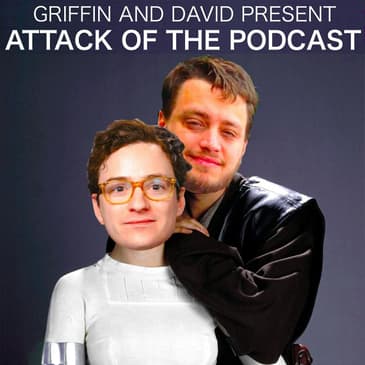



Joining Griffin and David this week is special guest J.D. Amato to discuss the behind-the-scenes making of this film, including, a featurette entitled: “Star Wars State Of The Art: The Pre-Visualization Of Episode II” (found in the initial DVD release of Attack of the Clones.)
Together, they examine the process of pre-visualization, why the CGI technology of its time compared even with today’s still makes this film ambitious, the uncanny valley and reasons why most of the special effects didn’t enhance or contribute to the overall story.
Though, George tried his best, why did Lucas put himself into a situation where no one could help him or this movie? Why did actors perform to no one in a blue room? Was there ever even a bigger picture or cohesive plan? Find out these answers and more!
[00:00:22] [SPEAKER_07]: Welcome, welcome, welcome, one and all to Griffin and David, present Attack Of The Podcast.
[00:00:29] [SPEAKER_05]: Hi, Griffin.
[00:00:29] [SPEAKER_05]: Hi, David.
[00:00:30] [SPEAKER_05]: How are you doing?
[00:00:30] [SPEAKER_05]: I'm doing alright, how are you?
[00:00:32] [SPEAKER_05]: Well, I was on vacation last week and I screwed up our recording schedule and we missed a week and I feel bad about it.
[00:00:37] [SPEAKER_07]: It actually worked out great because I needed that extra day to do more community service to offset the negative energy I put into the world with our last episode.
[00:00:47] [SPEAKER_07]: Our last episode donating all my time and money.
[00:00:51] [SPEAKER_05]: Our last episode was really embarrassing, but it was actually really fun to listen back to.
[00:00:55] [SPEAKER_05]: J.D., we are guests as well.
[00:00:58] [SPEAKER_05]: We'll introduce them later.
[00:01:00] [SPEAKER_07]: Multi-high for J.D. Amato.
[00:01:01] [SPEAKER_07]: We have an interesting meeting.
[00:01:02] [SPEAKER_05]: We have an interesting meeting, but explain to J.D.
[00:01:06] [SPEAKER_07]: You know in the janks how it doesn't make you have a using the janks?
[00:01:10] [SPEAKER_02]: I've seen the janks, yeah.
[00:01:11] [SPEAKER_07]: So you know how makes no sense that he stole that sandwich and you're like this guy's on the run.
[00:01:16] [SPEAKER_07]: Everyone's looking for him.
[00:01:17] [SPEAKER_07]: He has 35,000 dollars in a bag or whatever.
[00:01:21] [SPEAKER_07]: In his car he doesn't need it.
[00:01:23] [SPEAKER_07]: Why did he steal the sandwich and it's like some part of him was like it was a cry for help.
[00:01:27] [SPEAKER_07]: Like he wanted to be caught.
[00:01:28] [SPEAKER_02]: Right.
[00:01:28] [SPEAKER_07]: I don't want to talk about this fucking movie anymore.
[00:01:31] [SPEAKER_07]: I am so tired of this fucking movie and I sent the last two weeks analyzing why.
[00:01:35] [SPEAKER_07]: In our last episode, I read large sections, too many sections, but had to cut some out of a history paper.
[00:01:43] [SPEAKER_07]: I wrote in 10th grade called Back in Blackface or can you menstrual show me how to get to racism street?
[00:01:49] [SPEAKER_07]: Which was me trying to tackle the entire issue of representation of African Americans in the media.
[00:01:57] [SPEAKER_07]: In only the most inappropriate way possible.
[00:01:59] [SPEAKER_02]: And only the way that a young white male could.
[00:02:02] [SPEAKER_07]: Yep.
[00:02:03] [SPEAKER_05]: The weirdest thing is that Kifra is still talking about this when he really should let it go.
[00:02:07] [SPEAKER_05]: I'm just fine to J.D.
[00:02:08] [SPEAKER_05]: Okay.
[00:02:09] [SPEAKER_07]: I don't want to talk about this anymore.
[00:02:11] [SPEAKER_07]: I was trying to, you know, we're happy to have you here.
[00:02:13] [SPEAKER_07]: We're happy to talk about it.
[00:02:15] [SPEAKER_07]: For once I will say, I mean, this will tell you everything we're talking about today.
[00:02:18] [SPEAKER_07]: I do find myself relating to Georgie Purgy Lucas more in the wake of that paper.
[00:02:26] [SPEAKER_07]: Oh, I see.
[00:02:27] [SPEAKER_07]: Because it's the same thing where I thought I was really doing good and taking a good stand.
[00:02:31] [SPEAKER_07]: And this week we're talking about attack the clones, the second fan of menace movie from a filmmaking standpoint.
[00:02:37] [SPEAKER_07]: Sure.
[00:02:38] [SPEAKER_07]: J.D.Model who we have an interest yet.
[00:02:39] [SPEAKER_07]: No, we have an interest in.
[00:02:40] [SPEAKER_05]: It'll be like 20 minutes from now.
[00:02:42] [SPEAKER_07]: 20 minutes from now.
[00:02:43] [SPEAKER_07]: Is among many things one of the finest young filmmakers of his generation?
[00:02:48] [SPEAKER_02]: Thank you.
[00:02:48] [SPEAKER_02]: Well, I know I've not been introduced yet, but I will say this is not, this is not my thank you to you guys.
[00:02:54] [SPEAKER_02]: I'll do that once introduced me.
[00:02:55] [SPEAKER_02]: But thank you for having me on the podcast.
[00:02:57] [SPEAKER_02]: Yeah.
[00:02:57] [SPEAKER_02]: I'm excited to talk about this movie.
[00:02:58] [SPEAKER_02]: Of course.
[00:02:59] [SPEAKER_02]: One of the strangest sequels in film history.
[00:03:01] [SPEAKER_07]: No question.
[00:03:03] [SPEAKER_07]: No question.
[00:03:03] [SPEAKER_07]: You get a shot.
[00:03:05] [SPEAKER_07]: You make a first movie.
[00:03:06] [SPEAKER_07]: It does really well, but everyone hates it.
[00:03:07] [SPEAKER_07]: Yeah.
[00:03:07] [SPEAKER_07]: And somehow you pull it out of the hat, you get a second one.
[00:03:10] [SPEAKER_02]: Right.
[00:03:11] [SPEAKER_07]: And this is what he does with it.
[00:03:13] [SPEAKER_07]: But this is the point.
[00:03:14] [SPEAKER_02]: I, we, we, there's a lot of criticism out there of this movie.
[00:03:15] [SPEAKER_07]: Oh, a lot.
[00:03:17] [SPEAKER_07]: A lot of criticism.
[00:03:17] [SPEAKER_07]: In some way even more than than with the Phantom menace, the original Phantom menace.
[00:03:22] [SPEAKER_05]: I think Phantom menace got more criticism for its characters or specific wrongs such as
[00:03:27] [SPEAKER_05]: Jar Jar or whatever.
[00:03:28] [SPEAKER_05]: Where is this movie with the back of the hat?
[00:03:29] [SPEAKER_05]: Call the back of the hat.
[00:03:30] [SPEAKER_05]: As a film.
[00:03:32] [SPEAKER_05]: Yes.
[00:03:32] [SPEAKER_05]: I like that.
[00:03:33] [SPEAKER_05]: No one really liked it as a piece of cinema.
[00:03:35] [SPEAKER_05]: Yeah.
[00:03:35] [SPEAKER_07]: But we watched, uh, in preparation for this week, collectively watch a bunch of different documentaries
[00:03:41] [SPEAKER_07]: and like, each rat's behind us.
[00:03:42] [SPEAKER_05]: Which thing probably should have watched to begin with, honestly, because they really colored in a lot of
[00:03:46] [SPEAKER_05]: of the things we've sort of been speculating on for weeks now.
[00:03:48] [SPEAKER_07]: Well, here's a quick side rant.
[00:03:51] [SPEAKER_05]: Uh, go ahead.
[00:03:51] [SPEAKER_05]: Oh, about the blue reaction.
[00:03:53] [SPEAKER_07]: The blue ray is infuriating.
[00:03:54] [SPEAKER_05]: I don't know.
[00:03:55] [SPEAKER_05]: Yeah.
[00:03:55] [SPEAKER_05]: I don't even know what to say.
[00:03:56] [SPEAKER_05]: I used to have this on DVD this movie.
[00:03:59] [SPEAKER_05]: And then DVD was like play movie commentary extras and the extras.
[00:04:03] [SPEAKER_05]: You got your nice and easy track feature ads with your trailers and your interviews.
[00:04:08] [SPEAKER_05]: So wait, what's the blue ray that you guys have?
[00:04:10] [SPEAKER_05]: It's this.
[00:04:11] [SPEAKER_05]: It's the complete saga on blue ray.
[00:04:14] [SPEAKER_05]: So it's the source of the movie.
[00:04:15] [SPEAKER_07]: And then it's got like seven.
[00:04:17] [SPEAKER_07]: It's got other dust.
[00:04:18] [SPEAKER_05]: So many discs.
[00:04:19] [SPEAKER_05]: So I'm looking at it.
[00:04:20] [SPEAKER_07]: No, no, no, no, no.
[00:04:21] [SPEAKER_07]: There's the one, the one disc I looked at that had the special features for a tack the clown.
[00:04:25] [SPEAKER_07]: Yeah.
[00:04:25] [SPEAKER_07]: That's the only thing relevant right now.
[00:04:26] [SPEAKER_07]: But it's like literally two movies, seven discs of special features.
[00:04:29] [SPEAKER_07]: And on the disc.
[00:04:30] [SPEAKER_05]: Yeah.
[00:04:30] [SPEAKER_05]: It's all these and there's all these like paintings of like later, you know, these expanded universe characters.
[00:04:35] [SPEAKER_07]: Fucking like trading card characters.
[00:04:37] [SPEAKER_07]: And then let's get a shit about.
[00:04:39] [SPEAKER_05]: And so the on the blue ray that there's just a lot of features just for merchandise that are on.
[00:04:44] [SPEAKER_07]: Don't appear in either of the movies.
[00:04:45] [SPEAKER_07]: It's very strange.
[00:04:46] [SPEAKER_07]: Han Solo, all these dumb fucking anyway.
[00:04:51] [SPEAKER_05]: So on this on this, the special features laid out by planet.
[00:04:55] [SPEAKER_05]: Yes.
[00:04:56] [SPEAKER_05]: And but they don't make any sense.
[00:04:58] [SPEAKER_05]: No.
[00:04:58] [SPEAKER_05]: It's like kind of basically just each planet and there's four gets like a, you know, five minute movie about like how they designed it.
[00:05:05] [SPEAKER_05]: And that's kind of it.
[00:05:05] [SPEAKER_02]: And I read a lot with the planets are.
[00:05:07] [SPEAKER_05]: Yeah.
[00:05:09] [SPEAKER_05]: You could, you know, intense listeners could probably guess.
[00:05:13] [SPEAKER_02]: So Naboo, Naboo, Naboo.
[00:05:15] [SPEAKER_07]: I think you're looking episode one right now.
[00:05:17] [SPEAKER_07]: Or no, no, you're looking at episode two.
[00:05:19] [SPEAKER_07]: I'm always one of the planets.
[00:05:20] [SPEAKER_05]: Yeah.
[00:05:20] [SPEAKER_05]: Queen of Medallas from Naboo.
[00:05:22] [SPEAKER_02]: Yes.
[00:05:23] [SPEAKER_02]: A perfect layer.
[00:05:24] [SPEAKER_02]: Tatooine.
[00:05:25] [SPEAKER_05]: Yep.
[00:05:25] [SPEAKER_05]: Tatooine.
[00:05:26] [SPEAKER_05]: Yes.
[00:05:26] [SPEAKER_05]: Guys, she's from the blue.
[00:05:27] [SPEAKER_05]: We've been doing this for fucking it was hilarious.
[00:05:30] [SPEAKER_02]: Yeah.
[00:05:30] [SPEAKER_04]: It's a car or something like Carson.
[00:05:32] [SPEAKER_05]: Yeah.
[00:05:33] [SPEAKER_02]: I always said course on.
[00:05:35] [SPEAKER_02]: I don't know.
[00:05:36] [SPEAKER_02]: Then chorus on again then Naboo again.
[00:05:39] [SPEAKER_02]: And Tatoo again then.
[00:05:41] [SPEAKER_02]: Geonosis.
[00:05:42] [SPEAKER_05]: Geonosis.
[00:05:43] [SPEAKER_05]: There you go.
[00:05:43] [SPEAKER_05]: My de Geonosis.
[00:05:44] [SPEAKER_02]: It just goes on and on.
[00:05:45] [SPEAKER_02]: Yeah.
[00:05:45] [SPEAKER_02]: There's more written.
[00:05:46] [SPEAKER_05]: There's just a lot of stuff.
[00:05:47] [SPEAKER_05]: But it's probably thanks and liner notes.
[00:05:50] [SPEAKER_05]: There's a lot of like the word paintings.
[00:05:51] [SPEAKER_07]: There's a lot of material that I appreciate it about how they designed extra jet
[00:05:56] [SPEAKER_05]: to make.
[00:05:56] [SPEAKER_05]: Oh, really?
[00:05:57] [SPEAKER_05]: I think I missed the, oh no, no, no, I didn't.
[00:05:59] [SPEAKER_05]: A lot of material about the diner itself.
[00:06:01] [SPEAKER_05]: Yes.
[00:06:01] [SPEAKER_05]: The design of the diner.
[00:06:02] [SPEAKER_07]: But they're like a lot of like it like fucking like blue ray like 360 degree virtual reality
[00:06:07] [SPEAKER_07]: turn around's of my cats.
[00:06:08] [SPEAKER_07]: They made it the creatures.
[00:06:09] [SPEAKER_07]: But they cut out all these fucking documentaries that were on the original DVD that actually
[00:06:13] [SPEAKER_07]: showcase the filmmaking process in depth.
[00:06:15] [SPEAKER_05]: But I think they may be because they sort of highlight me embarrassing problems to the movie.
[00:06:20] [SPEAKER_07]: They're all very sad to watch.
[00:06:21] [SPEAKER_07]: They are sad to watch.
[00:06:22] [SPEAKER_07]: They're like capturing the freedmen and it's like people fighting against.
[00:06:25] [SPEAKER_07]: No, but this is an inevitability.
[00:06:27] [SPEAKER_05]: But I mean, as I'm pretty sure that these things are always made before the movie
[00:06:30] [SPEAKER_05]: keeping comes out, right?
[00:06:31] [SPEAKER_05]: Yes.
[00:06:32] [SPEAKER_05]: The DVD is kind of set up before the movie's premiere, right?
[00:06:35] [SPEAKER_05]: Like even commentaries.
[00:06:36] [SPEAKER_05]: Everything like everyone's recording this without knowing how it was received.
[00:06:40] [SPEAKER_05]: So you're seeing all these guys who must have slaved away.
[00:06:44] [SPEAKER_05]: I mean, George Lucas at one point says they were working like 22 hours a day and not eating,
[00:06:48] [SPEAKER_05]: like sleeping in there like chairs.
[00:06:50] [SPEAKER_05]: Well, we'll get to that sequence of psychos.
[00:06:51] [SPEAKER_07]: This is the biggest breakthrough of all the behind the scenes material.
[00:06:53] [SPEAKER_05]: And like they must be thinking, like we have produced like a genre stopping,
[00:06:59] [SPEAKER_05]: like piece of like advanced work here.
[00:07:02] [SPEAKER_05]: Yeah, our technology that we've invested in this is so incredible.
[00:07:05] [SPEAKER_02]: Yeah. Have you ever seen the movie Cube?
[00:07:07] [SPEAKER_02]: Yes.
[00:07:07] [SPEAKER_02]: I've seen the movie Cube.
[00:07:08] [SPEAKER_02]: So the movie Cube is a bunch of people are wake up and a cube.
[00:07:11] [SPEAKER_02]: They don't know why how they all got there.
[00:07:13] [SPEAKER_02]: And then they start to learn that each of them had a part in building this thing that they're all stuck inside.
[00:07:18] [SPEAKER_02]: And like this guy's like, I don't know.
[00:07:19] [SPEAKER_02]: I was just told, I was part of a contracting company.
[00:07:22] [SPEAKER_02]: We were just told to make these, you know,
[00:07:24] [SPEAKER_02]: right, they weren't aware that they were making Cube Prison.
[00:07:26] [SPEAKER_02]: Half mile long.
[00:07:27] [SPEAKER_02]: That's in watching the behind the scenes.
[00:07:29] [SPEAKER_02]: That sort of what I felt like is that every person was just sort of like,
[00:07:33] [SPEAKER_02]: I just made these walls and I made the best walls like that.
[00:07:36] [SPEAKER_02]: And none of them had any idea what the bigger picture was.
[00:07:39] [SPEAKER_05]: It's so yeah.
[00:07:40] [SPEAKER_05]: And they're parable of the elephant, right?
[00:07:41] [SPEAKER_05]: The, you know, someone describes a plan.
[00:07:44] [SPEAKER_05]: Right. Right.
[00:07:45] [SPEAKER_05]: And someone describes a trunk and they can't put it all together to be one thing.
[00:07:49] [SPEAKER_07]: What was interesting to me is that every person they interview seems to have like,
[00:07:55] [SPEAKER_07]: a lot of enthusiasm for what they're doing.
[00:07:57] [SPEAKER_07]: Like a certain like confused, weariness about it.
[00:08:00] [SPEAKER_07]: But like real enthusiasm for like, you know,
[00:08:02] [SPEAKER_07]: It's a crazy project this and this and that.
[00:08:03] [SPEAKER_07]: And then anytime they cut to George weather,
[00:08:05] [SPEAKER_07]: it's like a talking head interview or like sort of like studio footage of him looking over things,
[00:08:10] [SPEAKER_07]: giving notes or whatever.
[00:08:12] [SPEAKER_07]: It always feels, and I watched a bunch of,
[00:08:15] [SPEAKER_07]: what is JD pulling out?
[00:08:16] [SPEAKER_07]: He's got the movie.
[00:08:17] [SPEAKER_02]: Oh, he's going to dress certain points.
[00:08:20] [SPEAKER_02]: No, just like, I got to have a plan of background.
[00:08:21] [SPEAKER_07]: Yeah. That's cool.
[00:08:23] [SPEAKER_07]: He, uh,
[00:08:25] [SPEAKER_07]: I watched them feature hats for Phantom Menace too.
[00:08:28] [SPEAKER_07]: And between all the behind the scenes stuff are both of them.
[00:08:30] [SPEAKER_07]: He always just feels like he just wants to get it over with.
[00:08:34] [SPEAKER_07]: The short does.
[00:08:35] [SPEAKER_07]: Weirdly, you're thinking of something.
[00:08:36] [SPEAKER_07]: He's ripping off a bandage.
[00:08:37] [SPEAKER_05]: He does feel a little weary.
[00:08:38] [SPEAKER_05]: I mean, it's something about he has that monotone like way of talking to.
[00:08:42] [SPEAKER_05]: That doesn't help.
[00:08:43] [SPEAKER_07]: Phantom Menace, I think he was generally excited.
[00:08:45] [SPEAKER_07]: And I think starting up attack the clones when everyone had hated Phantom Menace,
[00:08:49] [SPEAKER_07]: or was predominantly hated.
[00:08:50] [SPEAKER_07]: Sure. He was just kind of like, he had to put his blinders on a lot more.
[00:08:54] [SPEAKER_02]: Honestly, what I believe is that he,
[00:08:57] [SPEAKER_02]: he is the only one that can see the fall out.
[00:09:00] [SPEAKER_02]: Right?
[00:09:01] [SPEAKER_02]: Sure.
[00:09:01] [SPEAKER_02]: Supposedly.
[00:09:03] [SPEAKER_02]: And I think he's having trouble in these behind the scenes, seeing how it all comes together
[00:09:07] [SPEAKER_02]: when he is literally only person that is in that position.
[00:09:10] [SPEAKER_02]: Yes.
[00:09:11] [SPEAKER_02]: And it seems like he might just be sort of stressed out and hoping that all these pieces independent
[00:09:16] [SPEAKER_02]: will come together.
[00:09:17] [SPEAKER_02]: So it feels like all the choices he's making.
[00:09:18] [SPEAKER_02]: Again, this is making completely just endowing characteristics on to him based on what I saw in the book.
[00:09:24] [SPEAKER_02]: But like, it's literally just him watching these small things and making commentary on them
[00:09:29] [SPEAKER_02]: in that the microproper's back then.
[00:09:32] [SPEAKER_02]: Where he's going.
[00:09:33] [SPEAKER_02]: Maybe that hair should be longer or this or that.
[00:09:36] [SPEAKER_02]: And you can tell there's a hesitancy for him to connect the larger dots of like,
[00:09:40] [SPEAKER_02]: whoa, whoa, whoa, whoa.
[00:09:41] [SPEAKER_02]: Yeah.
[00:09:41] [SPEAKER_02]: This doesn't seem to be too big.
[00:09:42] [SPEAKER_05]: This movie is logic like it's, yeah, it's general logical framework is completely unsound.
[00:09:48] [SPEAKER_07]: It's like the ultimate force through the trees movie where it's like every leaf is like lovingly designed.
[00:09:53] [SPEAKER_07]: Sure.
[00:09:53] [SPEAKER_05]: And watch on these things.
[00:09:55] [SPEAKER_05]: We're going to talk about that.
[00:09:56] [SPEAKER_05]: It's a lot of beautifully designed.
[00:09:57] [SPEAKER_05]: But they're lovingly designed.
[00:09:59] [SPEAKER_05]: So much effort is being put in here.
[00:10:00] [SPEAKER_07]: And watching what does remain on the fucking blurriest special features, all these things about like
[00:10:10] [SPEAKER_07]: babies who are on screen for half a second and like all the thought they put into it.
[00:10:13] [SPEAKER_07]: I mean, I didn't realize this, but they explained that the fucking Tuscan Raiders TPs are all made out of like skin
[00:10:19] [SPEAKER_07]: and bones from larger like woolly manic type creatures.
[00:10:22] [SPEAKER_07]: And that's on screen in the dark so briefly that barely registers.
[00:10:25] [SPEAKER_07]: And the guy talked about like, okay, so most we thought they need a home.
[00:10:28] [SPEAKER_07]: They're nomadic culture thing to move around.
[00:10:30] [SPEAKER_07]: So that's something that offers them shelter.
[00:10:31] [SPEAKER_07]: But doesn't this and that and the where they get the TP from.
[00:10:34] [SPEAKER_07]: Okay, so what if the structure of the TP instead of the sticks with the bones?
[00:10:36] [SPEAKER_07]: It's like this guy's putting so much thought into it.
[00:10:38] [SPEAKER_07]: It's on screen for half a second.
[00:10:39] [SPEAKER_07]: Yeah.
[00:10:39] [SPEAKER_07]: And doesn't even register because you're so confused by what's happening in the story.
[00:10:43] [SPEAKER_05]: I know all times.
[00:10:44] [SPEAKER_05]: It's the saddest part like the environment's don't really matter.
[00:10:47] [SPEAKER_05]: And they're like, even though they're very well-crafted.
[00:10:49] [SPEAKER_07]: There's some really good design work at moments and all this fucking like white noise because you're just
[00:10:53] [SPEAKER_07]: you're shoving needles into your eyes and trying to make sense of this fucking thing.
[00:10:58] [SPEAKER_07]: Jd.
[00:10:58] [SPEAKER_07]: Yes.
[00:10:59] [SPEAKER_07]: You had never seen the movie before.
[00:11:00] [SPEAKER_02]: I have never seen this movie before.
[00:11:02] [SPEAKER_05]: You watched it today.
[00:11:03] [SPEAKER_05]: You've watched scene Phantom Menace once as a child.
[00:11:06] [SPEAKER_05]: I see Phantom Menace once.
[00:11:07] [SPEAKER_02]: I think I saw Phantom Menace a couple times.
[00:11:09] [SPEAKER_02]: Oh, sure.
[00:11:11] [SPEAKER_02]: Really?
[00:11:13] [SPEAKER_02]: It didn't do it for you.
[00:11:14] [SPEAKER_02]: You were bummed out by it.
[00:11:15] [SPEAKER_02]: I was bummed out by it.
[00:11:16] [SPEAKER_07]: I at the time thought it was the best one yet.
[00:11:19] [SPEAKER_07]: And my best one yet.
[00:11:20] [SPEAKER_07]: I mean, of course, the best movie I've ever made.
[00:11:21] [SPEAKER_07]: Right.
[00:11:22] [SPEAKER_02]: I don't know why.
[00:11:24] [SPEAKER_02]: What they were based on.
[00:11:25] [SPEAKER_02]: But I felt like I went into it having expectations.
[00:11:27] [SPEAKER_02]: This was going to be a great movie.
[00:11:29] [SPEAKER_02]: Right.
[00:11:29] [SPEAKER_02]: And it did not fulfill the expectations that I had set up.
[00:11:32] [SPEAKER_02]: Yeah.
[00:11:33] [SPEAKER_02]: You know, ever Pope, nothing.
[00:11:37] [SPEAKER_02]: Yeah.
[00:11:37] [SPEAKER_02]: But because of that, I was too saddened to watch this next one.
[00:11:44] [SPEAKER_02]: To the point that I wanted to live instead in the world where I hadn't seen it.
[00:11:50] [SPEAKER_02]: Because so you're saying we have shattered your world.
[00:11:52] [SPEAKER_05]: We shattered it.
[00:11:53] [SPEAKER_02]: Well, making you appear on the spot.
[00:11:54] [SPEAKER_07]: You're like 15 years.
[00:11:55] [SPEAKER_07]: Yeah.
[00:11:55] [SPEAKER_02]: You had a smile.
[00:11:56] [SPEAKER_02]: I wanted to live in a world where I hadn't seen it.
[00:11:59] [SPEAKER_02]: Because that way it could have been good.
[00:12:01] [SPEAKER_02]: That I could, you know, I wanted it to be the mystery box that I could always go.
[00:12:05] [SPEAKER_02]: I haven't seen it so it could actually be good.
[00:12:07] [SPEAKER_02]: Right.
[00:12:08] [SPEAKER_05]: Sorting your sketch sort of thing.
[00:12:11] [SPEAKER_02]: Exactly.
[00:12:11] [SPEAKER_02]: I until observed I had no idea if it would ignite a nuclear explosion that would destroy me or keep us all safe.
[00:12:20] [SPEAKER_07]: I have a similar thing.
[00:12:21] [SPEAKER_07]: I'm like a pop culture complete us.
[00:12:22] [SPEAKER_07]: We're like, even if I dislike something.
[00:12:23] [SPEAKER_07]: If I like a part of it, I want to have the full breath of knowledge.
[00:12:27] [SPEAKER_07]: Yeah.
[00:12:27] [SPEAKER_07]: But Robocop, which is one of my five favorite movies of all time.
[00:12:29] [SPEAKER_07]: I have movie.
[00:12:32] [SPEAKER_05]: I've never seen the sequel.
[00:12:33] [SPEAKER_05]: I didn't see the remake, even though the remake, which is stupid.
[00:12:37] [SPEAKER_05]: Some people were like, hey, the remake's not bad.
[00:12:39] [SPEAKER_05]: Yeah.
[00:12:40] [SPEAKER_05]: I mean, I just had no interest.
[00:12:41] [SPEAKER_07]: But Robocop one has such a beautiful ending.
[00:12:43] [SPEAKER_07]: It's the most perfectly amazing film.
[00:12:44] [SPEAKER_07]: There's no reason to make a sequel to this movie.
[00:12:45] [SPEAKER_07]: Right.
[00:12:45] [SPEAKER_07]: Did I just don't want to see the second movie where the start.
[00:12:48] [SPEAKER_07]: He's got the helmet back on again.
[00:12:49] [SPEAKER_07]: He's talking like Robocop and he's lost like his humanity.
[00:12:51] [SPEAKER_07]: He has to be the same fucking scene.
[00:12:52] [SPEAKER_05]: You did watch every episode of the TV show and wrote and directed every single episode and played every part.
[00:12:57] [SPEAKER_07]: I didn't watch them.
[00:12:58] [SPEAKER_07]: I did write direct and play.
[00:12:59] [SPEAKER_07]: Right.
[00:12:59] [SPEAKER_05]: Yeah. I actually think I've seen a couple of episodes.
[00:13:02] [SPEAKER_07]: But I don't like to watch my work.
[00:13:03] [SPEAKER_07]: No, no, no, no.
[00:13:04] [SPEAKER_07]: Okay. So now you're old to shattered. You now live in a world where this exists.
[00:13:07] [SPEAKER_05]: Where about seven minutes before we introduce it by the way.
[00:13:10] [SPEAKER_05]: I'm keeping it in the box.
[00:13:10] [SPEAKER_05]: Copy that.
[00:13:11] [SPEAKER_07]: The box is open.
[00:13:14] [SPEAKER_07]: So you've seen the tackle of clues.
[00:13:15] [SPEAKER_07]: I've seen it.
[00:13:16] [SPEAKER_07]: You had 15 years of theorized what a sequel to the Phantom Manus would entail.
[00:13:20] [SPEAKER_05]: And we have been trying to ask, like, is this a good sequel to the Phantom Manus?
[00:13:24] [SPEAKER_05]: Which is one of our core questions.
[00:13:25] [SPEAKER_06]: Is it a good movie?
[00:13:26] [SPEAKER_06]: That's not a good question.
[00:13:27] [SPEAKER_06]: This is a good to the work.
[00:13:28] [SPEAKER_05]: Is it a sequel?
[00:13:30] [SPEAKER_02]: I just watched it.
[00:13:32] [SPEAKER_02]: And I don't understand what happened in it.
[00:13:33] [SPEAKER_05]: Yeah.
[00:13:34] [SPEAKER_05]: Makes no sense.
[00:13:35] [SPEAKER_05]: Oh, that happens during the movie.
[00:13:36] [SPEAKER_02]: That's a problem.
[00:13:37] [SPEAKER_02]: I don't understand what's happening.
[00:13:40] [SPEAKER_02]: What do we do?
[00:13:40] [SPEAKER_07]: And we still don't understand what's happening really.
[00:13:42] [SPEAKER_02]: But not in a way.
[00:13:43] [SPEAKER_02]: Well, here's the thing is that there's films where I don't know what's happening,
[00:13:46] [SPEAKER_02]: where it feels like you're not to listen.
[00:13:51] [SPEAKER_02]: Let me let me let me back up to this and say this.
[00:13:53] [SPEAKER_02]: That this film isn't achievement in several ways.
[00:13:58] [SPEAKER_02]: This is an impressive film.
[00:14:01] [SPEAKER_02]: Special effects wise, where they're at, they did some things that were extremely
[00:14:05] [SPEAKER_02]: about the film.
[00:14:06] [SPEAKER_02]: And for what they had at their fingertips, what they created is an amazing
[00:14:11] [SPEAKER_02]: feat of filmmaking.
[00:14:14] [SPEAKER_02]: But to me, and that's not saying it's an objective truth,
[00:14:18] [SPEAKER_02]: it didn't satisfy what I wanted from it.
[00:14:21] [SPEAKER_02]: And what I will say is that I didn't quit.
[00:14:24] [SPEAKER_02]: And I was going on, not because things were purposely being kept
[00:14:27] [SPEAKER_02]: from me in a way that was made me imagine.
[00:14:33] [SPEAKER_02]: And then get frustrated by it.
[00:14:35] [SPEAKER_02]: It was I was so inundated with information about what was going on
[00:14:40] [SPEAKER_02]: that I couldn't keep track of it.
[00:14:42] [SPEAKER_02]: And it became just this complete sort of like a mess of trade
[00:14:48] [SPEAKER_02]: and a lot of things that were going on.
[00:14:52] [SPEAKER_02]: And I think it also didn't help because a lot of the technological
[00:14:57] [SPEAKER_02]: things that made the film so hard to create technologically,
[00:15:02] [SPEAKER_02]: also made the film hard or the performers in it.
[00:15:05] [SPEAKER_02]: And I think as a viewer, you rely on the performers
[00:15:08] [SPEAKER_02]: to know how you should be feeling.
[00:15:10] [SPEAKER_02]: And when the performers don't know how they should be feeling,
[00:15:13] [SPEAKER_02]: then as an audience, you don't know how you should be feeling.
[00:15:14] [SPEAKER_02]: And then you've lost all guide posts for what's going on.
[00:15:17] [SPEAKER_02]: So when a piece of information is said,
[00:15:21] [SPEAKER_02]: and no one really reacts to it, nor do I.
[00:15:26] [SPEAKER_02]: And then it doesn't register as important.
[00:15:27] [SPEAKER_00]: Yes, I think it's incredible playing.
[00:15:29] [SPEAKER_05]: You're making a case for just like an aggressively surreal film.
[00:15:33] [SPEAKER_05]: You're making a case for a film that like abandons any,
[00:15:36] [SPEAKER_05]: like pre-tent, you know, any, like of the established ways of having
[00:15:39] [SPEAKER_05]: an audience enjoy a move.
[00:15:41] [SPEAKER_07]: All the in-sampathy is like this.
[00:15:43] [SPEAKER_05]: Yeah, and you're very right.
[00:15:44] [SPEAKER_05]: But yes, like important things are said and characters that
[00:15:47] [SPEAKER_05]: react with blank faces.
[00:15:49] [SPEAKER_07]: Well, I think all the time.
[00:15:51] [SPEAKER_07]: I think all these actors are trying to make declarations of love.
[00:15:54] [SPEAKER_05]: Things like that.
[00:15:55] [SPEAKER_07]: I think all these actors are trying to make deliberate
[00:15:58] [SPEAKER_07]: specific acting choices at every moment.
[00:16:00] [SPEAKER_07]: I don't think anyone's asleep at the wheel.
[00:16:01] [SPEAKER_07]: I think they're just genuinely so confused about what's going on
[00:16:05] [SPEAKER_07]: around them and what they're supposed to be playing
[00:16:07] [SPEAKER_07]: that the confusion reads more than their acting choices.
[00:16:10] [SPEAKER_02]: This is the weirdest thing.
[00:16:12] [SPEAKER_05]: Yeah, well, the...
[00:16:13] [SPEAKER_05]: I've been sort of cycling around and it's the testable
[00:16:16] [SPEAKER_05]: creatures exactly.
[00:16:17] [SPEAKER_07]: There's a fucking thing on the blue rate where the guy talks
[00:16:19] [SPEAKER_07]: about design, the testable creatures and how he had the design
[00:16:21] [SPEAKER_07]: and then he couldn't figure out the anatomy of how the musculature
[00:16:23] [SPEAKER_07]: would work. And he worked on it for months.
[00:16:25] [SPEAKER_07]: Why would he do that?
[00:16:26] [SPEAKER_05]: Because...
[00:16:27] [SPEAKER_05]: Why didn't George Lucas say, you know what?
[00:16:28] [SPEAKER_05]: These actually look really weird. Let's do something else.
[00:16:31] [SPEAKER_07]: Because he thousands of people working on the movie
[00:16:33] [SPEAKER_07]: and he went to your drops just to design a testable.
[00:16:35] [SPEAKER_05]: So yeah, but we should talk about him.
[00:16:37] [SPEAKER_05]: And JD is right. Like this movie is doing a lot of things
[00:16:41] [SPEAKER_05]: that movies hadn't done.
[00:16:42] [SPEAKER_05]: It was a filmmaking revolution, a lot of ways.
[00:16:44] [SPEAKER_02]: It was. And they're trying to do something that
[00:16:46] [SPEAKER_02]: to this day would be difficult to achieve.
[00:16:49] [SPEAKER_02]: If they tried to make a film this ambitious from a CGI standpoint,
[00:16:55] [SPEAKER_02]: it would be difficult.
[00:16:56] [SPEAKER_02]: And they were...
[00:16:56] [SPEAKER_02]: The... the inception of this film was probably 20 years ago now
[00:17:01] [SPEAKER_02]: was when they started planning to make this film
[00:17:04] [SPEAKER_02]: in the amount that technology has changed
[00:17:08] [SPEAKER_02]: in computer graphics and 3D rendering.
[00:17:10] [SPEAKER_02]: And it's like that.
[00:17:12] [SPEAKER_02]: It's been leaps and bounds over the past five years.
[00:17:15] [SPEAKER_02]: Let alone where it was 20 years ago when they started sort of
[00:17:18] [SPEAKER_02]: coming up with the plan for how they're going to do this.
[00:17:21] [SPEAKER_02]: So the fact that they achieved somethings they achieved
[00:17:23] [SPEAKER_02]: is really impressive, but that's...
[00:17:25] [SPEAKER_02]: it does not stand the test of time.
[00:17:28] [SPEAKER_02]: And also I don't think stood the test of time
[00:17:30] [SPEAKER_02]: at the moment because they were...
[00:17:32] [SPEAKER_02]: They were doing things that...
[00:17:33] [SPEAKER_02]: They wanted to do things that they did not have the technology
[00:17:35] [SPEAKER_02]: to achieve yet.
[00:17:36] [SPEAKER_02]: And they did the best they could possibly do under the circumstances.
[00:17:39] [SPEAKER_02]: And it was really impressive because these were the best of the best
[00:17:42] [SPEAKER_02]: of the best working on it.
[00:17:43] [SPEAKER_02]: But they just did not have the tools they needed to achieve
[00:17:45] [SPEAKER_02]: the things that they're trying to do.
[00:17:47] [SPEAKER_07]: I also think...
[00:17:48] [SPEAKER_07]: There are a lot of aspects to this.
[00:17:49] [SPEAKER_07]: I think there is a very, very wide goal
[00:17:53] [SPEAKER_07]: between the best effects in the movie and the worst effects in the movie.
[00:17:56] [SPEAKER_05]: What do you think the best effects in the movie are?
[00:17:58] [SPEAKER_07]: Well, okay, let's just talk about like character animation, right?
[00:18:00] [SPEAKER_07]: Because we have a ton of digital characters in this movie.
[00:18:03] [SPEAKER_07]: Outside of a fully animated movie,
[00:18:05] [SPEAKER_07]: this probably had the largest number of CGI creatures
[00:18:07] [SPEAKER_07]: and any film up until that point.
[00:18:09] [SPEAKER_02]: This was the first ever film to have a digital supporting cast.
[00:18:13] [SPEAKER_07]: Yeah, yeah, it's like...
[00:18:14] [SPEAKER_07]: I mean, there are like 10 live action actors in this movie.
[00:18:17] [SPEAKER_02]: Yeah, and this was really the first time
[00:18:19] [SPEAKER_02]: that main characters were digital.
[00:18:21] [SPEAKER_07]: Yeah, yeah.
[00:18:23] [SPEAKER_07]: Yeah, and it finms a lot of...
[00:18:24] [SPEAKER_02]: With Phantom Menace, I mean, I'm...
[00:18:26] [SPEAKER_02]: Phantom Menace and this, but this was the first film series where that was.
[00:18:29] [SPEAKER_07]: But Phantom Menace has like three, you know?
[00:18:31] [SPEAKER_02]: Well, that's all the gungins.
[00:18:33] [SPEAKER_07]: Yeah, but okay, it's...
[00:18:34] [SPEAKER_02]: Or gungins.
[00:18:35] [SPEAKER_07]: In terms of actual characters with like...
[00:18:38] [SPEAKER_02]: Thank you for directing yourself.
[00:18:40] [SPEAKER_07]: It's like, water, tarpoles, boss, nass and jar jar, and then the battle droids.
[00:18:45] [SPEAKER_07]: And the battle droids don't have to really perform.
[00:18:48] [SPEAKER_07]: Yeah, it could get army, you're seeing like big mass things.
[00:18:50] [SPEAKER_07]: But in terms of like, characters who have like more than a scene,
[00:18:52] [SPEAKER_07]: No, I know, you're actually an emotional role.
[00:18:54] [SPEAKER_05]: Well, it's the pod racers, but I guess that's...
[00:18:56] [SPEAKER_07]: Yeah, that's sort of...
[00:18:57] [SPEAKER_07]: Yeah, that's sort of...
[00:18:58] [SPEAKER_02]: Yes, so well, I guess you can...
[00:18:58] [SPEAKER_02]: So Boba has a comeback in this film
[00:19:01] [SPEAKER_02]: that I'm not a fan of.
[00:19:03] [SPEAKER_07]: You check us, Boba or Water?
[00:19:05] [SPEAKER_07]: What is our terrifying space shoot?
[00:19:07] [SPEAKER_07]: So Boba is the pod racer who eats...
[00:19:08] [SPEAKER_07]: Right, so Boba.
[00:19:10] [SPEAKER_05]: Where's so Boba?
[00:19:10] [SPEAKER_05]: Is he in this movie?
[00:19:11] [SPEAKER_05]: So Boba's in this movie.
[00:19:12] [SPEAKER_05]: We're not in this movie.
[00:19:14] [SPEAKER_02]: You guys don't see it as like...
[00:19:16] [SPEAKER_02]: It's devilish grin on this face.
[00:19:17] [SPEAKER_02]: So Boba is one of the first moments in watching this where I became disappointed in the movie.
[00:19:23] [SPEAKER_04]: No, I come on, come on, come on.
[00:19:25] [SPEAKER_02]: I want to know what I'm going to do.
[00:19:26] [SPEAKER_02]: Okay, I could try to find...
[00:19:28] [SPEAKER_02]: No, but just say it first.
[00:19:29] [SPEAKER_05]: Okay, I'll try and find it as you talk about it.
[00:19:31] [SPEAKER_02]: Okay, so...
[00:19:32] [SPEAKER_02]: When the assassin tries to shoot worms at Queen Amadala...
[00:19:37] [SPEAKER_02]: Sam was a little angeline.
[00:19:38] [SPEAKER_02]: Senator Amadala, whatever the her name is.
[00:19:40] [SPEAKER_02]: She's a senator.
[00:19:41] [SPEAKER_02]: She's a senator.
[00:19:43] [SPEAKER_02]: Scrolling to that scene.
[00:19:44] [SPEAKER_02]: Obi-Wan for a reason that is beyond me,
[00:19:47] [SPEAKER_02]: decides to jump out of the window and grab onto this robot.
[00:19:50] [SPEAKER_02]: As one does.
[00:19:51] [SPEAKER_02]: And then Anakin decides to get into a speeder.
[00:19:55] [SPEAKER_02]: Speeder.
[00:19:56] [SPEAKER_02]: Convertible speeder.
[00:19:57] [SPEAKER_02]: Yeah.
[00:19:57] [SPEAKER_02]: And drive after.
[00:19:58] [SPEAKER_02]: As one does.
[00:19:59] [SPEAKER_02]: As one does.
[00:20:01] [SPEAKER_02]: During this, they cut through traffic and calls also to the problems.
[00:20:04] [SPEAKER_02]: And at one point it cuts to a reaction shot of a driver who had to just cut off.
[00:20:10] [SPEAKER_02]: Who is Saboba.
[00:20:12] [SPEAKER_02]: And as they call back to the pottery scene,
[00:20:14] [SPEAKER_02]: I believe his line is,
[00:20:15] [SPEAKER_02]: Jed, up.
[00:20:16] [SPEAKER_02]: Jed, I poo, do.
[00:20:18] [SPEAKER_05]: I'm trying to find it exactly.
[00:20:19] [SPEAKER_05]: Where were you fucking missed this?
[00:20:20] [SPEAKER_05]: But like, re...
[00:20:21] [SPEAKER_07]: This is unbelievable.
[00:20:23] [SPEAKER_07]: I know what moment you're talking about.
[00:20:25] [SPEAKER_07]: I know what you're talking about too.
[00:20:27] [SPEAKER_05]: Here's like, that's not Saboba, but there's a guy.
[00:20:29] [SPEAKER_05]: It is sort of like, yeah.
[00:20:31] [SPEAKER_05]: I'm trying to show key call back to...
[00:20:33] [SPEAKER_02]: I'm 100% sure.
[00:20:35] [SPEAKER_02]: No, I'm sure.
[00:20:36] [SPEAKER_02]: Because that's Saboba's line.
[00:20:36] [SPEAKER_02]: It's like, how stupid.
[00:20:38] [SPEAKER_02]: Oh, yeah, there it is.
[00:20:38] [SPEAKER_02]: But he looks old.
[00:20:40] [SPEAKER_06]: Yeah, well, so he's a boy.
[00:20:41] [SPEAKER_07]: He's another guy.
[00:20:42] [SPEAKER_07]: Let me see.
[00:20:43] [SPEAKER_07]: It's probably one of those slaves, he owns.
[00:20:45] [SPEAKER_07]: We did backstory.
[00:20:45] [SPEAKER_05]: We did a backstory episode for all the pod racers because they all have incredibly dense
[00:20:49] [SPEAKER_05]: and complicated backstories on like, like, uh...
[00:20:53] [SPEAKER_02]: Ben Cuado and...
[00:20:54] [SPEAKER_05]: Yeah, Ben Cuajaneros and...
[00:20:56] [SPEAKER_05]: Oh, I've done bald.
[00:20:57] [SPEAKER_07]: Almost all of them are slave owners.
[00:20:59] [SPEAKER_07]: So, Boba tried to...
[00:21:01] [SPEAKER_07]: No, it was someone else's mom.
[00:21:01] [SPEAKER_07]: Oh, is like a...
[00:21:02] [SPEAKER_07]: Is that Pimp?
[00:21:03] [SPEAKER_07]: Yeah, Jesus Christ.
[00:21:04] [SPEAKER_07]: That is definitely so well what you're totally right.
[00:21:06] [SPEAKER_07]: And that other guy next to him is another pod racer.
[00:21:08] [SPEAKER_07]: I forget what he's saying is.
[00:21:09] [SPEAKER_07]: That's a different pod racer.
[00:21:11] [SPEAKER_07]: Jesus Christ.
[00:21:12] [SPEAKER_07]: How did we even get on this the way?
[00:21:14] [SPEAKER_07]: Is it?
[00:21:14] [SPEAKER_07]: So Boba owns a bunch of sex slaves.
[00:21:16] [SPEAKER_07]: He owns like four women and then one of his competitors hired an assass into
[00:21:21] [SPEAKER_07]: Kilsobalbo's sister and mother.
[00:21:23] [SPEAKER_07]: Like, that's how gross the world of pod racing is.
[00:21:25] [SPEAKER_07]: It's gross, JD.
[00:21:27] [SPEAKER_02]: Yeah, that moment really...
[00:21:29] [SPEAKER_05]: That's how I'm trying to attract back.
[00:21:32] [SPEAKER_05]: Why did you mention this?
[00:21:34] [SPEAKER_05]: Digital characters.
[00:21:35] [SPEAKER_05]: Digital characters.
[00:21:36] [SPEAKER_05]: Okay, okay.
[00:21:36] [SPEAKER_05]: I was going to film and had a lot of digital characters we've got.
[00:21:39] [SPEAKER_05]: I'll talk about some of them.
[00:21:40] [SPEAKER_07]: I was going to...
[00:21:41] [SPEAKER_07]: Yes.
[00:21:43] [SPEAKER_05]: The...
[00:21:43] [SPEAKER_05]: The... the... the...
[00:21:44] [SPEAKER_05]: La Masu and the other one, you know, the...
[00:21:46] [SPEAKER_05]: The Communion.
[00:21:46] [SPEAKER_05]: This will literally take the entire pod.
[00:21:48] [SPEAKER_05]: Yeah, yeah, we can't do this.
[00:21:49] [SPEAKER_05]: I'm just trying to...
[00:21:50] [SPEAKER_05]: All the long neck people.
[00:21:51] [SPEAKER_05]: Yeah, yeah.
[00:21:53] [SPEAKER_02]: All of...
[00:21:54] [SPEAKER_02]: At certain points...
[00:21:57] [SPEAKER_02]: Uh...
[00:21:58] [SPEAKER_02]: Obi-wan.
[00:21:59] [SPEAKER_02]: Is... digital?
[00:22:00] [SPEAKER_05]: Well, this is the...
[00:22:01] [SPEAKER_05]: I'm trying to...
[00:22:01] [SPEAKER_05]: I'm trying to...
[00:22:01] [SPEAKER_05]: I'm trying to...
[00:22:02] [SPEAKER_05]: Are two and see threepios seem to be like...
[00:22:05] [SPEAKER_05]: Largely digital, especially after you see that documentary.
[00:22:08] [SPEAKER_05]: Yeah, yeah.
[00:22:08] [SPEAKER_05]: Like, they seem to be just animatics.
[00:22:09] [SPEAKER_02]: I don't believe there's a single character in this film
[00:22:12] [SPEAKER_02]: That at some point isn't mostly digital.
[00:22:16] [SPEAKER_07]: Yeah, every character...
[00:22:17] [SPEAKER_07]: Yeah, anyone who's on screen from more than 2 seconds?
[00:22:19] [SPEAKER_07]: I mean, Danny Fettoney...
[00:22:20] [SPEAKER_07]: Do you know there's one?
[00:22:21] [SPEAKER_02]: And on my best, there's only one scene in this film
[00:22:24] [SPEAKER_02]: that did not have...
[00:22:26] [SPEAKER_02]: oh wait.
[00:22:27] [SPEAKER_02]: Was this film?
[00:22:28] [SPEAKER_02]: I believe it's this film.
[00:22:30] [SPEAKER_02]: That did not have CG in it.
[00:22:31] [SPEAKER_05]: What's the scene?
[00:22:34] [SPEAKER_07]: That's what you wanted to add in a comparison, right?
[00:22:37] [SPEAKER_02]: No, I might be wrong, never mind.
[00:22:40] [SPEAKER_05]: It does seem...
[00:22:41] [SPEAKER_05]: Honestly, that scene is impossible.
[00:22:43] [SPEAKER_05]: I can't think of a scene where that would be true.
[00:22:44] [SPEAKER_05]: Everything is...
[00:22:45] [SPEAKER_05]: It's as if you were on a computer.
[00:22:46] [SPEAKER_05]: Because you wanted to have a dinner.
[00:22:47] [SPEAKER_05]: There's the floating camera.
[00:22:47] [SPEAKER_05]: Yeah, no, no, no, no.
[00:22:49] [SPEAKER_05]: Forget that.
[00:22:49] [SPEAKER_05]: Just the background.
[00:22:50] [SPEAKER_05]: The set.
[00:22:51] [SPEAKER_05]: Everything is filled out in CG.
[00:22:52] [SPEAKER_05]: As we see in these documentaries,
[00:22:54] [SPEAKER_05]: it's all blue screens with one set like one piece of set.
[00:22:58] [SPEAKER_07]: Well, let me say this thing.
[00:23:01] [SPEAKER_07]: This...
[00:23:01] [SPEAKER_07]: The point is going to be...
[00:23:02] [SPEAKER_07]: The goal of a scene like, I think the Cmonians look really good.
[00:23:04] [SPEAKER_07]: I keep on getting a fucking head.
[00:23:05] [SPEAKER_07]: Okay, you go on about how great the movie is.
[00:23:07] [SPEAKER_07]: I think they look fine.
[00:23:08] [SPEAKER_05]: The set looks bad.
[00:23:09] [SPEAKER_07]: I think...
[00:23:10] [SPEAKER_07]: I agree with you.
[00:23:11] [SPEAKER_07]: But this is my point.
[00:23:12] [SPEAKER_07]: And then someone like Dexter Jetsor,
[00:23:13] [SPEAKER_07]: you know I love him.
[00:23:14] [SPEAKER_07]: I think it looks like a PlayStation 1 cut.
[00:23:16] [SPEAKER_07]: He does.
[00:23:17] [SPEAKER_07]: He does.
[00:23:17] [SPEAKER_07]: He just looks not like the...
[00:23:19] [SPEAKER_07]: The dynamic runner.
[00:23:21] [SPEAKER_07]: I like the design of him a lot.
[00:23:22] [SPEAKER_07]: But the animation itself is just like...
[00:23:23] [SPEAKER_07]: Ben, Ben, Ben, like this.
[00:23:24] [SPEAKER_07]: It looks like a fucking PlayStation 1 game.
[00:23:26] [SPEAKER_05]: You know, he...
[00:23:27] [SPEAKER_05]: Well, you haven't played a PlayStation 1 game.
[00:23:28] [SPEAKER_05]: I don't know why those things...
[00:23:29] [SPEAKER_05]: Oh, I played a PlayStation 2 game.
[00:23:30] [SPEAKER_07]: Which one?
[00:23:31] [SPEAKER_07]: Uh, bugs like...
[00:23:32] [SPEAKER_07]: I found it a good one.
[00:23:33] [SPEAKER_07]: It's really bad.
[00:23:35] [SPEAKER_07]: You know, like how like that era video games.
[00:23:37] [SPEAKER_07]: Like not the early era where they knew exactly what they were doing,
[00:23:39] [SPEAKER_07]: but the space in between went to got advanced enough to get ambitious.
[00:23:42] [SPEAKER_07]: And when they had the ambitions, but not the technical ability to execute it.
[00:23:46] [SPEAKER_07]: Those games are so tough to play because they're so bad that they're almost...
[00:23:49] [SPEAKER_07]: You know, logical.
[00:23:50] [SPEAKER_05]: It's like playing in a world where the rules of the world dominates.
[00:23:54] [SPEAKER_07]: Right.
[00:23:54] [SPEAKER_07]: And if you take the wrong step and fall through the floor,
[00:23:58] [SPEAKER_07]: and then just like walking through the floor with your arms up like this and you can't get out.
[00:24:01] [SPEAKER_05]: I mean, one of my favorite video games ever is this video game, Dase X,
[00:24:04] [SPEAKER_05]: which is trying to do a lot of things that games do now where it's like...
[00:24:07] [SPEAKER_05]: You have to be stealthy and like, you leave a body somewhere,
[00:24:09] [SPEAKER_05]: and other people find it they're going to make an fuss about.
[00:24:12] [SPEAKER_05]: But then there's like a glitch where if you like...
[00:24:13] [SPEAKER_05]: You can still tap the round time to body starts to level it.
[00:24:16] [SPEAKER_05]: Well, there's that, but like it's still limited.
[00:24:19] [SPEAKER_05]: So you can also just walk up to anyone hit them with a crowbar
[00:24:21] [SPEAKER_05]: and then like shock them and then they're kind of done.
[00:24:24] [SPEAKER_05]: And they won't make a fuss because no one else is near,
[00:24:25] [SPEAKER_05]: but it's still too easy to game the system.
[00:24:28] [SPEAKER_05]: It's still computerized.
[00:24:29] [SPEAKER_05]: Like you can... you know where the walls are basically.
[00:24:32] [SPEAKER_05]: I don't know what I'm talking about.
[00:24:33] [SPEAKER_07]: My point is that there are not enough people in the world with the skill
[00:24:38] [SPEAKER_07]: to be able to execute every single different digital thing this film asked for.
[00:24:44] [SPEAKER_07]: Oh, I see.
[00:24:44] [SPEAKER_07]: There's so much from the environments of the props to the ships,
[00:24:48] [SPEAKER_07]: to the characters, to modifications to the live action actors.
[00:24:54] [SPEAKER_07]: As you said, it's still too ambitious to pull off.
[00:24:57] [SPEAKER_02]: What this was to me was like when people tried to build like spaceships
[00:25:04] [SPEAKER_02]: before we really understood how to build spaceships.
[00:25:08] [SPEAKER_02]: Yes.
[00:25:08] [SPEAKER_02]: Like this... this to me was that like...
[00:25:12] [SPEAKER_02]: kind of like this was like the Apollo 1.
[00:25:15] [SPEAKER_02]: You heard of me and like...
[00:25:16] [SPEAKER_02]: we're going to use tape and Scott.
[00:25:18] [SPEAKER_02]: Like we're going to try to make this work and it's not quite going to work
[00:25:21] [SPEAKER_02]: and we're going to learn a lot of lessons from this.
[00:25:23] [SPEAKER_02]: They set out...
[00:25:24] [SPEAKER_04]: Look how bad this scene looks.
[00:25:26] [SPEAKER_02]: Oh, you mean the scene where they...
[00:25:28] [SPEAKER_02]: They didn't want to do everything.
[00:25:28] [SPEAKER_02]: They're seeing what I'm sitting in ramen spoons.
[00:25:32] [SPEAKER_07]: This feels like a good time to, of course, say our guest today.
[00:25:35] [SPEAKER_07]: Is that not what they're...
[00:25:36] [SPEAKER_07]: They're sitting in ramen spoons.
[00:25:37] [SPEAKER_07]: Our guest is JDMOD.
[00:25:38] [SPEAKER_05]: Oh yeah, we went 25 minutes in shit.
[00:25:40] [SPEAKER_05]: Yeah, this is JDMOD, he's director of the Chris Gethard Show.
[00:25:42] [SPEAKER_05]: Showrunner as well.
[00:25:43] [SPEAKER_07]: Oh, I'm sure I'm going to make our improviser on and off sometimes.
[00:25:47] [SPEAKER_05]: Brilliant.
[00:25:48] [SPEAKER_05]: Yeah, you know, multi-tone to bring in.
[00:25:50] [SPEAKER_05]: What about our finest minds?
[00:25:52] [SPEAKER_05]: He's so great.
[00:25:53] [SPEAKER_05]: Guys, thank you.
[00:25:53] [SPEAKER_05]: I'm so happy to be here.
[00:25:54] [SPEAKER_05]: Oh yeah.
[00:25:55] [SPEAKER_02]: I'm so happy to talk about these obscure films.
[00:25:57] [SPEAKER_05]: Host of 12 hour day.
[00:25:59] [SPEAKER_02]: Yes, 12 hour day.
[00:26:00] [SPEAKER_05]: I'm trying to think of some of the other things.
[00:26:03] [SPEAKER_05]: You made a weather's mystery or why the kids are...
[00:26:05] [SPEAKER_05]: Yes, it's really interesting.
[00:26:06] [SPEAKER_02]: You did cop show, cop show, and the Colin Quinn.
[00:26:09] [SPEAKER_02]: They tuned for more.
[00:26:10] [SPEAKER_02]: Really?
[00:26:11] [SPEAKER_02]: Oh, I didn't know that.
[00:26:12] [SPEAKER_02]: That's perhaps...
[00:26:13] [SPEAKER_02]: Maybe it was.
[00:26:14] [SPEAKER_02]: Who knows?
[00:26:15] [SPEAKER_07]: How long has been teasing it on Twitter?
[00:26:16] [SPEAKER_07]: I feel like this is the comfortable level of announcement of what I know is maybe.
[00:26:20] [SPEAKER_07]: Oh, quick.
[00:26:21] [SPEAKER_02]: With a co-starring Griffin Newman.
[00:26:22] [SPEAKER_02]: Hey, now.
[00:26:25] [SPEAKER_02]: Breakaway star of the series.
[00:26:26] [SPEAKER_02]: He's really funny.
[00:26:27] [SPEAKER_07]: It's supposed to only work one day.
[00:26:29] [SPEAKER_07]: Yeah, on the first one.
[00:26:30] [SPEAKER_02]: Yeah.
[00:26:31] [SPEAKER_02]: And then you're just too good.
[00:26:32] [SPEAKER_02]: Hey, come on.
[00:26:33] [SPEAKER_02]: Got it.
[00:26:34] [SPEAKER_02]: You're too funny.
[00:26:35] [SPEAKER_07]: Trying to grab your arm, come on.
[00:26:38] [SPEAKER_07]: Do you know about grab?
[00:26:39] [SPEAKER_07]: No.
[00:26:39] [SPEAKER_07]: She's...
[00:26:40] [SPEAKER_07]: We're looking for a camera.
[00:26:41] [SPEAKER_07]: We got to do that off my hand.
[00:26:41] [SPEAKER_07]: We got to do that.
[00:26:42] [SPEAKER_07]: Okay.
[00:26:44] [SPEAKER_07]: This film...
[00:26:45] [SPEAKER_07]: Yes.
[00:26:46] [SPEAKER_07]: In the last special features we watched a test of this was sort of the first thing
[00:26:51] [SPEAKER_07]: that could fall into the category of...
[00:26:52] [SPEAKER_07]: They keep it calling it virtual filmmaking.
[00:26:54] [SPEAKER_05]: Yes.
[00:26:54] [SPEAKER_05]: Yeah, the camera shakes, but there's no camera.
[00:26:57] [SPEAKER_05]: And it's all...
[00:26:58] [SPEAKER_05]: In fact, it's all just to kind of look like a film.
[00:27:00] [SPEAKER_05]: And it's...
[00:27:01] [SPEAKER_05]: It's a cartoon.
[00:27:02] [SPEAKER_07]: Hey, it was the first mainstream film shot on digital video.
[00:27:07] [SPEAKER_02]: Yes, it was.
[00:27:08] [SPEAKER_02]: Yeah.
[00:27:09] [SPEAKER_02]: And when they were...
[00:27:09] [SPEAKER_02]: It's a virtual filmmaking.
[00:27:11] [SPEAKER_02]: What that basically means is that instead of shooting scenes, you're shooting elements.
[00:27:14] [SPEAKER_02]: And then you're using those elements to produce shots in digital reality.
[00:27:19] [SPEAKER_02]: Right, shots.
[00:27:20] [SPEAKER_02]: So that's why...
[00:27:21] [SPEAKER_02]: That's why a lot of live action elements of this were shot independent of anything else.
[00:27:26] [SPEAKER_02]: Only as almost like a necessity to capture them.
[00:27:29] [SPEAKER_02]: And then they were composed and actually framed and put into reality in the computer.
[00:27:35] [SPEAKER_05]: But everything was like pre-visualized before the actors were even brought on set.
[00:27:40] [SPEAKER_05]: And then so the actors could be shown these weird kind of globby 3D models of what they were supposed to be seeing.
[00:27:48] [SPEAKER_05]: Right, right.
[00:27:48] [SPEAKER_05]: Which eventually be around that.
[00:27:48] [SPEAKER_07]: Your decisions are being made for you, which is always gray as an actor.
[00:27:52] [SPEAKER_07]: And then beyond that, something like the battle of genosis is like when you watch the scenes,
[00:27:56] [SPEAKER_07]: stuff seems like the most glaring example of this was like every different performer in that was shot.
[00:28:01] [SPEAKER_07]: Like there were never more than three actors on the soundstage at the same time.
[00:28:05] [SPEAKER_07]: And that's a scene with a ton of people.
[00:28:07] [SPEAKER_07]: And it was like, oh here are three jet eyes.
[00:28:10] [SPEAKER_07]: They're reacting to nothing.
[00:28:12] [SPEAKER_07]: There's not even a stand-in pretending to be a battle to write.
[00:28:15] [SPEAKER_07]: They're waving it around and then later, like six months later, he'd shoot Christopher Lee in a box.
[00:28:20] [SPEAKER_07]: And then like two weeks before that, he'd shoot Anakin.
[00:28:23] [SPEAKER_07]: And then like a week after that, he'd shoot Padme kissing Anakin.
[00:28:26] [SPEAKER_07]: Like it's like all any element within the shot was shot at a different time.
[00:28:30] [SPEAKER_02]: Yeah, so for me, one of the process of making films, especially like action oriented stuff right is you have your script.
[00:28:36] [SPEAKER_02]: And then from the script you go into pre-vids stage or basically it can be anything from just compiling photographs that are sort of a look book of what you want down to actually
[00:28:46] [SPEAKER_02]: Mapping out the shots, animating them, creating animatics with just sort of like almost think of them as like
[00:28:55] [SPEAKER_02]: Almost like a flip book of what's going on.
[00:28:58] [SPEAKER_02]: Well, that was a wing game, the same thing.
[00:28:59] [SPEAKER_02]: A flip book, what instead of they're being 300 cells, it's like two, like an animatic is usually very, very light.
[00:29:07] [SPEAKER_02]: But for this because there were so many elements that needed to be on top of, it would just ease your four their previous team to sort of self-shoot sort of versions of what they're going for to sort of prove how it would work.
[00:29:19] [SPEAKER_02]: And so instead of having storyboards, they had these actual sort of cartoon films, low five video of basically it would be the animators or their animators.
[00:29:28] [SPEAKER_02]: Family or their friends on these little sounds they just ahead in their offices shooting the scenes acting out the parts.
[00:29:35] [SPEAKER_07]: They show footage, they're like wearing fucking Jedi robes.
[00:29:38] [SPEAKER_07]: Right. And they're in one George Lucas's cars or something.
[00:29:40] [SPEAKER_07]: Right. Like they're playing the part.
[00:29:43] [SPEAKER_07]: There's just a shitty version of attack of the clones that exist in full that they used to plan out how to make attack of the clones.
[00:29:49] [SPEAKER_02]: And in this film too I know it was the case where George Lucas basically said here's the script.
[00:29:53] [SPEAKER_02]: You guys audition shots for me tell me what you want. And people would go basically so in a film like this there's going to be so many departments that are in charge of creating shots that everyone probably gets a handful of shots like three to five shots or like one sequence or three to five different shots and then George go.
[00:30:12] [SPEAKER_02]: All right show me the best version of that. What should your sequence be? And so somewhere we go.
[00:30:15] [SPEAKER_02]: Well we have the, we have the, like you know the speeder chase scene. So we thought it could be like this and like this and like this instead of drawing and just sort of shoot it and sort of say here's what we're like yeah they'd make like they make the movie they'd make the garage version of the movie.
[00:30:32] [SPEAKER_02]: And then it became the case for George Lucas instead of going here's what the shots are here's what I want he would watch it and then go.
[00:30:38] [SPEAKER_02]: Okay. Okay or maybe we should cut to this here.
[00:30:40] [SPEAKER_02]: And this and you know he'd sort of pick what he like exactly it was sort of Kennedy candy stores opposed to someone creating sort of a framework.
[00:30:49] [SPEAKER_05]: And then things like everyone bringing their scenes to the table and I think we have to note is you're saying like the script existed but as they say these things often the script is just like then a battle occurs like it's very bare bones like the cold war stuff basically sounds like was just a page of like, you know there's some explosions.
[00:31:04] [SPEAKER_05]: And then it was like you guys go and what can you come up with? Yeah.
[00:31:08] [SPEAKER_05]: So they make up all kinds of crazy stuff.
[00:31:11] [SPEAKER_02]: And my prediction is that the reason that became the process is because I think and probably the original conversations with ILM and a special effects team.
[00:31:20] [SPEAKER_02]: The conversation was we need to be very involved in the story process because the decisions that are made there are going to affect how we do things and the things that we're are possible for us to do are going to affect what the story can be because we're at a stage of the story.
[00:31:34] [SPEAKER_02]: And the story is special effects making that film were basically there were certain things that could be achieved and couldn't be achieved.
[00:31:40] [SPEAKER_02]: And so I'm sure the conversation was the story department and the visual effects department need to be one in the same because they need to be constantly talking.
[00:31:47] [SPEAKER_02]: So that's why I think the conversation became not here's why I want you to do it became tell me how we can do this and then it put the creative onus on the special effects team to be creating all these sequences and all of this stuff.
[00:31:59] [SPEAKER_02]: And it probably wasn't from laziness but it's probably just from sort of a fear of stepping into a arena that the special effects team couldn't come up with.
[00:32:08] [SPEAKER_02]: So I think that put sort of an undue focus on the special effects and the previous visualization department to basically create the film from scratch and then George Lucas to be the ones sort of overseeing it all.
[00:32:20] [SPEAKER_02]: And then I think he likes his actors into it.
[00:32:21] [SPEAKER_02]: Yeah, and then I think he probably had a hard time seeing the big picture of how it all connected because this was also very early in CGI and so people weren't used to giving notes on.
[00:32:33] [SPEAKER_02]: Pre-renders and things like that stuff that looked really, really sparse and so I think he just had to trust the process also so I think a lot of this was sort of.
[00:32:42] [SPEAKER_02]: The process taking on a mind of its own and creating this film despite the creative will of anybody.
[00:32:49] [SPEAKER_02]: Basically like a film by committee which is sort of tough.
[00:32:52] [SPEAKER_07]: It like metastasize into its own creature and then no one could stop the movie like the movie became something bigger than anyone person.
[00:32:59] [SPEAKER_05]: I mean, I'll say like watching the special features then when you see the movie are like wow they actually like it's kind of incredible they made a movie at all.
[00:33:05] [SPEAKER_05]: Yeah, it looks like okay. It's okay looking movie and because when you yeah it does not seem everything you see does not seem remotely conducive to making any kind of film.
[00:33:15] [SPEAKER_02]: No, and the special facts, you know this film it's a lot of criticism for a special facts it's special facts are beautifully done but.
[00:33:24] [SPEAKER_05]: They're really contribute to the story.
[00:33:26] [SPEAKER_02]: They don't contribute to happen and I mean it gets into a bare conversation of the point of filmmaking and visual storytelling and why you choose to do the things that you do.
[00:33:35] [SPEAKER_02]: I want to get into that conversation right and so I think.
[00:33:38] [SPEAKER_02]: I think the special facts from a technical standpoint or the given standpoint are incredible but I don't think they serve the story.
[00:33:46] [SPEAKER_02]: Yeah, I don't think they serve the story nor do they serve the purpose of why they should have been included in the film and I think because of that.
[00:33:54] [SPEAKER_02]: It created a lot of issues and then the focus becomes on the specific specificity of this effects and the details of the effects which.
[00:34:03] [SPEAKER_02]: At the time they're dealing with a lot of issues which we can sort of we can talk about the special effects and sort of from a more technical perspective why they why people have issues they have and what the technical limitations are that sort of created those issues that people have because nowadays you look at the subnego.
[00:34:16] [SPEAKER_02]: Why is this so cartoony and so bad and how's it?
[00:34:18] [SPEAKER_02]: Yeah, but it was a lot of the technical limitations that they're dealing with is stuff that hadn't been invented yet was right about to be invented that they didn't have.
[00:34:26] [SPEAKER_05]: If you're in the movie last two the two towers for the Oscar for visual effects that year and the two towers has better visual effects than this movie less but better.
[00:34:37] [SPEAKER_05]: The quality of the party would say even the movie before the two towers has worse visual effects or like at least has a lot of moments where you can see the scene is a lot more like this was all being invented like,
[00:34:47] [SPEAKER_05]: you know like the New Zealand guys made their own stuff in their advances that are so fentou is becoming normal.
[00:34:53] [SPEAKER_07]: And also Peter Jackson very smartly.
[00:34:56] [SPEAKER_07]: This is what everyone sort of like
[00:34:58] [SPEAKER_07]: complimented him on for the original
[00:35:00] [SPEAKER_07]: Lord of the Rings films and
[00:35:03] [SPEAKER_07]: criticizing him for on the Hobbit films
[00:35:04] [SPEAKER_07]: of avoiding stepping away from.
[00:35:06] [SPEAKER_07]: It's he was really smart
[00:35:08] [SPEAKER_07]: and went to use practical and went to use digital.
[00:35:10] [SPEAKER_07]: Sure, but like Bill Practical stuff
[00:35:11] [SPEAKER_07]: extend it with digital.
[00:35:13] [SPEAKER_07]: I know modified it with digital.
[00:35:14] [SPEAKER_05]: But the two towers does have
[00:35:16] [SPEAKER_05]: Gollum, it does have a digital character.
[00:35:17] [SPEAKER_05]: Oh, but that's what it's like.
[00:35:19] [SPEAKER_05]: Where is these characters don't work?
[00:35:21] [SPEAKER_07]: But if you go, I'm going to build some sets.
[00:35:22] [SPEAKER_07]: Yeah, no, of course.
[00:35:24] [SPEAKER_07]: The time that the effects people would have
[00:35:26] [SPEAKER_07]: to spend building the set
[00:35:27] [SPEAKER_07]: so let more people work on Gollum.
[00:35:29] [SPEAKER_07]: Make Gollum look as good as he can look rather than like
[00:35:32] [SPEAKER_07]: a fuck if design the table too.
[00:35:34] [SPEAKER_07]: We need 10 people on the table this week.
[00:35:36] [SPEAKER_02]: Well, some George didn't want to film a table.
[00:35:38] [SPEAKER_02]: Something to keep in mind is that
[00:35:40] [SPEAKER_02]: this was before
[00:35:44] [SPEAKER_02]: performance capture.
[00:35:46] [SPEAKER_02]: Or even motion capture was
[00:35:48] [SPEAKER_02]: a ubiquitous process in cinema.
[00:35:50] [SPEAKER_02]: I think oh yeah, total.
[00:35:51] [SPEAKER_02]: Gollum was the first performance capture
[00:35:53] [SPEAKER_02]: character with the dots on the face.
[00:35:55] [SPEAKER_02]: Yeah, performance captures basically where you create
[00:35:57] [SPEAKER_02]: motion tracking marks.
[00:35:59] [SPEAKER_02]: I mean, sort of step back and talk about
[00:36:01] [SPEAKER_02]: special effects stuff in how special effects work.
[00:36:04] [SPEAKER_02]: But Gollum was one of the first motion capture
[00:36:06] [SPEAKER_02]: and motion performance capture characters in the history of film.
[00:36:09] [SPEAKER_02]: And so if you look at what happens in Star Wars,
[00:36:12] [SPEAKER_02]: they were basically flying without a net.
[00:36:15] [SPEAKER_02]: The animators had to just
[00:36:17] [SPEAKER_02]: make everything up themselves.
[00:36:19] [SPEAKER_02]: They didn't have a baseline to work with.
[00:36:20] [SPEAKER_02]: A lot of times there it wasn't that there was
[00:36:24] [SPEAKER_02]: a lot of things you'll cover character and sort of
[00:36:26] [SPEAKER_02]: he was shooting blues when you'll cover the blue fabric
[00:36:28] [SPEAKER_02]: and have them act stuff out.
[00:36:29] [SPEAKER_02]: And they did that a little bit.
[00:36:30] [SPEAKER_02]: But a lot of times,
[00:36:31] [SPEAKER_02]: literally it was just an actor alone in a room.
[00:36:34] [SPEAKER_02]: We're responding to nothing talking to nothing.
[00:36:36] [SPEAKER_05]: And Liam Mason talks about it in one of those
[00:36:38] [SPEAKER_05]: documentaries where he's like, I just really wanted to focus on something
[00:36:41] [SPEAKER_05]: because I feel like audience is wanting you to be
[00:36:43] [SPEAKER_05]: reacting to something.
[00:36:44] [SPEAKER_05]: Well, there's nothing to focus on.
[00:36:45] [SPEAKER_02]: Yeah, as difficult as that is for an actor.
[00:36:48] [SPEAKER_02]: That is equally as difficult for an animator.
[00:36:49] [SPEAKER_02]: Because you're getting it.
[00:36:51] [SPEAKER_02]: You're giving no context or reference.
[00:36:54] [SPEAKER_07]: And do you know what's even worse for today?
[00:36:56] [SPEAKER_07]: The audience.
[00:36:58] [SPEAKER_07]: It was nobody whimmed.
[00:37:00] [SPEAKER_07]: No one whimmed.
[00:37:03] [SPEAKER_02]: But there's a lot of issues that we can sort of get into the
[00:37:07] [SPEAKER_02]: details of I think a lot of the things that stick out to people.
[00:37:11] [SPEAKER_07]: Speaking to that, the briefly, there was a moment that
[00:37:13] [SPEAKER_07]: really jumped out to me.
[00:37:14] [SPEAKER_07]: They don't even come in on.
[00:37:14] [SPEAKER_07]: But there's like a blue screen acting feature at.
[00:37:17] [SPEAKER_07]: This is at the process of it.
[00:37:19] [SPEAKER_07]: And you and McGregor's like, look, I'm not going to say it was
[00:37:21] [SPEAKER_07]: easier that it was fun, hopefully it worked.
[00:37:23] [SPEAKER_07]: But he's clearly like, I don't know if this is a fucking performance.
[00:37:26] [SPEAKER_07]: Right.
[00:37:26] [SPEAKER_07]: And we've already talked about what we think he does a pretty decent job.
[00:37:29] [SPEAKER_07]: So what he improves with each one?
[00:37:30] [SPEAKER_07]: Yeah.
[00:37:30] [SPEAKER_07]: Someone like a Christian sin who seems lost at seeing.
[00:37:33] [SPEAKER_07]: Right.
[00:37:34] [SPEAKER_07]: Well, I was in no wonder.
[00:37:35] [SPEAKER_07]: I mean, he's not a great actor.
[00:37:37] [SPEAKER_07]: Well, no wonder.
[00:37:38] [SPEAKER_07]: I don't know.
[00:37:39] [SPEAKER_07]: The fact that this performance is that bad.
[00:37:41] [SPEAKER_07]: I attribute to him being that lost.
[00:37:42] [SPEAKER_07]: Maybe.
[00:37:43] [SPEAKER_07]: But the point I was going to make though,
[00:37:45] [SPEAKER_07]: the thing that kind of blew my mind and what you're talking about,
[00:37:47] [SPEAKER_07]: them flying without a net and having to figure out as they went along,
[00:37:51] [SPEAKER_07]: they showed behind the scenes of the Dexter Jets or Diner scene.
[00:37:54] [SPEAKER_07]: And they did that was a physical set that was largely
[00:37:56] [SPEAKER_07]: practical in camera.
[00:37:58] [SPEAKER_07]: Sure.
[00:37:58] [SPEAKER_07]: Obviously with like CGI elements in the background,
[00:37:59] [SPEAKER_07]: but they built that whole fucking thing.
[00:38:01] [SPEAKER_07]: And then they had an actor playing Dexter Jets or the voice of Dexter Jets
[00:38:04] [SPEAKER_07]: are onset with you and McGregor.
[00:38:05] [SPEAKER_07]: But there was the moment that supposed to be the two of them hogging.
[00:38:08] [SPEAKER_07]: But they make physical contact.
[00:38:10] [SPEAKER_07]: And he didn't do it because they didn't want to have to cover up.
[00:38:12] [SPEAKER_07]: Sure.
[00:38:13] [SPEAKER_07]: CGI.
[00:38:14] [SPEAKER_07]: And then they show, they don't come on this,
[00:38:15] [SPEAKER_07]: they just show as part of the like real of like progression.
[00:38:19] [SPEAKER_07]: Them having to create a fully CGI Jedi robe,
[00:38:23] [SPEAKER_07]: like a fully CGI cloak because his cloak didn't move the way it would
[00:38:28] [SPEAKER_07]: if someone with four big arms being yeah was grab.
[00:38:30] [SPEAKER_07]: Dude, right.
[00:38:31] [SPEAKER_07]: So they like filmed a guy wearing a cloak being hugged by the air.
[00:38:35] [SPEAKER_07]: And then they were like, fuck, now we've just been like a month where
[00:38:37] [SPEAKER_07]: someone has to digitize a cloak and make it have the right amount of fibers
[00:38:41] [SPEAKER_07]: and then the physics and have the light go through it.
[00:38:43] [SPEAKER_07]: And then have the cloak move the way it would with the four arms.
[00:38:46] [SPEAKER_07]: And keep on going back and forth with the guy,
[00:38:48] [SPEAKER_07]: anime and Dexter Jets are to be like,
[00:38:49] [SPEAKER_07]: are the arms hairy because if they were hairy then the cloak would move more.
[00:38:53] [SPEAKER_07]: And it's like they just fucking planned everything out in the worst way possible
[00:38:55] [SPEAKER_07]: because no one had done up before and they were biting off way more than they could share.
[00:38:59] [SPEAKER_05]: But I also wanted to say as I was saying to JD before,
[00:39:01] [SPEAKER_05]: podcast started in those feature at you see footage of Hating Christianson,
[00:39:07] [SPEAKER_05]: like during shooting.
[00:39:09] [SPEAKER_05]: Yeah.
[00:39:09] [SPEAKER_05]: Seems really animated and fun in the history of the house.
[00:39:13] [SPEAKER_05]: Great movie.
[00:39:14] [SPEAKER_05]: I'm having great time.
[00:39:15] [SPEAKER_05]: He looks like there's these scenes in him
[00:39:17] [SPEAKER_05]: that are joking around with him a Gregor and like,
[00:39:19] [SPEAKER_05]: you know, and where is that on screen?
[00:39:22] [SPEAKER_05]: Like it's not there.
[00:39:23] [SPEAKER_05]: He seems great.
[00:39:24] [SPEAKER_05]: Yeah, he seems like a fun guy.
[00:39:26] [SPEAKER_05]: You know, he's in this movie called 90 minutes in heaven now.
[00:39:28] [SPEAKER_05]: No, it's coming out in a few weeks.
[00:39:30] [SPEAKER_05]: It's like one of those Christian movies about a guy who like dies and goes to heaven
[00:39:32] [SPEAKER_05]: and then he comes back to earth and he's like,
[00:39:34] [SPEAKER_05]: I wasn't having an eye saw this stuff.
[00:39:35] [SPEAKER_05]: I don't want to.
[00:39:36] [SPEAKER_02]: I don't want to.
[00:39:37] [SPEAKER_02]: Anyway.
[00:39:37] [SPEAKER_02]: Oh, she got seen.
[00:39:38] [SPEAKER_02]: Hey, you're Christmas.
[00:39:39] [SPEAKER_02]: And you know, he was he competed in the eco challenge.
[00:39:41] [SPEAKER_02]: I don't know what them.
[00:39:43] [SPEAKER_02]: No, I mean, the eco challenge was Mark Burnett's first big television
[00:39:45] [SPEAKER_02]: or a it was he organized this adventure race and they made it.
[00:39:50] [SPEAKER_02]: They televised it and it was just it's really grueling adventures.
[00:39:53] [SPEAKER_05]: Was it before he was famous or was this pre-surviber?
[00:39:56] [SPEAKER_02]: Well, no, but so before he was not famous after he basically after shooting this movie,
[00:40:01] [SPEAKER_02]: I believe okay.
[00:40:05] [SPEAKER_02]: Him and his like brother and sister formed a team and this is like something
[00:40:09] [SPEAKER_02]: like professional adventure racers have to do it.
[00:40:11] [SPEAKER_02]: And this was right when the eco challenge stood blue up and so it was like for the first time
[00:40:15] [SPEAKER_02]: I wrote it was like Hayden Christians and he his friends form a team and then playboy has their
[00:40:20] [SPEAKER_02]: team and so then it was like it would follow not only the pro adventure racers who are the
[00:40:25] [SPEAKER_02]: front, but also these people who are like struggling to survive this thing.
[00:40:28] [SPEAKER_02]: But it was so interesting seeing Hayden Christians and his team ended up having to get eliminated.
[00:40:33] [SPEAKER_02]: We got like rest.
[00:40:33] [SPEAKER_02]: Oh, they got rescued in the middle of it.
[00:40:35] [SPEAKER_07]: Was he mildly curious?
[00:40:36] [SPEAKER_07]: Was he nice?
[00:40:37] [SPEAKER_07]: Yeah.
[00:40:37] [SPEAKER_07]: He seemed nice.
[00:40:38] [SPEAKER_02]: He's like a normal kid, but yeah the situation here is part of it was really tough for this film.
[00:40:42] [SPEAKER_02]: Oh yeah, it's impossible.
[00:40:43] [SPEAKER_07]: No, yeah.
[00:40:44] [SPEAKER_07]: For someone who has his little experiences he did and you know I think it's very limited as an actor.
[00:40:48] [SPEAKER_07]: Like that performance is inexcusably bad, but there's also no way he was going to produce
[00:40:52] [SPEAKER_07]: a new one.
[00:40:53] [SPEAKER_07]: I believe it's in those circumstances.
[00:40:55] [SPEAKER_02]: I believe his performance is inexcusably bad.
[00:40:57] [SPEAKER_02]: Really?
[00:40:58] [SPEAKER_02]: I believe it is because I believe the situation he was put in along with all the other performers
[00:41:03] [SPEAKER_02]: is a nearly impossible scenario.
[00:41:05] [SPEAKER_05]: And he's in the worst situation of any performer in this film.
[00:41:07] [SPEAKER_05]: I think.
[00:41:08] [SPEAKER_05]: Yes, if it was on his shoulders more than anyone else.
[00:41:11] [SPEAKER_05]: He's the greener actor.
[00:41:12] [SPEAKER_05]: He's the one who's new to the, he was in the first one.
[00:41:14] [SPEAKER_05]: Only character in the film who is playing an emotional arc.
[00:41:17] [SPEAKER_05]: Everyone else is the same at the beginning in the end.
[00:41:20] [SPEAKER_05]: Obi-Wan is kind of like, rough, you know, dad guy and Padme is the same.
[00:41:25] [SPEAKER_05]: He's the only one who has to change and show real development.
[00:41:30] [SPEAKER_05]: And they're like obviously the script gives him nothing to know.
[00:41:32] [SPEAKER_05]: Right.
[00:41:33] [SPEAKER_05]: And he's back all these there.
[00:41:34] [SPEAKER_05]: The problem becomes that.
[00:41:37] [SPEAKER_05]: Here's the scene where Macewindor and Yoda admit that like their Jedi Paris don't work anymore.
[00:41:41] [SPEAKER_05]: That was kind of drastic.
[00:41:41] [SPEAKER_07]: At the point there was a scene.
[00:41:43] [SPEAKER_07]: There was not, it was in the concept art gallery on, on fucking course on, on the fucking
[00:41:47] [SPEAKER_07]: blue ring on disc 27.
[00:41:50] [SPEAKER_07]: But there was like an unused concept art thing of Macewindor's office.
[00:41:54] [SPEAKER_07]: And the caption underneath was George decide to scrap the scene that takes place in Macewindor's
[00:41:59] [SPEAKER_07]: office after he decided having him in a real world office took you out of the reality of the film.
[00:42:04] [SPEAKER_07]: And the concept art was literally just like Macewindor sitting in like a golden sack.
[00:42:08] [SPEAKER_07]: Like quarter off.
[00:42:10] [SPEAKER_07]: It was supposed to be like, I guess this scene or one of the scenes like this where he brings
[00:42:13] [SPEAKER_07]: an Anakin.
[00:42:13] [SPEAKER_07]: Right.
[00:42:13] [SPEAKER_07]: It was like this room.
[00:42:15] [SPEAKER_07]: And it was just like a corner office with a big desk and like some desk toys and stuff like that.
[00:42:19] [SPEAKER_06]: Like a drinking bird and an Anakin.
[00:42:21] [SPEAKER_06]: God.
[00:42:21] [SPEAKER_06]: Take a seat.
[00:42:22] [SPEAKER_05]: He's just his lightsabers like sitting in a credenza.
[00:42:26] [SPEAKER_05]: Unless you can buzz an Anakin.
[00:42:29] [SPEAKER_05]: That's the worst part of attack of the close.
[00:42:31] [SPEAKER_05]: At least in Phantom Menus the Jedi's during this like weird tower and this is at the top in their
[00:42:36] [SPEAKER_05]: chair.
[00:42:36] [SPEAKER_05]: This one, it's yeah.
[00:42:37] [SPEAKER_05]: It's like, oh yeah, welcome to like the Jai here's the school here's the library.
[00:42:41] [SPEAKER_05]: It's just a boring like community center.
[00:42:43] [SPEAKER_02]: Yeah, exactly.
[00:42:44] [SPEAKER_02]: It's like you can get the Jedi discount if you go to Moss Island, your Jedi card.
[00:42:49] [SPEAKER_07]: Jai D.
[00:42:50] [SPEAKER_07]: Yes.
[00:42:50] [SPEAKER_07]: A motto.
[00:42:52] [SPEAKER_07]: Our guests today on this week's episode.
[00:42:53] [SPEAKER_07]: Do we introduce them?
[00:42:54] [SPEAKER_07]: No, I don't think so.
[00:42:55] [SPEAKER_07]: Film maker.
[00:42:56] [SPEAKER_07]: They've said it.
[00:42:57] [SPEAKER_07]: Thank you.
[00:42:57] [SPEAKER_07]: Of course.
[00:42:58] [SPEAKER_07]: Thank you for being here.
[00:42:59] [SPEAKER_07]: It's a pleasure.
[00:43:02] [SPEAKER_07]: You're a filmmaker.
[00:43:04] [SPEAKER_07]: Yes.
[00:43:04] [SPEAKER_07]: I'm an actor.
[00:43:06] [SPEAKER_02]: I'm more of a wannabe filmmaker.
[00:43:08] [SPEAKER_02]: I've made a film yet.
[00:43:09] [SPEAKER_07]: I feel like I'm a wannabe.
[00:43:10] [SPEAKER_02]: I've made a feature film yet.
[00:43:12] [SPEAKER_07]: You're a director.
[00:43:13] [SPEAKER_02]: I've made a lot of TV.
[00:43:15] [SPEAKER_07]: You're your your content creator.
[00:43:17] [SPEAKER_05]: Yeah, well we're all content creators in this 20 minutes.
[00:43:19] [SPEAKER_05]: That's true.
[00:43:20] [SPEAKER_02]: That's true.
[00:43:21] [SPEAKER_02]: Um, middle of short films.
[00:43:23] [SPEAKER_02]: It's been a lot of TV.
[00:43:24] [SPEAKER_02]: Yeah and worked in special facts back in college and did a lot in special facts and now I mostly work in TV.
[00:43:31] [SPEAKER_07]: I think the point you made is very smart and logical and basic and obvious, but
[00:43:40] [SPEAKER_07]: powerful that like any other thing you do in a movie is kind of window dressing if the
[00:43:47] [SPEAKER_07]: performances aren't emotionally accessible to the audience.
[00:43:51] [SPEAKER_07]: Because that is really like the end of story everybody.
[00:43:54] [SPEAKER_07]: Yeah, but it's like the story gets funneled through the people, you know?
[00:43:58] [SPEAKER_07]: Sure.
[00:43:58] [SPEAKER_07]: Like you're going to be turned off more by a bad performance than by bad effects.
[00:44:02] [SPEAKER_07]: If the story is working, you go that looks shitty, but it's awesome.
[00:44:05] [SPEAKER_07]: Like the actual great movies that have bad elements.
[00:44:08] [SPEAKER_07]: TV shows.
[00:44:08] [SPEAKER_07]: But if like the performances work and the story works through those performances,
[00:44:12] [SPEAKER_07]: you can kind of forgive a lot.
[00:44:14] [SPEAKER_07]: You couldn't I mean look at like King Kong.
[00:44:16] [SPEAKER_07]: Yeah or whatever.
[00:44:17] [SPEAKER_05]: Any anything that was made basically a hundred years ago.
[00:44:19] [SPEAKER_01]: Right.
[00:44:19] [SPEAKER_07]: The story is good.
[00:44:20] [SPEAKER_07]: Now don't you think the cornerstone of getting good performances out of actors is letting
[00:44:26] [SPEAKER_07]: work with each other and like find chemistry and energy with each other?
[00:44:31] [SPEAKER_02]: Yeah, I think that's the important aspect of it.
[00:44:35] [SPEAKER_07]: Isn't it so counterintuitive to like throw someone like Hayden Christensen?
[00:44:41] [SPEAKER_07]: They spent a lot time talking about how the droid factory sequence was.
[00:44:48] [SPEAKER_07]: They shot the film, they went through post, they were like finishing effects and editing it,
[00:44:52] [SPEAKER_07]: and then they was like oh there's this weird lag.
[00:44:54] [SPEAKER_07]: There isn't enough action, they cut out a couple more dramatic scenes and they were like let's
[00:44:58] [SPEAKER_07]: add the droid factory thing, which was never in the script.
[00:45:01] [SPEAKER_05]: We haven't talked about this yet.
[00:45:02] [SPEAKER_05]: That was added nine months into post production.
[00:45:04] [SPEAKER_05]: Right.
[00:45:05] [SPEAKER_05]: George Lucas was decided after seeing a concept drawing of the droid factory that there should be
[00:45:09] [SPEAKER_05]: a whole extended sequence that took place here.
[00:45:12] [SPEAKER_07]: So they shot the scene that took place before and after that.
[00:45:15] [SPEAKER_07]: Yeah already.
[00:45:15] [SPEAKER_07]: And just popped in the scene which we've talked about how it is completely in Kongroisten bizarre.
[00:45:20] [SPEAKER_05]: With everything else in the movie and it's basically like children's comedy routine.
[00:45:23] [SPEAKER_07]: And how their performances are notably like maybe at their worst in that scene because
[00:45:27] [SPEAKER_07]: you can't tell what they're reacting to.
[00:45:30] [SPEAKER_07]: Like the things, the cranes they're shaping away from and we thought it was just oh he was
[00:45:33] [SPEAKER_07]: giving them vague direction but that only was it like nine months later.
[00:45:36] [SPEAKER_07]: They didn't have a script for them.
[00:45:38] [SPEAKER_07]: They were like we're going to work some stuff and they showed them some rough like previous animation.
[00:45:41] [SPEAKER_07]: They explained they shot all of that in fucking four and a half hours before.
[00:45:43] [SPEAKER_05]: They said they shot it before launch.
[00:45:45] [SPEAKER_05]: So like all the scenes that them like on conveyor belts and like yeah you know
[00:45:49] [SPEAKER_05]: all the way over fighting people.
[00:45:51] [SPEAKER_07]: They fly them to fucking London.
[00:45:52] [SPEAKER_05]: They shoot the fine wood or else tree.
[00:45:55] [SPEAKER_07]: And they're like okay so just pretend like there's a bull and you're like what are
[00:45:58] [SPEAKER_07]: you looking over and they're like look over their shoulders to literally ask
[00:46:01] [SPEAKER_07]: what are you saying and they use that take and they're like great moving on.
[00:46:05] [SPEAKER_07]: Like they gave no one any time to fucking make this work.
[00:46:07] [SPEAKER_07]: So if you're going to do a movie like this and there have been other films done in this
[00:46:12] [SPEAKER_07]: sort of virtual filmmaking way since then 300 notably Sky Captain the World Tomorrow since
[00:46:17] [SPEAKER_07]: did it. Do you read that story about Sky Captain the World?
[00:46:19] [SPEAKER_07]: Fascinating. It was fascinating.
[00:46:21] [SPEAKER_07]: The big thing that links a sense city and 300 and many other films that have been done in
[00:46:25] [SPEAKER_07]: this style is that they are far more expression-ass to it.
[00:46:28] [SPEAKER_07]: Yeah, the actor oh, it's stylized.
[00:46:29] [SPEAKER_07]: The visuals. Yes of course.
[00:46:30] [SPEAKER_07]: But the performance is kind of match that.
[00:46:32] [SPEAKER_07]: Yeah, they almost sort of weaponize how we're the energy as in these movies
[00:46:36] [SPEAKER_07]: once all these dramatically sealed elements just like taped together like a collage.
[00:46:41] [SPEAKER_07]: And those movies are trying to look like fucking illustrations and like paintings.
[00:46:44] [SPEAKER_07]: And like I know this is fucking attack of the clones.
[00:46:47] [SPEAKER_07]: But it is trying to establish a reality within this fancy world.
[00:46:50] [SPEAKER_07]: It's trying to take a fancy world and film it as if it is a real world that exists.
[00:46:54] [SPEAKER_07]: Whereas since cities like these are people, these are cartoons.
[00:46:56] [SPEAKER_07]: Yeah. These are drawings come to life.
[00:46:58] [SPEAKER_07]: Right. Um, but I think all of those films with all their mixed levels of success and failure
[00:47:04] [SPEAKER_07]: artistically you can tell that the directors went out of their way to make it clear the actors what
[00:47:12] [SPEAKER_07]: to provide clear context, guidelines, emotional like surroundings, things to play off of, you know,
[00:47:20] [SPEAKER_07]: explain to the depth and you're working with a director here who's trying to push these boundaries
[00:47:24] [SPEAKER_07]: and seemingly hates actors. Like, you seem to be a dismissive of what actors do.
[00:47:30] [SPEAKER_02]: So I'm going to dial this back a little bit. Sure.
[00:47:32] [SPEAKER_02]: So I'll say this first is that as someone who tries to make stuff professionally,
[00:47:38] [SPEAKER_02]: I try not to criticize other people's things too much. Yes.
[00:47:44] [SPEAKER_05]: Just because Griffin also should do that, but doesn't.
[00:47:48] [SPEAKER_05]: I should. I have someone who wants to work in Hollywood and like, you know, form connections with
[00:47:52] [SPEAKER_05]: a, you know, people who make movies he is doing an abominable job of networking. My agents told me not to do this.
[00:47:57] [SPEAKER_07]: And so just badmouth people every week and it's just not going to get hired ever again.
[00:48:01] [SPEAKER_02]: And so one of the things that I try not to do is I try not to endow characteristics on
[00:48:06] [SPEAKER_02]: to directors or creators. Sure. When I criticize or look at the things that they create.
[00:48:11] [SPEAKER_02]: You just look at the product. Well, look at the product. I think I think as if you're going to
[00:48:16] [SPEAKER_05]: criticize something, you have to look how do R2 and C3PO end up anywhere. It doesn't matter.
[00:48:21] [SPEAKER_02]: You have to look at something as basically a primary source, right? This was created.
[00:48:27] [SPEAKER_02]: And my first instinct is always you have to say this is how the person intended to make it. That's
[00:48:30] [SPEAKER_02]: your first instinct. I agree. Yes. This is how they intended to make it. And we're too well.
[00:48:34] [SPEAKER_05]: Don't try to guess it. Why? That's what they intended. Exactly. That's the intended.
[00:48:39] [SPEAKER_02]: Don't like, one of my least hurt things in criticism is when someone goes, um,
[00:48:44] [SPEAKER_02]: this director is an idiot. They didn't even think about it. Did it? Because it's,
[00:48:48] [SPEAKER_02]: instead of looking at the film as a primary source, it's then, it's crafting your own narrative
[00:48:52] [SPEAKER_02]: for the directors doing. Which then gets you down the road of you're just self-justifying
[00:48:57] [SPEAKER_07]: for whatever things you see that. Which by the way, there are tons of terrible movies made by
[00:49:01] [SPEAKER_07]: very intelligent people with the best intentions and everyone should have incredible movies
[00:49:04] [SPEAKER_07]: that were mistakes or people ended up doing things wrong and the final product. Right. It's
[00:49:09] [SPEAKER_07]: good to know. In a way that it can only work when divorce from what their intentions exactly.
[00:49:14] [SPEAKER_02]: And so then I think the second part of things, if I look at something that feels really off,
[00:49:17] [SPEAKER_02]: I really don't like it. And I have trouble believing that this was the intention of the creator.
[00:49:23] [SPEAKER_02]: Then the next step is I look at the process. Yes. And try to see what happened in the process
[00:49:28] [SPEAKER_02]: in the actual story of making this that could have led to this version of things. So looking
[00:49:33] [SPEAKER_02]: at this film, I think there's a lot to speak up. Because also let's keep in mind,
[00:49:39] [SPEAKER_02]: George Lucas, um, what, what are the, what are the things that you guys know? George Lucas,
[00:49:44] [SPEAKER_02]: you know, he made a team in American graffiti. He made T.H. X 1138.
[00:49:48] [SPEAKER_07]: Take a long break. He might want to do this. He's a busy producer. He's a lost star.
[00:49:52] [SPEAKER_05]: Okay. And he's like legend and great. Legend or willow. I would love.
[00:49:57] [SPEAKER_02]: Which willow. Legend is Ridley Scott. It's like his original story. It's amazing. And I could do a
[00:50:01] [SPEAKER_05]: whole podcast about legends. Well, that's interesting. Is that sometimes I sometimes see people go crazy for
[00:50:05] [SPEAKER_05]: willow. I sometimes see people go crazy for willow. I love willow and crazy for you know, legend.
[00:50:09] [SPEAKER_05]: I was just reading about Tom Cruise and like how that was his like escape from top gun and from
[00:50:13] [SPEAKER_05]: film because that movie took a long time to make. And it was like in the middle of nowhere. Yeah.
[00:50:17] [SPEAKER_05]: And he just like included himself. And that was before top gun though. Well, I think it was no wait.
[00:50:22] [SPEAKER_05]: Was it? I'm looking. I believe maybe it was after Ridley's. I think right after Ridley's.
[00:50:25] [SPEAKER_02]: Yes, he's not written. Legend legend. He was I think 21 years old.
[00:50:29] [SPEAKER_02]: It's crazy. Is it? Ridley's. It's really. Ridley's. It's really.
[00:50:32] [SPEAKER_02]: It's really. It's really. It's really. It's really. It's really. It's really. It's really.
[00:50:33] [SPEAKER_02]: What's Tim Curry's incredible. Love legend. And the original film they they set to make
[00:50:37] [SPEAKER_02]: out legend is an incredible film and what the studio did to it made it to a not a good film.
[00:50:41] [SPEAKER_02]: We can get it and all that stuff. Soundtrack. Oh my god. You can also listen to our day. There's a lot of
[00:50:45] [SPEAKER_07]: you explaining. Yes. You got to come back and do legends sometimes. No, we're going to do it. We
[00:50:49] [SPEAKER_05]: these that's the kind of movies we're interested in. We're like a lot of creative capital is being put on
[00:50:53] [SPEAKER_07]: a line. Yeah, you know. When someone has sort of like free reign to make something. That I mean,
[00:50:58] [SPEAKER_02]: that's because that's what these movies are. Self finance. So you do a podcast called We Are Legend.
[00:51:02] [SPEAKER_05]: Are we talking about legend? It's a really good time. But then can we also talk about
[00:51:06] [SPEAKER_05]: I am legend because I think that movie's brilliant too. Yeah, I think that's interesting.
[00:51:09] [SPEAKER_05]: It has a horrible ending. Wait, what? The Francis Lawrence movie I imagine. First you know what?
[00:51:19] [SPEAKER_02]: I am a legend. I've never heard of this. We really? Yeah. With Will Smith? Will Smith?
[00:51:24] [SPEAKER_05]: Yeah, I can't tell if he's drinking a bit. I can't tell because JD is kind of sort of like
[00:51:28] [SPEAKER_07]: we don't do bits on the reader. That's the thing. We don't do bits on it. There's no mere
[00:51:32] [SPEAKER_02]: straight from the heart. No, I'm sorry guys. I probably just as doing a bit where I acted like I didn't
[00:51:36] [SPEAKER_07]: know movie existed. Oh, yes, you know we wouldn't do that. I wouldn't get that. Yes, sorry. We try to work with
[00:51:42] [SPEAKER_07]: full interview. It's our full reference place. Remember the Shrek monologue and I am legend?
[00:51:47] [SPEAKER_07]: Yeah, when he just recites the scene from sure. Yeah, it's crazy. Okay, JD that's fine. Please don't
[00:51:52] [SPEAKER_02]: do that anymore on our show. We don't do this kind of bit. Yeah, sorry. I won't do that. I don't do
[00:51:56] [SPEAKER_05]: it right. I like it. And you know what I really hate is those kind of meta bits where you're like
[00:51:59] [SPEAKER_05]: doing a bit about another bit. That's just a crazy. That's like in this, that's why people hate
[00:52:05] [SPEAKER_07]: modern comedy. Yeah, and like bits about bits about bits. She's like a fucking level. And the worst
[00:52:10] [SPEAKER_05]: thing is when white guys have some fucking podcast where they just like talk about movies. I mean,
[00:52:15] [SPEAKER_07]: you know what I'll say? I hate it when like white 15-year-olds think they can fix the racism of
[00:52:19] [SPEAKER_07]: the world in a history paper. Yeah. That's like my least favorite thing in the world. Those people
[00:52:24] [SPEAKER_05]: should actively be put. Those people should be put. Like the government should like send out agents
[00:52:28] [SPEAKER_07]: hunting for them. Well, well, they should have been put to death at 15 but they're still alive right now.
[00:52:31] [SPEAKER_05]: Maybe let them go. No, no, I think I think, I think, you can't forgive. Maybe they can't see
[00:52:35] [SPEAKER_02]: there either way. Fun fact whenever Griffin goes to the bathroom he just mutters to himself.
[00:52:39] [SPEAKER_02]: That he solved the racism. That is a weird reference. That's a weird deep reference to the
[00:52:48] [SPEAKER_02]: jinx there. Um, like you said, like solved racism of course. All the burping. Yeah. Anyway, go on.
[00:52:55] [SPEAKER_02]: Anyways. So what do you think of the process? I look at the process and the process of this
[00:52:59] [SPEAKER_02]: actually really interesting because this film was one of the most ambitious films.
[00:53:05] [SPEAKER_02]: Um, at its time and probably looking back for where it was in the history of special facts
[00:53:10] [SPEAKER_05]: for what they wanted to. And what it innovated that is now to us completely commonplace.
[00:53:16] [SPEAKER_02]: And so there's a couple concepts that are important to understanding a film like this and why
[00:53:20] [SPEAKER_02]: things like special effects are tough and why this isn't work. And so like the first one is like just
[00:53:26] [SPEAKER_02]: talking about technological side we can get into all the nitty-gritty details of
[00:53:29] [SPEAKER_02]: what they had at their disposal and what things we take for granted now that they didn't have
[00:53:34] [SPEAKER_02]: back then that make it much easier to create full real life special facts. Right? But then there's a
[00:53:40] [SPEAKER_02]: concept that is very, very, very important to special effects being enjoyed and that's a concept
[00:53:46] [SPEAKER_02]: of the uncanny valley which I'm sure you guys are familiar with. Which is the more photo-realistic
[00:53:51] [SPEAKER_05]: trying to make something like there's a certain point in which that breaks and things just look
[00:53:55] [SPEAKER_02]: really, really strange. Exactly. The closer you get to reality, the more your brain is,
[00:54:04] [SPEAKER_02]: shocked by discernible differences from reality. It's almost like a self-preservation mechanism in
[00:54:09] [SPEAKER_07]: our brains that we don't want to trust something that looks like us but is not real. Yeah,
[00:54:14] [SPEAKER_02]: and I actually believe it came from basically like our inherent desire to like not be around sick
[00:54:22] [SPEAKER_02]: people and people that had problems and things like that. And it's like the reason why cookie monster
[00:54:26] [SPEAKER_02]: doesn't bother us but like a kid can watch Sesame Street not be bothered by cookie monster
[00:54:32] [SPEAKER_02]: but if a kid meets someone who has a chromosome disorder with a life birth in the tears,
[00:54:36] [SPEAKER_02]: yeah, comfortably because it's like that looks like a person or something off and I don't know what.
[00:54:41] [SPEAKER_07]: So your brain just goes into this panic mode where you obsess over what is wrong. Exactly.
[00:54:46] [SPEAKER_07]: Try to figure out what's wrong and then you lose focus and engagement with,
[00:54:50] [SPEAKER_07]: when we're talking with regard to some movies. Right. What often happens is you then step out of
[00:54:54] [SPEAKER_07]: it and are trying to figure out like are the eyes weird? Is it that the fingers move? Sure.
[00:54:57] [SPEAKER_02]: Right. And then you're not paying attention. And so the uncanny valiant special effects is when things
[00:55:02] [SPEAKER_02]: start looking close, far the from a cartoon close to reality your mind puts up more red flags
[00:55:07] [SPEAKER_02]: as to this is not real because it goes this looks very close to being real but it's not
[00:55:12] [SPEAKER_02]: and I need to I need to figure out why. And so special effects that's your biggest that's the thing
[00:55:17] [SPEAKER_02]: you're battling the most is the uncanny valley and not only does like go for character performances like
[00:55:23] [SPEAKER_02]: things like creatures that's why I think a lot of the aliens and creatures in Star Wars aren't
[00:55:27] [SPEAKER_02]: but the moment they try to create humans and CG or organic elements and CG,
[00:55:33] [SPEAKER_07]: you're just things like creatures that have hair it feels weird. Yeah exactly or like when you
[00:55:38] [SPEAKER_02]: start seeing people's mouths or eyes or things like that. If you see a wide shot of a bunch of
[00:55:42] [SPEAKER_02]: creatures walking across the screen it looks fine because you have no context for that. But then
[00:55:46] [SPEAKER_02]: the moment you see them turn Hayden Christianson into a CG puppet that's doing a back flip your brain is like
[00:55:51] [SPEAKER_02]: what is I don't this is not real. Look, extra Jason's mustache. I would argue has a similar
[00:55:56] [SPEAKER_07]: fact or I get really grossed out when I see it because we know what a mustache is supposed to look like
[00:56:00] [SPEAKER_02]: even if it's on a weird frog alien. Right and there's a couple of concepts in
[00:56:07] [SPEAKER_05]: yeah he's something he's something he's that's why we like textures because he's not quite as
[00:56:12] [SPEAKER_05]: recognizedably an ethnic type. He's not the mistake of first movies make where it's like yeah this is
[00:56:18] [SPEAKER_02]: one ethnic type. The rice for his in Asian man. Yeah we talk to that exactly. Yeah we've talked
[00:56:26] [SPEAKER_02]: in terms of the difference. No, it's a different way. You mean breakfast at Tiffany's?
[00:56:29] [SPEAKER_02]: Well, breakfast at Anne Rosemary's baby at the end when is there an Asian person? Oh yeah. Oh yeah.
[00:56:34] [SPEAKER_07]: Yeah. It's a one moment though. Breakfast at Tiffany's. Right with Tiffany's.
[00:56:39] [SPEAKER_07]: Intermissions where they just let Mickey really do like a side track from the Chinese food waiter.
[00:56:43] [SPEAKER_05]: Yeah one of my favorite movies of all time the taking a Palom 1 2 3 has like a whole extended comedy
[00:56:48] [SPEAKER_05]: bit that goes through the movie where Walter Mathes had to deal with a bunch of Japanese businessmen who
[00:56:52] [SPEAKER_05]: like touring the empty-ass subway office and he like literally just insults him to their face because
[00:56:57] [SPEAKER_05]: he thinks they don't understand English all the time and they're just all like oh yeah you know it's
[00:57:01] [SPEAKER_07]: terrible. That Chinese waiter is buddy hack it not Mickey right I just want to correct that.
[00:57:06] [SPEAKER_05]: No but no in breakfast is Tiffany's but I connected it to anybody hack it. Uh yeah.
[00:57:12] [SPEAKER_05]: It's not like I'm like don't even when I saw breakfast in the 70s when I was like eight years old
[00:57:15] [SPEAKER_05]: at my mother was like oh that I forgot Mickey movies in this movie and I was like this is deeply
[00:57:20] [SPEAKER_07]: that this isn't this film. I remember what my initial reaction was. I was a small child and
[00:57:25] [SPEAKER_07]: I watched I turned to my mom and went, is that a legal? Okay that's it done I've done my
[00:57:31] [SPEAKER_05]: damage for that but that's my damage for the week. That's horrifying but you do oh this is the
[00:57:35] [SPEAKER_05]: lightsaber fight. You did it. You did it. You did it. Uh all right anyways. Anyways.
[00:57:40] [SPEAKER_02]: With animation and uncanny valley there's a couple there's a couple things that are very tough
[00:57:45] [SPEAKER_02]: and are sort of like white whales in computer generated images and 3D animation. One of those
[00:57:52] [SPEAKER_02]: is weight the concept of the weight is so so impossibly difficult to nail down just why performance
[00:57:57] [SPEAKER_02]: capture becomes a huge thing is because it allowed you to have have weight built into things
[00:58:02] [SPEAKER_02]: because you're capturing truly what weight was where as when you're dealing with just like actual
[00:58:07] [SPEAKER_02]: human body when you're working from scratch weight never works how you want it to. So that's why
[00:58:12] [SPEAKER_02]: in this you see a lot of characters that feel like they're sort of not quite touching the ground.
[00:58:16] [SPEAKER_02]: You're absolutely right about what it's something that's like the being pulled from above.
[00:58:21] [SPEAKER_02]: Yeah. The next big element that is a huge sort of like white whale in terms of the uncanny
[00:58:26] [SPEAKER_02]: valley of 3D animation is there's there's this thing there's a great effort who wrote about
[00:58:31] [SPEAKER_02]: it one of the Disney old men talks about it but like when two cg went to animate characters touch
[00:58:39] [SPEAKER_02]: each other it's sort of like a magical moment. It's two things that don't exist.
[00:58:42] [SPEAKER_02]: Chilling contact and contact is something we take for granted because it's like my particles
[00:58:47] [SPEAKER_02]: had this this thing but an animation at such a sort of a mind-blowing concept of how to replicate
[00:58:54] [SPEAKER_02]: this thing with two sort of two things that are just projections of what reality is supposed to be.
[00:59:00] [SPEAKER_02]: So in 3D animation when a 3D character touches another 3D character it's impossibly difficult
[00:59:05] [SPEAKER_07]: because logically the two figures should just pass through each other like go so.
[00:59:09] [SPEAKER_02]: Right because it's all just data and so Hamilton to one blob right.
[00:59:12] [SPEAKER_02]: Like a lawnmower man and then even more difficult than that is when it's a good thing.
[00:59:16] [SPEAKER_02]: Well done.
[00:59:17] [SPEAKER_02]: Oh my god.
[00:59:17] [SPEAKER_05]: Is when a anime artist that spoofed it was the funny sort of thing over here.
[00:59:22] [SPEAKER_05]: A lawnmower man such such a funny episode.
[00:59:24] [SPEAKER_05]: I don't see that. It's really really funny.
[00:59:25] [SPEAKER_05]: You should watch it.
[00:59:26] [SPEAKER_02]: Did they have a horrible CG?
[00:59:28] [SPEAKER_02]: Yeah.
[00:59:28] [SPEAKER_02]: Amazing.
[00:59:29] [SPEAKER_07]: Okay and Keith David.
[00:59:30] [SPEAKER_05]: David is a man who designed a VR computer system that is obviously completely defunct.
[00:59:35] [SPEAKER_05]: It seems I'll rip a tash knife.
[00:59:36] [SPEAKER_07]: It's amazing.
[00:59:37] [SPEAKER_02]: And lawnmower man while we're speaking of it first feature of a CG,
[00:59:42] [SPEAKER_02]: CG live action in a great character.
[00:59:44] [SPEAKER_02]: And so when an anime character touches a real element that is also a very, very difficult.
[00:59:50] [SPEAKER_02]: Sure having a mung pick something up or having them maybe say hug each other in a diner.
[00:59:55] [SPEAKER_02]: Yeah.
[00:59:56] [SPEAKER_02]: It's extremely impressive.
[00:59:57] [SPEAKER_02]: I mean yeah and that's why it's sometimes even easier than to just scrap everything and go.
[01:00:03] [SPEAKER_02]: Well just make them all CG that way we have control over it.
[01:00:06] [SPEAKER_02]: And then the last thing is anything else.
[01:00:08] [SPEAKER_05]: Then there's things like this that are just completely realistic and just completely work and
[01:00:11] [SPEAKER_05]: don't seem weird at all be you to fight.
[01:00:14] [SPEAKER_05]: Yeah.
[01:00:14] [SPEAKER_05]: That's just anyway going.
[01:00:16] [SPEAKER_02]: And then anything organic is the last time.
[01:00:20] [SPEAKER_02]: So that includes lighting that includes facial recognition.
[01:00:24] [SPEAKER_02]: All these little things that we take for granted are incredibly hard to do.
[01:00:28] [SPEAKER_02]: And so there's a couple of concepts that have gone into that that they didn't have at the disposal.
[01:00:32] [SPEAKER_02]: So the first big one that they didn't have in shooting the attacking of clones was motion capture
[01:00:37] [SPEAKER_02]: and performance capture.
[01:00:39] [SPEAKER_05]: That is huge.
[01:00:40] [SPEAKER_05]: I guess that's huge.
[01:00:41] [SPEAKER_05]: They don't have it for like Yoda or Jar Jar any of the characters.
[01:00:44] [SPEAKER_05]: 90% of the dialogue.
[01:00:47] [SPEAKER_02]: Exactly.
[01:00:48] [SPEAKER_02]: And what that meant is that it was much easier for them to create CG everything.
[01:00:55] [SPEAKER_02]: And then add in the real element sparsely then it was to have real elements and add in these CG elements
[01:01:00] [SPEAKER_02]: to mix because then the CG elements would pop out of the screen.
[01:01:04] [SPEAKER_02]: Whereas when everything's CG, it makes it easier for you to sort of manipulate stuff.
[01:01:07] [SPEAKER_02]: But that meant that you end up in these scenarios where these actors then were put in these giant
[01:01:12] [SPEAKER_02]: blue experiences.
[01:01:14] [SPEAKER_05]: And they're hitting off of nothing all the time.
[01:01:16] [SPEAKER_02]: They're given nothing all in pursuit of avoiding having that situation where
[01:01:21] [SPEAKER_02]: they can't adjust or tweak race on reality.
[01:01:25] [SPEAKER_02]: And that's a lot of that has to do with the technology they have.
[01:01:27] [SPEAKER_07]: And also watching this Blu-ray today, I think the digital elements look so much crisper than
[01:01:35] [SPEAKER_07]: the human elements.
[01:01:37] [SPEAKER_07]: Which I know is it just camera limitations at the time.
[01:01:39] [SPEAKER_07]: But there's this weird disparity between like when there's a fully digital shot in the movie,
[01:01:44] [SPEAKER_07]: when they're like establishing shots of a location.
[01:01:46] [SPEAKER_07]: She ships flying by, she creatures on the ground or whatever.
[01:01:48] [SPEAKER_07]: It kind of looks beautiful every time.
[01:01:49] [SPEAKER_07]: The second ether on actor in there, it always feels weirdly muddled.
[01:01:53] [SPEAKER_07]: Yeah.
[01:01:54] [SPEAKER_07]: You're looking through like peanut dirty glass.
[01:01:56] [SPEAKER_02]: Well, what they get into is basically this was the first film they shot entirely on HD camera.
[01:02:01] [SPEAKER_02]: And the camera they're using shot in 1920 by 1080, which is like now what we consider HD.
[01:02:07] [SPEAKER_02]: But when we shoot special effects stuff now, we shoot in much higher resolution than HD
[01:02:11] [SPEAKER_02]: because that gives us the ability to move and change things around.
[01:02:14] [SPEAKER_02]: They didn't have that on top of that.
[01:02:16] [SPEAKER_02]: They're camera sensors for what they're using.
[01:02:19] [SPEAKER_02]: We're much less information on them, which meant that basically like when you basically,
[01:02:25] [SPEAKER_02]: everyone knows that when you record information, it's pixels right?
[01:02:28] [SPEAKER_02]: And pixels would have boils down to is if you draw a square on a piece of paper and then
[01:02:33] [SPEAKER_02]: draw two lines so you have basically like three horizontal bars next to each other and make one red,
[01:02:39] [SPEAKER_02]: one green, one blue.
[01:02:42] [SPEAKER_02]: That's what a pixel is.
[01:02:43] [SPEAKER_02]: Red, green and blue.
[01:02:44] [SPEAKER_02]: And then the color of the pixels is determined by how much red, how much green, how much blue
[01:02:48] [SPEAKER_02]: is there.
[01:02:49] [SPEAKER_02]: And that's all of what pixel, there was also a fourth category which is transparency or like white value
[01:02:55] [SPEAKER_02]: which basically that means how much you can see through a pixel.
[01:02:59] [SPEAKER_02]: So that's the building block of everything.
[01:03:02] [SPEAKER_02]: That's the building block of everything.
[01:03:03] [SPEAKER_07]: And these pixels were overdosing on blue because they were photographing 98% below.
[01:03:08] [SPEAKER_02]: Right. So basically if you think about those these pixels right,
[01:03:12] [SPEAKER_02]: let's say that like one means that like all the way red, zero means no red.
[01:03:18] [SPEAKER_02]: And if you think of like a TV screen is something that if like if if red green and blue were
[01:03:22] [SPEAKER_02]: compared to what 100% that means it's white just because they're getting all of the colors
[01:03:25] [SPEAKER_02]: based on your needs or if it's also zero that's black.
[01:03:28] [SPEAKER_02]: Now the amount of gradients between that, that's what color depth is.
[01:03:31] [SPEAKER_02]: So the amount that you can specify how much color there is, that's what color depth gets into
[01:03:38] [SPEAKER_02]: and basically for these cameras they didn't have that much color depth.
[01:03:42] [SPEAKER_02]: And they also have what's called digital noise which basically means in recording all of this stuff.
[01:03:47] [SPEAKER_02]: They're sort of you can just think of it as like data is taken in sort of in fact
[01:03:55] [SPEAKER_02]: there with with less precision. So that creates sort of like this like static e-noise
[01:03:59] [SPEAKER_02]: and that static e-noise interrupts the color depth and the amount of information you have
[01:04:03] [SPEAKER_02]: about the color. That means that if you try to adjust it it starts looking not real
[01:04:08] [SPEAKER_02]: which is why cameras now have this like there have such high color depth and how such
[01:04:13] [SPEAKER_02]: pixel density of shooting 4K that basically you can do anything you want with image
[01:04:17] [SPEAKER_02]: it will still look how it looks. But these cameras they could do very little with the dead
[01:04:21] [SPEAKER_02]: very little in film you call it dynamic range film has incredible 35 millimeter has incredible dynamic
[01:04:28] [SPEAKER_02]: range 70 millimeter has ridiculous dynamic range you can probably you could take like an iMac
[01:04:34] [SPEAKER_02]: 70 millimeter film you could like shoot it at the sun and also have like a night time scene
[01:04:38] [SPEAKER_02]: in front of it and they would both expose properly because there's so much range in the film.
[01:04:45] [SPEAKER_02]: Early HD cameras had absolutely like minimum minimum minimum color depth
[01:04:50] [SPEAKER_02]: and color range in dynamic range like literally it was
[01:04:53] [SPEAKER_02]: impossibly difficult to get things exposed correctly. Why did they shoot the movie on this thing?
[01:04:58] [SPEAKER_02]: Because otherwise if you shoot on film basically this was the very early or the idea I know I
[01:05:03] [SPEAKER_02]: of CG which meant that the computer process they had were not that advanced. Right?
[01:05:09] [SPEAKER_05]: So the process is crazy in the documentary you see them working on what look like a 90s big
[01:05:13] [SPEAKER_02]: blocking computer. Yeah, they're CRT screen. It's truly crazy. And so what that meant was that
[01:05:22] [SPEAKER_02]: to get these basically you need all these elements that you shoot to end up digitally because
[01:05:26] [SPEAKER_07]: you're going to be manipulative then digitally. So it'd be adding another step onto the process
[01:05:30] [SPEAKER_02]: So what you create otherwise was called the digital intermediate where you shoot on film and then you scan that film to digital
[01:05:36] [SPEAKER_02]: at the time that we that this was a different amount of exactly the time that this was made the
[01:05:40] [SPEAKER_02]: digital intermediate process was actually really cumbersome and it meant that the workflow was much longer.
[01:05:45] [SPEAKER_02]: Whereas this way they could just shoot stuff and immediately bring into computers and start working with it
[01:05:50] [SPEAKER_02]: which is a huge advantage workflow wise to what they're doing but not a huge advantage color-wise to
[01:05:54] [SPEAKER_05]: what they're doing. And you know with everything you're saying now I think the movie looks great
[01:05:58] [SPEAKER_05]: because like the way you're talking it feels like this movie should just look like a washed out garbage and it looks okay
[01:06:03] [SPEAKER_05]: right and that's that sort of what I'm saying is like they were up against
[01:06:05] [SPEAKER_05]: and they were doing a lot. Yeah, a lot and they did a really good job. From the documentaries it really does seem
[01:06:09] [SPEAKER_05]: like they were working 24 hours a day. They said when they added that that the joy factor.
[01:06:14] [SPEAKER_07]: Everyone had to work like 25 hours a day for like you know 17 months and 40 billion years.
[01:06:21] [SPEAKER_04]: But this is the thing it took them three years to make this move max. Right between 99 and 2002 that's
[01:06:26] [SPEAKER_05]: what that's their window. Yeah, I don't even know when they shot it. I think to start
[01:06:32] [SPEAKER_02]: a principal's photography in 2000. You know what I was right? And the other thing to consider is that
[01:06:36] [SPEAKER_02]: when they did this they didn't have at the disposal a few things that are huge now. One of the big
[01:06:42] [SPEAKER_02]: things is that was just starting they did a little bit of it I believe in this film but not so much.
[01:06:47] [SPEAKER_02]: When you talk about such a fact there's this guy that basically created all of modern special effects
[01:06:51] [SPEAKER_02]: or 3D live-in action integration with digital elements. That's this guy Paul Depevek
[01:06:56] [SPEAKER_02]: and he's won all these cigarette awards and all this academy awards all this stuff because he is
[01:07:01] [SPEAKER_02]: a genius. And so pretty much every technology you see is this guy sort of created this sort of
[01:07:07] [SPEAKER_02]: genius sort of helped create it with his team of people and one of those big things is what's called
[01:07:11] [SPEAKER_02]: HDR illumination and that's global illumination which means that when you shoot something in real life
[01:07:17] [SPEAKER_02]: and you're having interact with the digital element you have to have the digital lighting that is
[01:07:21] [SPEAKER_02]: theoretical in the right you're matched the live action lighting. Right that's a nearly impossible
[01:07:25] [SPEAKER_05]: something to hit jar jar in the same way that it's hitting even Christians. Exactly. And that's
[01:07:30] [SPEAKER_02]: what was one of the things that made early CG so impossible to integrate with live action. Right
[01:07:34] [SPEAKER_02]: and why for something like this it's easier for them to shoot um basically like you can shoot a
[01:07:42] [SPEAKER_02]: whole scene and put a CG element in or you can shoot a live-action element putting a CG world.
[01:07:47] [SPEAKER_02]: Those both have their no, I guess your whole argument is it's kind of like that's why they're mostly
[01:07:52] [SPEAKER_02]: relying on a CG world all this and so they didn't have hgriol illumination stuff they had a little
[01:07:57] [SPEAKER_02]: bit of it basically what that is is you can take you you take a mirror ball and you shoot a camera
[01:08:03] [SPEAKER_02]: at it and you take all the ranges of exposure of that mirror ball and then if you take that image
[01:08:07] [SPEAKER_02]: of that mirror it's actually you're shooting every because of the way a sphere works. All
[01:08:12] [SPEAKER_02]: of the mirror is projecting out the entire scene around you like imagine if you're looking at a
[01:08:17] [SPEAKER_02]: sphere you can even do this if you look at just like a glass ball or something you have like
[01:08:21] [SPEAKER_02]: that like you see it reflect everything in the room that way what you do is you have all the
[01:08:26] [SPEAKER_02]: information and then in a computer you basically use math to inversely project that image onto a sphere
[01:08:31] [SPEAKER_02]: around your digital scene and then you shoot theoretical light rays through that sphere
[01:08:38] [SPEAKER_02]: and based on how brighter dark things are in the hgri image it picks up light and then puts
[01:08:43] [SPEAKER_02]: that on your element if you don't have that otherwise your best bet is you just have to pick
[01:08:49] [SPEAKER_02]: I think this is sort of what the lighting scenario was right I guess we'll just put this light here
[01:08:53] [SPEAKER_02]: which is what I believe a lot of the lighting in this film was really whack is really just like
[01:08:59] [SPEAKER_02]: this bizarre atmosphere of studio lighting and their skin tones really off throughout
[01:09:03] [SPEAKER_07]: we talked about this a lot like especially the humans look really odd and there's there's really
[01:09:08] [SPEAKER_02]: no good source lighting in this if you look at all this sort of like very atmospheric soft lighting
[01:09:13] [SPEAKER_02]: which makes the humans look weird but makes it easier to render and match lighting for the cg
[01:09:18] [SPEAKER_02]: elements but it creates again another step of the uncanny value how come this looks weird it's because
[01:09:23] [SPEAKER_02]: oh because that light that's lighting this person in this room that's supposed to be 10 feet high
[01:09:27] [SPEAKER_02]: that light is actually 30 feet high in the studio and though you don't notice it
[01:09:32] [SPEAKER_02]: objectively your eye picks it up and you go oh something's wrong here I don't know what it is
[01:09:39] [SPEAKER_02]: and there were just so many elements of uncanny value in this film that it makes the whole thing
[01:09:43] [SPEAKER_02]: steam odd and the big one being the performances are also bizarre so then all these visual
[01:09:50] [SPEAKER_02]: you set you off and the performance serve bizarre so then you're just lost you go I don't know
[01:09:54] [SPEAKER_07]: what to say is like the while putting movie ever made you've explained on a technical level why
[01:09:59] [SPEAKER_07]: this movie makes people feel weird right which is yeah they also didn't have subsurface
[01:10:03] [SPEAKER_02]: scattering which is basically you have oil on your skin so when you light something in cg
[01:10:08] [SPEAKER_02]: you sort of create materials that's the reflectiveness of skin but skin actually isn't reflective
[01:10:13] [SPEAKER_02]: like cloth or metal is there's oil on your skin so it happens when light goes into your skin
[01:10:18] [SPEAKER_02]: it actually goes through oil and then bounces off material and then scatters and so this guy
[01:10:23] [SPEAKER_02]: called that that that that created this whole system to sort of capture real-life people's
[01:10:28] [SPEAKER_02]: skin which is why in this whenever you see it go to a cg model of a person it looks so
[01:10:32] [SPEAKER_02]: weird and shiny that's because they didn't actually develop this process yet to create this
[01:10:36] [SPEAKER_02]: sort of oily subsurface scattering that but invented yet so all this stuff they were just doing
[01:10:42] [SPEAKER_02]: by eye and all the animation they're doing by eye and it was the best of the best of the best
[01:10:47] [SPEAKER_02]: doing that but man is it impossible and they got so so close yeah the problem is they got so so close
[01:10:54] [SPEAKER_07]: so creates all those weirder it creates all those uncanny facts that looks stylized exactly there's
[01:11:00] [SPEAKER_07]: I think I'm one of the making of things where George is like sitting with the team and maybe
[01:11:06] [SPEAKER_07]: talking to camera at this point he like looks over and talks straight to the documentary or
[01:11:10] [SPEAKER_07]: with the what's it and Rick McCollum at the producer yeah and he's saying like this is so stressful
[01:11:17] [SPEAKER_07]: and this is so overwhelming I mean you know I'm paraphrasing here but he's like not only is it that you
[01:11:23] [SPEAKER_07]: know no one's tried to do this on this scale before and it's tried to do most of the separate elements
[01:11:27] [SPEAKER_07]: of what we were trying to do on this movie let alone put all those elements together into one project
[01:11:31] [SPEAKER_07]: and so there's a responsibility in the pressure of are we gonna make this movie good but I'm also like
[01:11:36] [SPEAKER_07]: breaking the barriers for all this technology to allow other people to use it in the future so we
[01:11:41] [SPEAKER_07]: really have to figure it out the right way and you feel like that was the heart like the horse
[01:11:46] [SPEAKER_07]: the cart leading the horse on this entire movie yeah is that like everything came from okay
[01:11:52] [SPEAKER_07]: here's like a my rough idea of the movie what if I want to do it in this technical way and
[01:11:56] [SPEAKER_07]: revolutionize how films are made well now I have to distort everything in my plan for what this
[01:12:01] [SPEAKER_07]: film is on a narrative and emotional level to fit into this workflow which is unprecedented
[01:12:07] [SPEAKER_07]: he kind of succeeded as you pointed out I mean not he wasn't the one who revolutionized everything
[01:12:12] [SPEAKER_07]: but the fact that he pushed filmmaking into this next phase caused other people to have to step
[01:12:17] [SPEAKER_07]: up and figure out how to make it less weird and creepy and now these things are able to be done
[01:12:23] [SPEAKER_07]: far more seamlessly usually not wall to wall the same extent of the fucking George he poured
[01:12:27] [SPEAKER_07]: these to and because most people realize it's good to have like an actors responding to things
[01:12:31] [SPEAKER_07]: right but there's so many sequences in big movies where everything's done in computer
[01:12:35] [SPEAKER_07]: and you it doesn't even really fucking register you can tell but it works and it's seamless enough
[01:12:40] [SPEAKER_07]: right but this is just a fucking disaster and so with all of that I ask you shady
[01:12:45] [SPEAKER_02]: is this a good no I agree yeah it's not a good see it doesn't sequelize well it just doesn't
[01:12:55] [SPEAKER_02]: make sense I don't understand it I don't being someone who's looked into looked into all of the
[01:13:01] [SPEAKER_02]: outer universe elements of this series sure you've like you've really tried to invest in the
[01:13:06] [SPEAKER_02]: whole world yeah doesn't make sense I cannot follow it and I will say George tried his best
[01:13:14] [SPEAKER_02]: yeah but he put himself in a situation where he he created a workflow where no one could help him
[01:13:19] [SPEAKER_02]: and save him there were no actors the actors were not put in a situation where they could help him
[01:13:25] [SPEAKER_02]: they could add charm or they could figure out their character no one could have that right yeah
[01:13:29] [SPEAKER_02]: none of the teams working on previous visualization or creating only the characters none of them
[01:13:33] [SPEAKER_02]: could help him because no one was able to see the big picture except for him because of this
[01:13:37] [SPEAKER_02]: workflow and because of that he was left everyone independently was left at the dry and as
[01:13:42] [SPEAKER_02]: result he was off the note could help each other and so the film just was this sort of like
[01:13:47] [SPEAKER_02]: mindless thing that took over its own control and just got to the finish line just because
[01:13:52] [SPEAKER_02]: the workflow and because it had to it because it had to you mean sort of like how
[01:13:59] [SPEAKER_07]: chancellor palpate and give a complete power chooses to militarize which it feels like may lead
[01:14:05] [SPEAKER_02]: to the downfall of the republic there is a theory out there that has always been stated that I
[01:14:10] [SPEAKER_02]: believe truly is that granted consider like the author theory of filmmaking where the director is
[01:14:17] [SPEAKER_02]: one who's vision is everything if that is the case then there is a belief that every film
[01:14:23] [SPEAKER_02]: is truly about the director I agree and I that is something that I always find very interesting
[01:14:27] [SPEAKER_02]: and whenever I watch film I always think about that and I would say this film is no different
[01:14:32] [SPEAKER_02]: it's about power corrupting people yes it's about someone having the world of the finger tips
[01:14:37] [SPEAKER_07]: and convincing themselves that they're making the right decision for everyone else in the future
[01:14:41] [SPEAKER_02]: and everyone else being unable to see the big picture of what they're trying to achieve
[01:14:45] [SPEAKER_02]: and going on with the flow and then disaster happens that is true especially when you get to the
[01:14:50] [SPEAKER_05]: januettes like if they zoomed out for a second they should probably realize like there's something
[01:14:55] [SPEAKER_05]: that's very as like at the heart of Denmark you know like right under their nose but they keep
[01:15:01] [SPEAKER_05]: being like okay well someone tried to kill amadala let's figure that out like you know it's sort
[01:15:06] [SPEAKER_05]: of one thing at a time alright yeah where is they should really just be asking the bigger question
[01:15:11] [SPEAKER_06]: now there's a fucking clone of word that everyone has to fight off screen how do you know
[01:15:16] [SPEAKER_02]: it's off screen also why is it not the movie this is the last movie they made why jango fett
[01:15:20] [SPEAKER_07]: name is son boba oh yeah I don't even we don't remember not remember gonna talk about that boba
[01:15:25] [SPEAKER_07]: baby thank you so much for being on the shirt do we introduce yeah yeah I think something close
[01:15:29] [SPEAKER_05]: did you see fantastic for no yeah it's really we have you seen it you know I need to see
[01:15:34] [SPEAKER_07]: how have you guys not seen I'm so scared I really want to talk to you guys that sort of
[01:15:38] [SPEAKER_07]: feel the same way jd feels the reason he hasn't watched it's like in a button but like it is bad
[01:15:43] [SPEAKER_02]: fantastic for my team yeah we all love fantastic they have not made a good mint has a
[01:15:48] [SPEAKER_07]: four film no what do you guys think is the best friend has a four film made you can't say the
[01:15:53] [SPEAKER_05]: incredible's corpsman yeah agreed no it's it's the second term story not true no I'm not 100
[01:15:59] [SPEAKER_07]: because this is the thing I wrote I write I wrote an article about that I wrote a whole
[01:16:04] [SPEAKER_05]: article about like wife and test scores been so troublesome to adapt over these years and I
[01:16:10] [SPEAKER_05]: liked that I was like you know the corpsman film is so kitschy that it actually maybe almost is
[01:16:15] [SPEAKER_05]: like almost right on top I rewatched the corpsman film no it's not a good movie but it gets the
[01:16:20] [SPEAKER_05]: tone close no no for perhaps the server gets the tone close it disagree I didn't see any of the
[01:16:26] [SPEAKER_02]: best that it does probably the corpsman one yeah so you're talking about you guys you've done
[01:16:31] [SPEAKER_05]: bomb it up but it still gets the tone better than the corpsman uh corn movie has a good score
[01:16:35] [SPEAKER_07]: and the right aesthetic it's a good score it's got a really good score I downloaded on mine it's
[01:16:41] [SPEAKER_02]: it's uh it's human torch effects are some of the best in the business yeah they're really crazy
[01:16:46] [SPEAKER_05]: I mean I think the home movie special effects budget was clip art right like the home movie is a clip
[01:16:50] [SPEAKER_02]: part yeah special effects yeah it was like you hold a blow torsion from the camera back stand behind that
[01:16:55] [SPEAKER_07]: producer band aka bendus or aka hello fanile aka the haze aka mr. positive yeah what's up
[01:17:04] [SPEAKER_07]: uh what do you think we we get how are you feeling about tackling the class oh well I mean
[01:17:08] [SPEAKER_03]: I'm so sick of this movie we didn't touch upon the sound design which I thought was great wonderful
[01:17:12] [SPEAKER_02]: I'm Ben Ben birds very nice I just wanted to put that out there were a couple synch issues
[01:17:16] [SPEAKER_02]: there are moments where they they 80 art in lines yeah you can see their mouth moving differently
[01:17:22] [SPEAKER_04]: it's hard it's hard it's hard a lot of death it isn't this isn't the 60s and 70s anymore you
[01:17:28] [SPEAKER_02]: can't just have a wide chat and put any dialogue you want they still get movies all the time you
[01:17:32] [SPEAKER_05]: crazy have you guys seem fantastic or the whole movie is 80s we just told you we just told you
[01:17:38] [SPEAKER_02]: we haven't seen HD I could see I could see Senator Amadala's lips moving differently than what
[01:17:44] [SPEAKER_02]: she's saying explaining why they know each other Ben birds still seems cool though
[01:17:47] [SPEAKER_03]: JDM out of thank you so much for being on the show and also since we're coming to the end
[01:17:52] [SPEAKER_03]: of a run here talking about tag of the clones I think we should start putting out the email address
[01:17:59] [SPEAKER_07]: and see if any of the things you want what you want to cover yeah or even just like I
[01:18:03] [SPEAKER_03]: talk about this movie final thoughts as well on on the film in general it's a griffle and
[01:18:08] [SPEAKER_07]: some no no it's griffle and a David present at Gmail oh and the user name you typed in griffle
[01:18:14] [SPEAKER_07]: Simsburg as a name if we in the police and you an email from this it would say
[01:18:19] [SPEAKER_07]: for real sims for sure that was Ben's pitch for what we should call this pocket yeah I was
[01:18:23] [SPEAKER_05]: totally unbored Griffin rejected uh Jenny Mada thank you so much for being on the show
[01:18:27] [SPEAKER_02]: JD what do you think we should call this pocket yeah yeah yeah yeah yeah yeah yeah yeah yeah
[01:18:32] [SPEAKER_02]: yeah it works yeah I mean for any project it's it's it what what what what are you trying to
[01:18:36] [SPEAKER_02]: feel the name of well we're called Griffin and David present at sort of our you know right
[01:18:40] [SPEAKER_07]: the last hours movie we're only in ten episodes we got two more left like we're gonna do
[01:18:44] [SPEAKER_07]: other movies you should do other sci-fi movies see what's out there yeah my brother suggested blank check
[01:18:49] [SPEAKER_07]: oh I love them or at least I did when I saw that we call the podcast like blank check or
[01:18:54] [SPEAKER_07]: something some very similar can we do a blank check up the same no question yeah but the idea
[01:18:58] [SPEAKER_07]: we already did we keep it giving complete creative control if you guys watched the doc on the making
[01:19:03] [SPEAKER_05]: of the island of back in the row no no I've heard amazing kill my brando yeah yeah you have to
[01:19:09] [SPEAKER_07]: watch that speaking of things got to watch all ten episodes are now on youtube for the good
[01:19:15] [SPEAKER_02]: yeah yeah don't try to the 10th episode so this one uh 10th episode next week yeah great so
[01:19:19] [SPEAKER_07]: yeah 10th episode was tremendous thank you really it's incredible beautiful season of television
[01:19:25] [SPEAKER_07]: that you've produced yep thank you hopefully there will be more kind of TV that actually
[01:19:29] [SPEAKER_05]: challenges the boundaries of what the format can do unlike everything else yep and I would argue
[01:19:34] [SPEAKER_07]: it's supposedly does that reminds us why TV exists in the first place I agree a method of communication
[01:19:39] [SPEAKER_07]: to unite people around our country I agree again that means a lot thank you it's an incredible
[01:19:44] [SPEAKER_07]: series everyone please watch it hopefully there'll be more cop show season one yep also on youtube
[01:19:50] [SPEAKER_02]: on youtube or on else studios dot com and Terry weather's mysteries you do monthly at UCB I think it's
[01:19:57] [SPEAKER_02]: third Friday everyone and it's a great show people so thank you just really cool and 12 hour a day
[01:20:01] [SPEAKER_05]: and 12 hour a day 12 hour a day so this is a podcast you know once in a while right yeah we're
[01:20:06] [SPEAKER_02]: recording a new episode this week we really what what what day uh on Friday
[01:20:11] [SPEAKER_02]: Connor and I are both taking a plane to Colorado together oh I knew about that for those of you
[01:20:15] [SPEAKER_07]: could don't know 12 hour a day is a podcast with JD and a passing future guest kind of rat life
[01:20:20] [SPEAKER_07]: in which they just talked for 12 hours every episode 12 hours long and real time at least 12 hours
[01:20:24] [SPEAKER_07]: yeah at least 12 hours yeah I think you start to be on the show thank you I've been
[01:20:29] [SPEAKER_07]: thank you so much tolering this movie for another week we're almost done so close and as always
[01:20:35] [SPEAKER_06]: is that legal their times to turn bro