
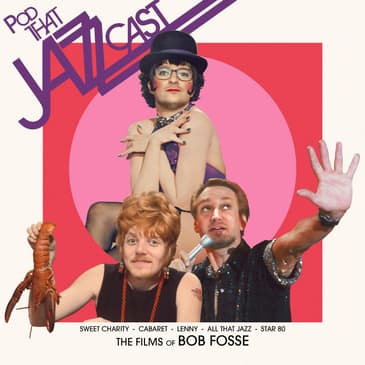




We have THOUGHTS! Comedian and “stand-up historian” Colin Quinn joins us to talk about the legacy of Lenny Bruce, and what Fosse gets right (the milieu of the clubs, Valerie Perrine’s wonderful performance as Honey Bruce), and what he gets wrong (the actual humor). Plus - we entertain the idea of a miniseries structured not around a specific filmmaker, but a series of late-70s, early-80s films where the main auteur is…cocaine.
Editor’s Note: This episode includes Zoom audio.
Join our Patreon at patreon.com/blankcheck
Follow us @blankcheckpod on Twitter and Instagram!
Buy some real nerdy merch at shopblankcheckpod.myshopify.com
[00:00:01] Blank Check with Griffin and David, Blank Check with Griffin and David Don't know what to say or to expect All you need to know is that the name of the show is Blank Check What's the worst thing you can say to anybody? Podcast you mister.
[00:00:25] That's really weird, you know, because if I wanted to hurt you, I should say un-podcast you mister. Because podcast you is really nice man. I gotta say it's hard to do Hoffman doing Lenny. Could you do Lenny? I don't know that I would know what Lenny is.
[00:00:41] I feel like the Hoffman thing is kind of, I mean this is almost the Hoffman thing. Right. And then the Lenny thing is a little, I feel like I'm just going into Cartoon Ship Monk there. Yeah, I think when you're doing Lenny you're just doing Angry Jew, right?
[00:00:56] I'm doing, yeah. Hoffman, that's very specific. The Hoffman thing, but then you're trying to put Lenny on the Hoffman. It's an interesting balance. Look, we love it when our guest interjects before they're introduced. Yeah, our guests can just weigh in.
[00:01:11] I don't know if our guest has a Hoffman or a Lenny. Oh, I'm always ready to interject on this kind of stuff. I saw you holding back, yeah.
[00:01:19] Funny you said it because one of the biggest problems is over the years I feel like people trying to do Lenny. Yes. In stand up and so suddenly you have these people and I watch a lot of Lenny Bruce before the movie and whatever.
[00:01:35] I've listened to some old tapes over the years because he changed the game in so many ways. But him doing it at that time, you allow for a lot of pontification and you allow for a lot of dead air because he was changing the game. Yes.
[00:01:53] And I'm just watching. But once somebody does that structurally, everybody else's responsibility is joke, joke, joke in the middle of that structure. And so when I went to Lenny Bruce, people were like, oh, Lenny Bruce wasn't that funny. Like a lot of comedians say that.
[00:02:06] I go, but it doesn't – what he did at that time was something else. You know what I mean? He was like the first modern comedian and then other people figured out how to make that funnier and more entertaining. That's right.
[00:02:18] And by the way, that go Joe Ansis was apparently where he stole his whole style. Sure. That was like Rodney Dangerfield's friend and his friend. So they all loved that guy. But the guy wouldn't get on stage, so fortune favors the brave.
[00:02:32] Somebody should have said that to Joe Ansis. But yeah, so I mean it is interesting to watch people steal that kind of style of Lenny Bruce. It gets very didactic and just a little bit pompous. You know what I mean? It's too much sometimes.
[00:02:51] But when he did it, you have to give him a lot of slack in my opinion. Would you agree with my assessment – I was trying to do the math while watching this movie again last night.
[00:03:00] I feel like still conservatively 25 percent of comedians are trying to do Lenny Bruce today. And they tend to be the most self-indulgent comedians working. He's a whole quadrant of stand-up comedy essentially. You're saying like it all goes back that way. Kind of, right?
[00:03:16] Or they're at least doing a distillation of Lenny. Well, everybody gets influenced by somebody in comedy. You have to be influenced by somebody. It's like that great line in Manhattan when Woody Allen goes, you think you're God and he goes, I have to model myself into somebody. Sure.
[00:03:33] So better Lenny Bruce than some old time. But yes, I feel like he's had undue influence not just on comedians. Now here's what I'd like to attack all thinkers on comedy. Great. Here we go. Audience members, everybody.
[00:03:47] Because not just comedians but this idea, this romanticized idea of tortured truth teller is too much for me. Because it isn't a thing about comedy in my opinion. Once again, something nobody says in my opinion. You won't hear that on social media.
[00:04:06] Is that comedy like doctors first do no harm, first make people laugh. So if you're not making people laugh, I don't even want to discuss. I don't care if you have the most breakthrough revelations that changed the world. I advertise as a philosopher.
[00:04:23] So when people go to see a comedy show, get the babysitter or whatever, they're supposed to – you're supposed to elicit laughter. That's what the advertising for a comedian is. So if you're not doing that, I don't care how brilliant you think you are. You're not – you're false advertising.
[00:04:37] You're not shocking people. You're not freaking them out. It's this whole idea of like, yeah, man, I had the bourgeoisie and an outrage with my observations. They can't handle it. These middle class morality suburban – and it's like all right. That was – when Lenny Bruce did it, it's shocking.
[00:04:54] Truly. 1960, you took by the Catholic Church, you kind of got your ass beat to death. You know what I mean? And so I'm just saying now going after the Catholic Church, not that they don't deserve it,
[00:05:06] but don't act like – I'll be on stage sometimes making some stupid Catholic Church joke. A couple of people are like, whoa. And I'm like, yeah, I'm really stepping out on a limb. I'm going to watch myself.
[00:05:17] You don't have someone being like, all right, into the paddy wagon with you like the minute you say it. Exactly. And that's the thing. It's this romanticized thing that it's like comedy is chain smoking, tortured. Get laughs.
[00:05:31] And the highest form of it in my opinion, again, is if you can say what you're trying to say and get laughs. So I'm not saying there aren't different levels, but the laughter has to be there or it's not an even discussion.
[00:05:44] And if 25 percent of comedians are doing some derivation of Lenny Bruce, I think the bigger problem is 15 percent of comedians maybe take all of the wrong lessons from Lenny Bruce, not just in their act but in their sort of how they view themselves and their personality.
[00:06:00] And it's like I'm this radical disruptor. You know, sermon on the mount. I need to – yes, the tortured chain smoking black and white. Like when they're doing standup and they're bombing, they think they look like Dustin Hoffman in this movie.
[00:06:15] And someday someone is going to talk about how misunderstood they were at their time. Right. But that's also the responsibility of the people that have commented all these years because people love that idea of Lenny Bruce. And it's stuck as this archetype for everybody.
[00:06:30] And I love it. I mean, I get it. I'm in there. I'm like, this is cool. He's like a badass. By the way, Dustin Hoffman, Lenny Bruce, horrible. Wow. Dustin Hoffman is one of the most amazing actors of all time. He tried.
[00:06:43] Either you're a standup or you're not. You can't be not funny and be a standup. So Dustin Hoffman is going like this the whole movie, which is rule one of what I would never do in – what I can't imagine anyone doing standup.
[00:06:56] He tells his joke and he goes like this and smiles at the crowd. You're Lenny Bruce. Lenny Bruce was a badass. And smiling like this, like, hey, guys, are you in? That's a guy telling a joke at like a business conference, like, I hope I get the lead.
[00:07:11] Lenny Bruce, whatever his faults were, he was a sexy kind of like, I don't care. Yeah, man. And he was that guy. You know what I mean? He wasn't a guy that's up there like, hey, guys, are you in?
[00:07:23] I appreciate you saying that because I think with this movie, you might watch it and come away with the basic take we're all talking about. Oh, well, Lenny Bruce, he wasn't that funny. And maybe the real answer is like, well, Dustin Hoffman is Lenny Bruce isn't that funny.
[00:07:38] Lenny Bruce might have been funny. But Lenny Bruce through Dustin isn't that funny. They said the guy that did the play Cliff Gorman was apparently great. Like they had that plane and it's based on. But when it came to the movie, they have to have Lenny Dustin Hoffman.
[00:07:52] Got to get the star. And he's the fake Lenny in the Lenny within a movie in all that jazz. That's Bob Fosse's apology for not putting him in the film. He's very good in that. But again, even what Bob Fosse chose is Bob Fosse is not funny.
[00:08:09] So he's the whole thing with comedy. Funny, funny, funny. If it's not funny, I don't care about the torture. It's fine. I get every once in a while they torture you. But if I'm watching a movie about, you know, I don't know who that like.
[00:08:22] What was that movie? I saw like the Elton John movie. Like Elton John, his life. It's interesting enough. It's interesting enough. But if you don't hear the songs, then you're like, why am I watching this movie about a guy who was on drugs and tortured?
[00:08:36] He's like everybody else. We all have 10 people in our lives like this. Oh, yeah. He's a great songwriter.
[00:08:42] So with every comedy movie is my bone to pick in comedy general movies and TV show is if you don't have jokes that if you don't curate the material correctly, then I'm not watching this guy. The funniest. And it drives me nuts.
[00:08:57] You know, so that's part of my problem is I glitch. Bob was like, the death stuff is deep. I'm like, is it really, Bob? Is it really? Is that it? Death, man. Death.
[00:09:08] It's like, OK, you know, that was that 50s Ingmar Bergman and Woody and all of them. They would just thought that made them deep to be into death. Speaking of, you know, archetypes, you know, they're like, yeah, we're into like death. And it's like, oh, it's too much.
[00:09:21] Death as a personality. Look, we're going to dig into all of this. Dig, dig, man. Yeah. Listen, dig. This is a podcast called Blank Check with Griffin and David. I'm Griffin. I'm David. It's a podcast about filmographies, directors who have massive success early on in their careers.
[00:09:38] They're given a series of blank checks to make whatever crazy passion products they want. Sometimes those checks clear. Sometimes they bounce. Man, it's a miniseries on the films of Bob Fosse. It's called Pod That Jazz Cast. That's right. And today we're talking about the film Lenny.
[00:09:54] And we got with us not just a comedian, but clearly a historian, an expert, a truth teller. A modern philosopher. Yeah. What is every euphemism for stand up comedian? Also, it exists. Modern philosopher. And look, all that stuff is great. That's the highest form.
[00:10:15] If you're making people laugh the whole time. Right. So here's the main credit I'll list. Our guest today is funny. Yeah, that's it. Really good jokes and makes people laugh. That's it. Colin Quinn. By the way, you know, Cabaret, which I did. You guys do already Cabaret.
[00:10:32] We did Cabaret. Yeah. So did you ever hear that great story? The interview with Joel Gray talking about Bob Fosse and how he won Bob Fosse wanted to play the part. Right.
[00:10:44] And then he said, it's either me or Joel Gray because he thought they would take Joe Gray and he took Joe Gray. And then the first day rehearsal in Berlin, Bob Fosse did a flip. Did you see that? Yes. Yes.
[00:10:55] And he landed on his head in black and blue and he just rest of the time just try to cut Joel Gray out of the whole movie. Yeah, it's crazy. Yeah. And that was before this movie.
[00:11:04] So, I mean, obviously his judgment was they were like, are you crazy? Joel Gray is a great part of the movie. So he had no choice but to cast Dustin Hoffman. This is going to be an anti-Dustin. It's going to turn into an attack on Dustin Hoffman, unfortunately.
[00:11:17] OK, here's here's what I want to say right off the bat, because I know this is it's sort of the common complaint of this movie throughout the comedy community is just he doesn't get the sort of rhythms of being on stage correctly.
[00:11:32] It's such a sort of literal impression. He's approaching it very literally minded and he evokes him in a lot of ways. But the dynamic of him on stage interacting with the crowd never feels correct. And the other thing is fundamentally, he's not funny.
[00:11:47] None of these routines are funny. Right. I would argue Hoffman does a good job with all of the sort of offstage stuff. But like 50 percent of this movie is is actually having to do the routines. Right.
[00:12:00] And I had the same feeling where I was like, look, I've never found Lenny Bruce personally very funny. I understand his historical importance. I think he's worth studying for these reasons. But watching the movie, I was like, man, he's really not funny. These routines suck.
[00:12:15] And then this morning I put on Lenny Bruce live at Carnegie Hall and I was like, oh, no, no, no, no. There's a reason this guy was well known. Yes. Yeah. It's still not my favorite kind of thing.
[00:12:26] It wasn't just that he got on stage and said sucker, you know, like he was he was a performer of Renown. It's still self indulgent. You know, we've adapted the form has evolved since then.
[00:12:37] But you listen to him and it's like he has an innate sense of comedy that perhaps is not Dustin Hoffman's strong suit. That's exactly right. Dustin Hoffman can be a very funny comic actor, right? Like Tootsie. I don't know. Right. He's a different thing. It's all different.
[00:12:55] And like I said, the biggest crime to me is that that smile to the audience. I mean, I couldn't believe it. I mean, but the material was Bob Boise doesn't always look at that maybe. You know what I mean? Because material wise.
[00:13:12] Yeah, I feel like Bob Fosse himself admitted that he wasn't a fan of Lenny Bruce, didn't find him very funny and was fascinated by, as you already called out, the looming specter of death, his number one favorite theme. Colin Cullen's body just shrugged.
[00:13:27] His entire body just sighed because I don't even believe Bob Boise's looming specter of death judging on his behavior in his life. I believe that people at that time had a fashion where they were like, I'm into death. And everybody's like, oh, this person's deep. Yeah.
[00:13:44] I just don't buy it. I think it's an affect. I think he was very obsessed with the notion of what Lenny represented in terms of breaking down those walls and changing the vernacular because Fosse was a guy who tried to rewrite
[00:13:58] dance in that kind of way and make things sexier, more tactile, more dull and more dangerous. But the actual comedy itself, I think by his own admission, he was never that interested in. He's really interested in Lenny as a figure in terms of what he represents. That's right.
[00:14:14] That's what I think so, too. And the other part of it, the other thing is like that Bob Fosse grew up playing these types of clubs that he was this child dancer doing on lineups with burlesque dancers. The entertainer thing, the backroom entertainer thing. That's that's that.
[00:14:33] That seems very he loves the sad, dirty show people thing. He loves these terrible rooms and staying in the hotels and all that sort of shit. But then you get to the comedy of it and he's like, I don't know. That's the whole thing.
[00:14:46] It's it's like watching a musical without the music. I mean, if you're not if you're not watching a comedian being funny, then why are you watching this person? It's every other 10th person, you know.
[00:14:56] It is funny that this movie pretty much has the exact same structure as Cabaret, where it's like you're cutting in between this one sort of performance and these slivers of the life. But Cabaret was a masterpiece. Yes. Well, because he's really good at doing musical numbers.
[00:15:14] This is the thing about Bob Fosse that people don't talk about that much. Very good at musical numbers. Yeah. But that's my question to you, Colin. What's your what's your overall Fosse feeling? Have you you know, is Cabaret that's your favorite?
[00:15:27] How do you how do you feel about the Fosse filmography? Well, what else was there? All that jazz I thought was good, except the depth thing was corny. But like, look, the beginning of all that jazz when it's just quiet and then the music and the stretch.
[00:15:40] And I was like, that's masterpiece. Masterpiece. First movie, Sweet Charity with Shirley MacLaine. Oh, did he direct that? He directed that. And then his last movie after all that jazz is Star 80. Oh, Star 80 was good. Yeah, Star 80 rolls.
[00:15:56] But it is one of the darkest movies ever made, arguably. It's a grim one. Yeah. Yeah. By the way, how good was Eric Roberts when he quotes to Cliff Roberts and he quotes the Playboy philosophy at the party?
[00:16:09] We're going to talk about Eric Roberts performance of that movie is one of the few times where you feel like this is actual just evil captured on camera. He was amazing. It's unbelievable. He never really shook it. But so overall, you do seem to like his movies. Yes.
[00:16:25] Yeah. Yes. I love Bob. But I wanted to I want to bring out because Colin, people don't know you were secretly a major cinephile. You did a Criterion Closet video. That's right. You've been to the closet. Oh, yeah. You've been to the closet. I watched I watched this.
[00:16:39] I went, what am I doing? Let's let's rope Colin in here. And I thought between your your bona fides as a cinephile and your expertise, your strong minded opinions on Lenny Bruce, which when I texted you to do this, you said Lenny Bruce
[00:16:52] looks like an open micro compared to me. That was your immediate response. I like to be, you know, that's my my persona. But yeah, Lenny Bruce was no. Of course, Lenny Bruce like what you said, he changed the form. That's hard.
[00:17:06] You know, he changed the form and he didn't do it because it didn't need it. Like you could change the form when it doesn't need it to. But it needed it and he changed it. And it was really interesting, you know.
[00:17:19] And I still say it's so funny because even among comedians, we talk there's nothing one line or people are so funny like you watch Rodney Diggs, but some of these one liners have more truth in them than somebody rambling for 20 years.
[00:17:35] And joke jokes are some of the funniest jokes ever. You know, joke jokes. But a hundred percent. Pound for pound, Dangerfield, in my opinion, is the funniest person to ever do it. You just watch it every 15 seconds. Something funny. Well, he didn't write those most of them.
[00:17:50] But I mean, no, I know. I know. I'm just giving credit as a performer, as as a as a brand, as a construction. Just funny. Well, funny is because what he was saying and what he looked like and what he sounded like all perfectly consistent, you know? Correct.
[00:18:07] And and the other outside thing is you're like, nobody really gets respect. So even though you're laughing at him for not getting respect, you don't feel like you get respect either. So it sort of keeps you in there. There's a universality to it that he figured out. Right.
[00:18:21] Right. And yeah, he was he was probably pound for pound or the most consistently where he just show up and you'd be like, oh, I remember seeing Caddyshack. And at that time, Dangerfield's like an old fashioned type comic. Yeah.
[00:18:34] And he's with Bill Murray, all these guys were creating my Caddyshack. Jaws might want to do that movie someday. Caddyshack have all these hip guys that we love, like Bill Murray and Chevy Chase, Worldstone
[00:18:45] and Smoking Pot is all these references in the movie Saturday Night Live with the hippies and in the middle of it. Why did Dangerfield comes on, which we loved him? He was so funny.
[00:18:54] Ted Knight, who's this lame sitcom guy from too close for comfort, comes on and steals the movie. Yes. Yes. I remember that gave me a great lesson when I saw that.
[00:19:05] I go, this guy's some I didn't want to say, what's this guy in the moon in the movie? He stole the movie. He was so good. It's one of those things.
[00:19:14] I think that's a movie where I mean, when I saw it when I was young, I didn't get Ted Knight's performance. And then the older I get, every time I rewatch that movie, you go, this is the most interesting thing happening in the movie. It is. He's incredible.
[00:19:28] By the way, do you ever I mean, this would relate to Lenny Bruce and a lot of the movies that seemed to Chevy Chase and Bill Murray that they just left in because they want to
[00:19:37] see what those two where he's golfing through and they talk about you come by my house. An inexplicable scene. It's the middle of the night. Chevy Chase is like, oh, I'm golfing like it doesn't make any sense. Right. Yes. But but nowadays they would say cut that scene.
[00:19:50] It's not pushing the plot forward. It's not. And that's the kind of scene that I feel like every movie strives for in some way. Just these people being in a moment. You know what I mean? It's I thought it was such a beautiful scene.
[00:20:03] I rewatch Caddyshack recently because I had not seen it since I was like a kid or whatever. And that movie is almost abstract. It is very strange. It is weird that it was such a game, such a phenomenon.
[00:20:14] It doesn't have a plot and it's ostensibly about these young guys. But then the young guys are sort of irrelevant to it. It's so strange. Yeah. No, but I think when they shot it, there was a much more conventional script that was like
[00:20:26] breaking away that was really about the Michael O'Keefe character. And sometimes you had these fringe characters and then that's a movie where they got so much good shit with the four elder random improvisers. Yeah, they were like, Michael O'Keefe down to 20 minutes.
[00:20:41] Let's hit the basics of that plot. And it's just a hangout movie. But that they released it and it worked is just yes. Patience. Yeah, totally work. Yes. Well, I'll tell you, it was good. Speaking of side characters, Valley, Brian and Lenny, I'm saying, oh, speaking of all
[00:20:55] the people, she was amazing. Yes. She went to Academy Award. I don't know. She was nominated. She won best actress at a con. It was an impossible part because she had to live up to not only Lenny's expectations, but Bob Fosse.
[00:21:12] She represented everything about Fosse's obsession his whole life other than death. And she was that good. We like every scene. You're like, yes. And I like to get a play Milton Burrow. Remember him? He's like, yes. Put his hand on her leg.
[00:21:28] She lost Griffin to Ellen Burstyn for Alice doesn't live here anymore, which is OK. And it's a great year. It's fade down away for Chinatown. Gina Rowlands for a woman under the influence and Diane Carroll for Claudine.
[00:21:40] It's like but the thing is she was nominated in lead, which she shouldn't. This is a supporting performance. She's not in a lot of the movie. And she won a lot of critics awards in supporting. And she might have won there, but she whatever.
[00:21:53] She was run as lead. So you have she's functioning like the narrator for a lot of the movie. I know she spends the middle chunk in jail. I know she just doesn't have a lot of screen time. Sure. This is a question I want to ask you, Colin.
[00:22:05] Is there a performance of an actor playing a stand up that you think gets it right? Or do you think it's fundamentally a thing that someone who doesn't have experience doing stand up never gets that sort of dynamic, that energy? Correct. For the at least the performance sequences.
[00:22:22] Yeah. I mean, I feel like I feel like it just goes to show like how everybody probably feels that way at their job. So whenever they see like, you know, that guy wasn't a soldier, that guy was in a cop. She wasn't a hooker.
[00:22:36] Like whatever your job is, you're like, they can't build it. You know, they can't do it. Right. I mean, I get those chick flicks when they're like my presentation. They're like, oh, she didn't work at a woman's magazine. You know what I mean? Like nobody gets it right.
[00:22:52] So I guess it but yeah, I've never seen I mean, I can't even think of that many. But I mean, I've never seen I feel like it's also that that relationship with the audience that he tried to do the audience thing. Right. Well, forcing.
[00:23:06] But it's like, what would you do with an audience? I mean, I want to listen to an old Lenny Bruce tape from 1950s that this guy Hal had. And it was him yelling at this table and going, man, you people, why do we see you right there?
[00:23:22] And I was just laughing because it never changes. And he goes, and after the show, you're gonna go, we were helping you. And I was like, even Lenny Bruce had to deal with like the cliche. We were helping you after the show. Yeah.
[00:23:34] By heckling, you know, by talking. So I was like, it would be interesting to see somebody really get the essence of of the audience, you know, in a comedy show, you know. But but so far, I feel like that's a big part of it.
[00:23:49] It's almost like in between the audience and the comedian, like almost that whatever's in between those two. How would you capture that? You know, it's strange. It's it's it's hard. And I think even if the performer gets it right, there's something about when you're
[00:24:04] staging stand up, when you've hired people to be the audience, when they have to watch the performance many times. Like it's it's a thing that I think, to his credit, Apatow was smart about in Funny People,
[00:24:18] which is send these people out to real clubs, put a camera in the back. Don't make the same crowd sit through the same routine multiple times. Just go to another club on another night, get a different audience and mostly casting actors who had some background in stand up.
[00:24:32] Oh, yeah. People do stand up with stand ups, too, which is also the smart move. You know, you got to throw them out there. They're going to be out there getting that competitive streak like I know I'm in a movie,
[00:24:44] but I'm going to get laughs from this crowd to screw this. You know, I mean, the Sandler scenes in particular, I think have that energy that like you can't capture. It's it's just yeah, it's it's not the same thing when I I mean, to your point about the
[00:24:59] smiling thing, right? When Norm MacDonald died, I showed my father his roast, the Bob Saget roast set. Right. Which for my money is just is one of the greatest stand up performances ever. It's incredible. And my dad had never seen it and I showed it to him.
[00:25:13] I was trying to explain to him the context of it. Right. Yeah. And I said to actually set it up as like, you don't understand the roast works like this. He's doing something, you know, like all of that stuff. Right. Yeah. And my dad watches the other row.
[00:25:26] And before this is Lisa Lampanelli just like hitting like three pointers from half court. Right. Like everyone else is going so, so hard, so dirty, so mean. And he comes up and the other thing I said was, look, when they put this on Comedy Central, they reedit it.
[00:25:40] They added in crowd reaction shots to make it seem like he was killing it. This is the unedited footage. And I showed it to my dad and he just turned me halfway through.
[00:25:48] I was trying to explain him because he was never really a norm guy like why Norma support. And he turned to me and he went, this guy just didn't give a shit. Huh? And I went, yeah, exactly.
[00:25:58] And he went like, that's fearless to get up there and tell jokes that corny when everyone else has been. And you just watch his face and he just isn't affected at all by the fact that he's playing to abject silence. No, he knew it. Right.
[00:26:14] And it's that thing, especially when Lenny Bruce is like fucking rewriting the form with his bare hands. Right. And he isn't getting out there on stage looking for approval, which is that thing. It's the actor insecurity. Please love me thing that I think Hoffman has to.
[00:26:29] That's how he relates to the idea of being a performer. 100 percent. And I'm sure he gets that right. Yeah, that's that seems so inherent to Hoffman's. Yes, he can't think of not wanting to win their approval in that moment.
[00:26:44] And I'm look and I'm sure Lenny Lenny Bruce wanted laughs the whole time. Lenny Bruce never went out there to not get laughs. But like you said, it's the way it's a way of being like, OK, this is where I draw the line.
[00:26:56] You guys got to meet me halfway. I'm not going. You know what I mean? Or else it's not funny. The worst thing in stand up to the guaranteed bomb is anyone that goes out there needing anything goes out there and wants so badly for the audience to laugh.
[00:27:11] They withdraw. It's like it's like trying to, you know, get somebody attracted to you. If you go in like this, they're like, oh, get away from me. There has to be a little bit of, you know, yourself, yourself in there.
[00:27:25] Like, hey, I'm drawing my boundary, too, you know? And I think that's what that was missing. But I don't want to put it all on him because a lot of it was, you know, the favorite director part for me. You know what I mean? Yeah.
[00:27:39] Let's let's dig into how this movie got made. So this movie obviously is coming right after Bob Fosse is just the most enormous success. He wins best director for Cabaret at the Oscars.
[00:27:49] He wins best director at the Tonys for Pippen, and he wins best director at the Emmys for Liza with a Z all in the same year. Yeah, he's the first and still only person to essentially get the directing triple crown. Right. In one year. Same year. Yeah.
[00:28:06] And his reaction, which seems very Bob Fosse, is to enter a state of massive depression. Right. Which, you know, that that that, you know, that makes that tracks with his entire sort of creative process, basically.
[00:28:20] But he was also I only know because probably a few years later and I was a lot younger, I used to eat massive amounts of speed and chain smoke. And believe me, when you're not when you're not on the crest of it, you're in a depression. Right. Right.
[00:28:39] Right. I mean, that makes sense. He's so high low. Yeah. And ranking who's his girlfriend. You know, obviously we'll talk about her more in all that jazz, but she she brings up this Looney Tunes cartoon called Showbiz Bugs where Daffy and Bugs Bunny are in competing acts.
[00:28:53] The audience loves bugs. Daffy keeps trying to outdo him and he can't. And Daffy figures out the only way he can do it is to blow himself up. And the audience goes wild. Bugs loves it and claps.
[00:29:04] Bugs Bunny, his ghost floating up, says, I know, I know, but I can only do it once. And ranking is like, that's Buff Buffy. Like she's on this cartoon. I just had to read that quote. It's so good. Yeah, that's a good quote. Yeah.
[00:29:18] And it's one of those things. I mean, there's sort of the whole episode of Fosse Verden, the series, which I highly recommend people aren't watching it or haven't watched it before this.
[00:29:26] There's the episode that's all about this insane year for him that ends with him in a mental health clinic. Like he just had a complete psychotic break. And it is that thing. Yes, obviously aided by living a fast lifestyle, taking speed, chain smoking, you know, all
[00:29:42] his vices and whatever. But I think for a guy like that, when you start elevating to higher and higher highs, it only creates a greater distance you can fall. Well, then a guy like that, anybody? Yes, absolutely. Any athlete, any star high school athlete.
[00:29:59] And then in college, you're on a bench and everybody else goes on. You know, it rocks your world, you know? And I think Lenny Bruce was so I said Lenny Bruce, Bob Fosse, but I think the similarities
[00:30:11] here what he's sort of relating to Bob Fosse was so self-hating and always felt so unworthy of love and was constantly chasing love in all areas, but never actually feeling loved. But wait a minute. Name the percentage of people that don't that does not describe.
[00:30:26] Oh, every whole world. I'm saying welcome to the I'm saying welcome to the world, Bob. Absolutely. But I think when you have a year where everyone's fucking lauding you as a genius, his reaction to that is you fucking phonies, you pieces of shit. I'm a phony.
[00:30:43] I'm a piece of shit. You know, I don't know. I don't know. I don't know. I mean, I don't know if I bought it. His reaction to this is he checks into rehab. He doesn't like it. He says he didn't like lithium because it killed a sex drive.
[00:30:58] And he said, I knew it was time to check out when I started putting on shows for the other inmates. So then he comes out. He's got three things going, Griff. He's got The Little Prince, which is sort of this passion project that Stanley Donnan is working on.
[00:31:14] You love that book, right? Griffin, that's that's a big thing for you. The Little Prince, the children's book. Yeah, but but so he's in that movie as an actor. He plays the snake was was he at one point supposed to direct it or produce it or something?
[00:31:28] Well, he choreographed that sequence, I believe. Sure. And Donnan at one point gave over a lot of control to him for that. But I guess I guess that's all he works on. Yeah. Yeah. Have you ever seen that movie, Colin? It's incredibly bizarre.
[00:31:44] It's a learner and lobe Little Prince adaptation that Stanley Donnan did in the 70s with Bob Fosse and Gene Wilder. And a child and a child in the middle of the desert. I love it, but it's yeah, it's bizarre.
[00:31:59] And there's like 10 minutes of the movie that Fosse just takes over and it becomes Fosse and head to toe black leather in the desert, seducing a child like the snake at the Garden of Eden. Oh, and Bob Fosse plays the part? Bob Fosse plays the part.
[00:32:15] It's incredibly bizarre. The other thing, obviously, Chicago, which they're trying to turn into a movie, doesn't they intend that to be Gwen Verdon's return to Broadway, I guess. Like I guess they want to do it on stage, you know, whatever that's all going on.
[00:32:33] And then Lenny because they bought the rights of the original film and play. And yeah, right. There's this whole thing right where they're fighting for the rights for anyway. And then Lenny had been on Broadway.
[00:32:42] Cliff Gorman, as you as we mentioned, he wins the Tony for the stage play. And he basically sees this play and it's like, I can do this as a little movie and no one will, you know, people would not be on my back about it. Right.
[00:32:59] Like he rather than rather than try and cash in the big check post cabaret, he's like, well, I can absolutely understand how this would work as a movie. And like, you know, I'm just going to do it. I'm just going to do it as a very small movie.
[00:33:15] And you know, I guess that makes sense. But it does seem like you say, it does seem weird that like he's not that transfixed by Lenny Bruce. No. Like we're saying, like he's more just interested in like, you know, the intimacy of it and the
[00:33:31] shock of it, I guess. Like I don't think he's he's not a comedy guy, Bob Fosse. Like you know, right. He is. He has no interest in that world. But as we found out in Fosse Verdon, his best friends, Neil Simon and Paddy Chayefsky. Yes. Right.
[00:33:50] It is my favorite thing about that show is that Paddy Chayefsky is is like LeBron James and train wreck that it's like, what if your best friend, this romantic comedy saying like you're fucking it up, Bobby? I love that. That was the reference.
[00:34:05] As he's researching Lenny Bruce, he's reading all these interviews with him and he has the idea of like, okay, that can be the format of the movie, right? It's basically question and answer trying to dig into like who was the real guy.
[00:34:17] This sort of Rashomon approach talking to different people who knew him. The movies written by Julian Barry, who I mean, wrote the play and you know all that and they bring in Dustin Hoffman because Fosse wants Cliff Gorman. But the studio is like absolutely not.
[00:34:34] The studio is United Artists. I think you need a movie star. Pacino was actually Fosse's second choice. Okay, but he turned it down and Hoffman is the third choice and Fosse negs him throughout. Basically Fosse the whole time is like, look, you were in my pick.
[00:34:52] Sorry, you know, I hope you'll be okay. But like I they do not have a good relationship on set at all. And interesting. At one point, Hoffman told Fosse he'd worked out a walk for his version of Lenny Bruce and Fosse replied, I wish you wouldn't do that.
[00:35:06] The last five performances of yours degenerated into a walk, which is a weirdly specific burn where I guess he's saying like too many, you know, too much of that bullshit from you. Where is Hoffman? Because like obviously the Graduate and Midnight Cowboy, that's that's the late 60s.
[00:35:24] But like I guess he's done like Little Big Straw Dogs, Little Big Man, Papillon, like you know, not maybe not quite as big movies. Well, and then I mean, it's it's 15 years later. But Rain Man is absolutely a performance that is walk forward.
[00:35:39] Well, that's a good thing about doesn't help me. He's like, I don't give a shit what he said. I'm still going by doing my thing. I'm doing my right. But of course, I got it. So his whole thing is dance. He's going to notice your walk. Yes. Yeah.
[00:35:54] Yes. Because I feel like right after this, then it's the real Hoffman run. You know, all the presidents, men, marathon man, straight time, Kramer versus Kramer, Tootsie like it's all his, you know, dominant late 70s, early 80s stuff like he slows it
[00:36:10] way down in the right Kramer versus Kramer. Seventy nine. He wins the Oscar. Then Tootsie is three years later than Ishtar is five years later. And then and then he wins the second Oscar for Rain Man. Like his 80s are very bizarre.
[00:36:24] But I think there was that thing with him post graduate where he was strategically picking roles to zag as far away from graduate as possible. I think he has talked about this, that he like really didn't want Benjamin Braddock to be his movie star persona.
[00:36:43] So it's like, let's just blow it up every time. Like what are the genres you wouldn't expect to see me in? Rats or RZA was like a real statement of intent. You know, I think Straw Dogs was like he was trying to go to darker places.
[00:36:56] He was trying to be edgier. He was trying to work with more provocative filmmakers. What I love him. I mean, he's amazing. But I do think that that he was a guy that I admire all those kind of guys that you just couldn't see as movie stars.
[00:37:10] And suddenly they were the movie stars when I was a kid. You know, like they were just these all smaller guys and kind of, you know, they just blew it up. And Hammond, Al Pacino and De Niro even De Niro wasn't like some handsome guy.
[00:37:24] He was a weird looking guy for a movie guy, you know, and they all became big stars, you know, Colin, did you see Lenny in theaters? Like is that I mean, you would have been what, like a teenager or something? No, I would have. Yeah.
[00:37:36] Yeah, no, I was still a little young for that. But I mean, yeah, yeah, yeah. But I mean, no, I wish I had seen it sounds like that was the one to really judge everything by, you know, like material wise. Yeah.
[00:37:48] And it's also the thing of like, not only did these guys become unconventional movie stars, but Hollywood was in such a state of upheaval that like anything they wanted to do would get greenlit regardless of how risky it seemed because they didn't know exactly what the audience wanted.
[00:38:04] Like they were chasing a very amorphous younger audience. So this weird reality of like if if Dustin Hoffman wants to do a Lenny Bruce biopic, it's a go picture. It's as easily greenlit as any fucking action movie The Rock wants to make. Obviously, it's a smaller budget.
[00:38:21] It's a cheap movie. Right. Yeah. This movie ends with his dead body on a floor like the fact that the whole movie is living in like the slums of this guy's depression doesn't matter. They're like Hoffman. Anyone will go see anything he does. But that's his. Yeah.
[00:38:35] Plus, there was so many future options in those days. But here's the problem. If I go to see a movie about a comedian and I'm not laughing about the whole movie, that's a tone. Like I said, that's the narrative, the romanticized thing everybody wants now. Comedy.
[00:38:51] It's really dark behind the lights. It's as dark as a sanitation department. It's as dark as electrical engineers. You understand? It's all the same. There's not some. You know what I mean? This is ridiculous. It's been driving me crazy my whole career.
[00:39:07] No, but like, oh, you understand they make us laugh and yet they are sad. You know, the duality there. It's just so incredible. Believe me, I understand. I understand as well as everybody else what the you know, what the thing is, the dichotomy
[00:39:23] between onstage and offstage and how you feel a certain way. But once again, every job that you don't think nurses go. Nobody cares when I feel pain. I'm working all the time on pay. It's just life, you know, too much. But people get rolls, everybody, you know?
[00:39:41] Just because this isn't a visual medium, people are only going to get to hear the audio of this. I just want to say Colin is expertly leaning into the camera as punctuation on the zoom to hit your punchlines on jokes. Yes. Yeah. And that's the key.
[00:39:57] The key is what you said before. The real key to comedy. Yes. Material, all that. Your your your mind, what your angle is. What you said about Norman Downey is the key. If you really care that much, it's not funny.
[00:40:10] And why Norman was so funny was because he wanted laughs. He worked hard, but at a certain level, you're like, that's as far as I can go. I don't give a shit that much. We're going to have this be dictated, you know?
[00:40:23] And I think I mean, I just watched the documentary that Apatow did for HBO. But like Carlin, really, it feels like took everything that Lenny Bruce set up and figured out how to add more jokes into it.
[00:40:39] While still trying to speak to profound truths and challenge authority, you know, but it's like there were actual jokes there. Like he was a comedian first and foremost. A comedian. Yeah. And Lenny Bruce, like you said, will never like live a kind of yours different.
[00:40:56] He was still indulgent. But in those days, the indulgence was almost part of the journey that people wanted to see because how did you move from punchline one line is to this.
[00:41:06] So I bet it was I bet it was a different journey in those days to watch as an audience to just to hear someone slow it down that much seemed radical because every other guy is just doing one liner, one liner, one liner.
[00:41:19] So you almost want to watch that journey like to us now is indulgent. It's shorthand. But back then maybe that was part of it. I don't know. You know. All right. Valerie Perrine, she's in this movie. Raquel Welch apparently was considered for this role. Jill Robinson names.
[00:41:34] I don't know. Joey Heatherton, Janice Lind. She seems like kind of a wild person. At one point she shaved her pubic hair into a heart in preparation for the stripping sequence called Fosse into the dressing room and said, I have a heart on for you. Stuff like that.
[00:41:54] A lot of stories like that in these of of wild behavior. We talked about, you know, Jan Minor who plays Lenny's mom, Sally Marr, the real Sally Marr wanted to play the role herself. Oh, wow.
[00:42:06] Fosse thought about it because he's like, she's so unique that it would be obviously amazing to capture it. But he said he thought it would feel like weird and cheap, especially since Lenny Bruce was dead.
[00:42:21] Like the you know, he didn't want to like, you know, and then Sherman Hart is basically playing a Milton Berle type, right? Yes. And they they start reading the screenplay and Fosse's like, this thing sucks. It's going to be a disaster.
[00:42:37] And they then pivot to the the interview type thing to present the movie. And that is according to Fosse what saved the movie. But Dustin Hoffman hates it. Like Dustin, I don't know. Are there stories of Dustin Hoffman being chill and nice on set, though?
[00:42:52] Like, no, I feel like he's always supposed to be the prickliest guy of all. Right. Like, but in this case, he's probably right. It was right. It was a bad screenplay. Well, but but the other problem is it's like I think Fosse's creating that superstructure
[00:43:06] of the interviews to compensate for the fact that the Hoffman doing stand up is not compelling enough to carry the movie. Yeah. But again, they should have, you know, they didn't do that in those days. They bring a stand up in and try to explain.
[00:43:21] And again, the material nobody could kill with that material either. Some of it was funny, actually, at the beginning. But it was just I don't know. And by the way, Milton Burrow paid for the funeral, even though the play abused him.
[00:43:33] They didn't say they paid for his funeral. Yeah, he paid to put him in the ground. Yes. According according to sources, Dustin Hoffman was the Edward Norton of his time where the story was always he comes in, he has opinion on fucking everything. Right.
[00:43:51] He wants to take on every role. And the stories are always look, he's right most of the time. Right. Do you really want to deal with it? Right. I mean, I think I can say this now because he is dead.
[00:44:04] But Dustin Hoffman weirdly, very badly wanted to play the Franklin Jella role in draft day. And I know those people are dead. Oh, Ivan Reitman is dead. OK, yeah. Ivan Reitman. No, I know. I know who's dead and who's alive. David. Sorry, sorry, sorry. Go ahead.
[00:44:22] I keep tabs. Ivan Reitman said life is too short to work with Dustin Hoffman, which when you're offered fucking Dustin Hoffman to play the fourth lead of your like sports management comedy. Most people would do anything they could to get him to plus up those scenes.
[00:44:38] And he just went literally, I don't have the energy to have these fights with him. Even if he's right, I don't have the energy. Had he ever worked with us? No, I guess he never did. No, I don't think he had. Certainly no.
[00:44:49] And like fucking Reitman worked with Redford and Murray and all these incredibly difficult, you know, leading men. And he just went, I'm too old. I don't give a shit. I don't want to get into these fights with him.
[00:45:00] Well, apparently what Hoffman is doing, unsurprisingly, he goes out to L.A., he starts exploring, you know, like performing stand up, things like that. He keeps calling Bob with ideas. He found out that apparently Lenny Bruce at one point had advertised a show by getting
[00:45:16] a cut out of Hitler and putting it on the side of the freeway and then having just it's a Lenny Bruce, you know, opening on the on that, you know, which again, it sounds so corny now, but like back then, I'm sure was crazy. And crazy. That right.
[00:45:33] And and so Hoffman's like calling up Fosse being like, we got to do that. We got to put that in. Right. And Fosse is like, no, I'm not. I'm not. You know, I'm doing well. Is resistant to Hoffman's notes, I guess.
[00:45:47] Hoffman says this guy is not a collaborator. But you know, I mean, I'm sure Bob Fosse's, you know, a side of it is essentially like I'm trying to make my movie over here.
[00:45:58] Like I'm you know, whatever your idea of Lenny Bruce's, you go direct to Lenny Bruce movie. I'm the director like, you know, that that seems to be. But somebody idiotically putting a Hitler thing on the side of a of a freeway.
[00:46:12] Only a comedian would come up with that. That's such a stupid idea. So they should have done it because Bob Fosse wants it to be this dignified thing of like Lenny and his deep foot.
[00:46:24] But only a comedian would think of a shitty idea like this, would Hitler do it? So I'm saying Bob Fosse should have got something in that spirit. This is the thing I think.
[00:46:35] Yes, I think Fosse could have allowed for Lenny to be a little sillier in this movie. And Bob Fosse is clearly like, no, this was a tortured drug addicted genius who stood up against hypocrisy and stood up for free speech.
[00:46:48] And that's what I want to make a movie about. And I'm watching it. And I come away with the impression of, yeah, this guy was a drug addicted, very smart guy who stood up for free speech.
[00:46:57] And, you know, like but I'm not coming away with the impression of like, God, I can I can tell why this guy changed comedy or I or even like why this guy liked comedy. He mostly just seems annoying. I'm sorry.
[00:47:12] Like when he's like being a pain to the judge, I'm like, can you at least be a funny pain to the judge? Exactly. And I bet he was funny to that judge. But I'll say this too.
[00:47:22] And I think this memory is probably in my head from Hoffman's Inside the Actor Studio. But I feel like any time I have heard him talk about this film, his preparation for this film,
[00:47:35] his work on this film, he talks about it the way that now people describe playing the Joker like he talked about is like I locked myself in a room and I wrote down every routine. I put him on note cards and I smoked obsessively.
[00:47:47] I tried to get into his head. This performative thing that now every actor has to do where they're. I had to write down murderous things in a notebook until I started laughing. And then I became the Joker, America's greatest dramatic figure.
[00:48:02] And it's like he was also so attracted to the self-tortured aspects of this guy. Both of them, I think, were primarily into this idea of what Lenny Bruce represented rather than what he actually kind of was as an artist, his basic art, which was trying
[00:48:19] to make people laugh, drunk people laugh in nightclubs. And it's funny also that this film comes so pretty soon after he's dead. I mean, it's like the timeline between him dying, the play running on Broadway. This movie all happens in less than 10 years. Yeah, I died in 66.
[00:48:38] So this movie is what? Eight years later. Yeah. Yeah. Like there's not a ton of distance perspective. Well, it's also crazy that this movie was a wide studio release and like 10 years earlier he was getting arrested for saying, you know, fuck or whatever.
[00:48:54] That's just what's crazy about the 60s. Like you know that it all happened so quickly. The other of these romanticized narratives is that Lenny Bruce was getting arrested in 19—10 years earlier. He got arrested like once or twice. The rest of the time he was beloved by the nation.
[00:49:15] He was the biggest star in comedy. So it was like, oh my God, he was shunned. He took a million chances and he deserved all his success. But he was successful, you know? He wasn't successful after he died. He was successful while he was alive. Yeah.
[00:49:30] And he deserved it. He changed the game. Like when you think of someone like Bill Hicks, right? Like a sort of similar like truth teller, gone too soon type comedian. Like he was never like that famous, right?
[00:49:41] Like he never was a guy who could was playing Carnegie Hall or whatever. Or was he? Maybe I— No, no, no. He was not. He was actually starting to blow up in England at the time when he got very sick, Bill. So he probably, who knows?
[00:49:55] But yeah, but Bill Hicks was right. He was never as big as that. No, he wore clubs. He wore clubs. Right. Whereas Lenny Bruce like climbed the mountain of comedy. And Bill Hicks and Lenny Bruce, the other thing that in common, which is nobody talks
[00:50:08] about their early stuff, which was really funny joke jokes too. So like they didn't come at it from a point of view like I'm going to be a truth teller. They started a certain way. They were very successful.
[00:50:21] Bill Hicks was very successful as a club comic when he was 16, 17. And then they decided to push it further on. You know, they get a little older and they got restless. Not to keep relating everything back to the George Carlin documentary, but just because
[00:50:36] I watched five hours of that recently. So I was really thinking about his whole career arc. But it's such a key piece to him that like he spent 10 years being a very conventional comedian. He learned how to do funny voices.
[00:50:50] He learned how to have stage presence, you know, and like what he was doing was more traditional, but it was still funny. He wasn't hacky. And then he got to a point where he said, I want to actually find a way to represent
[00:51:01] what I think and tackle more complicated subjects. But he was fitting that into a basic fundamental understanding of how to make people laugh. He understood rhythms. He understood energy. He understood wording and construction and all of that shit.
[00:51:17] Whereas a lot of when you see, I think the worst open micers, they are people who are just getting to, I'm going to say shit you're not supposed to say. And then when people don't laugh at it, it's what you said where they go, well, I was too
[00:51:29] extreme for them. They didn't laugh because I was too hot for this fucking room. Oh yeah. No, there's a lot of that. And yeah, no, exactly. You have to be, you have to, like I said, I mean, it still comes down to laughs.
[00:51:43] If you're in a comedy club and you're not laughing, unless that person really is revealing the great truths that nobody in life has figured out yet. We usually like, what am I doing? You're like, I'm not going to come back here. You know what I mean?
[00:51:57] It's your long winded, drunken friend at a party, you know? Lenny Bruce had the benefit in the 1950s and 60s, and not to diminish what he did, that like no one was getting on stage into a microphone in front of a crowd and going like, hey, people
[00:52:12] have sex. So that in and of itself was shocking. And that was truly a thing that had not been verbalized in that kind of sphere before. Yes, people would make like everything was an innuendo and it was, oh, there was some
[00:52:26] truth to it because all those people wouldn't have laughed at those people. One liner is like they're laughing at mother-in-law jokes because people's mother-in-laws live with them and everybody's wedged together. And the mother-in-law was judging him a little bit because she hadn't judged her husband.
[00:52:41] And now it's the 1950s. She's like, this son of a bitch. I see what they're doing now. I didn't see it when I was young. So, I mean, it was all true stuff that was funny.
[00:52:50] But Lenny Bruce is like, I'm telling you the thoughts in my mind that we don't talk about. And when he's starting out as a, you know, evolving into that stage as a stand up, sitcoms are still showing married couples in separate beds.
[00:53:05] There's this thing where it's like, well, we all know this doesn't represent reality, but we obviously don't want to talk about it. We don't want to talk about it. So merely saying the thing, as you said, was like, well, you're verbalizing something that hasn't been said before.
[00:53:17] That alone is going to give you a lot of juice. Absolutely. Yeah. I mean, there was a lot. But once again, you know, hindsight is 20 20. But, you know, I always think like if only Bob Forsey had known enough to really interview
[00:53:33] all the comedians that were anti Lenny Bruce, I'm sure to that day they were still like that and somehow waged them in the movie saying, here's what I think. Then you would have seen like what Lenny Bruce faced.
[00:53:44] I mean, you know, I mean, a lot of comedians loved him, but a lot of comedians didn't like, you know, they were like, that's that. It's like they hinted with Milton Burr.
[00:53:53] But it's like that big facade that he wanted to that he did crash through, you know, it's interesting. I had the realization watching this. I was watching him with the woman I'm dating.
[00:54:06] And I during one of the more sort of self indulgent runs he has, and especially with Hoffman trying to overplay the drama in these things. I think that's another thing is like, you know, all the stand up performance scenes,
[00:54:22] Hoffman is so into playing the self tortured aspect of it that that's smothering the comedy a little bit, even though I think Fosse is selecting least funny stretches of his material.
[00:54:35] But I said to her at one point, I went, this is really just that Twitter thread that you roll your eyes at now, like every one of these routines that they show in the movie is like Mattia Glacius going, let me try to explain something to you.
[00:54:49] And then in brackets, it says one out of twenty seven. And you go, holy fuck. What is this? What is this fucking guy? Yeah, dig this. I'm going to tell you how these things fucking work. And you're like, OK, mute.
[00:55:00] You know, it is interesting to see the crowds in this movie, the audiences and to imagine that at least right. Like what? Like a 1950s comedy concert goer would have been like, right?
[00:55:14] Like someone born in the turn of the century who's like, all right, what's this guy going to say? And he's getting up there and he's being like men and women, they have sex with each other. You know, it is.
[00:55:24] That's what I was kept trying to put my head in, like in that space in like like what what was the crowd back then? It is in many ways the most traditionally biopic scene in this movie.
[00:55:36] And this is a movie where like I agree with all of the criticisms we're saying. I still kind of love this movie just in its construction and its approach to the biopic in the same way the cabaret is Fosse trying to blow up what a movie musical is.
[00:55:49] And I do think while not totally understanding the subject, I think the form of this movie is really interesting and is a form I wish more biopics followed rather than trying to conform people's lives to very traditional three act structures.
[00:56:05] But there's that scene in the script that feels like the most biopic scene where his manager comes backstage at the strip club and is like, I can't explain this to you, but people think what you're doing is about to be a thing.
[00:56:20] They think this is in and you're on the cusp of something. And he's like, I don't want to go back to fucking clubs. I don't want to do mother in law jokes.
[00:56:27] The great thing about performing at a strip club is I can say anything and no one gives a shit. And the manager being like, no, but what I think is about to change is people at traditional clubs will let you talk like you're at a strip club.
[00:56:38] And it's that realization of he only finds his freedom as a comedian when he's accepted that he's in a place where like, none of this fucking matters. This is a fucking den of depravity. I can just talk. Exactly. Yeah, right, right.
[00:56:53] And this cultural shift of something is changing and people now maybe want to hear the tie get loosened. Yeah. And maybe not for the better. What about this though? You say traditional biopic structure. Unfortunately, I just made I made sure it was an earlier movie.
[00:57:10] I just Google it. There was another biopic that had that structure and it was called Little Big Man. And it was four years before Lenny. And you know, started that with Hoffman, Dustin Hoffman, Dustin Hoffman, Arthur Penn movie. I'd never seen Little Big Man.
[00:57:30] That's like a classic revisionist Western, right? Like that's, you know, hey, the Wild West wasn't so cool. No, right. I saw when it came out, I was a little kid and it was a big, that was a big hit.
[00:57:42] Lenny was not a big hit when it came out. At least people thought it was kind of disappointing even then. Some more context on Lenny. All right. It's shot for 100 days, which is insane. Fosse claims more like 80, but no.
[00:57:59] Apparently one thing he insisted on was the extras for the crowds. He would only let them watch two performances max. So they had like 2500 extras in one week and they would cycle them in and out because
[00:58:11] like Fosse was like, I need them to have authentic reactions and you know, like while they're shooting performances. But like this is the thing, like as much as this is Bob Fosse making a small movie, he has the clout at this point to make demands like that. Right?
[00:58:25] Like I mean, there was that thing. They dramatize it and Fosse for him. But the whole idea was like, Bob, you just got out of rehab. Your health is fucked. Your brain is fucked. Like maybe take a break.
[00:58:38] You've had this crazy year and he's like, no, I have to keep working. I'll tackle a small movie. It was a play. I can keep it stage bound. I can shoot it on location. And then very quickly he was like, we got to go to Miami.
[00:58:47] It has to be real Miami. We have to go to all these clubs. We have to shoot in three different cities. It's got to be interviewed for him. We're going to cut it all up. It's going to be this whole. Yes. 100%.
[00:58:57] And is he the off camera voice of the interviewer in this? Is he? I don't know. I mean, that makes sense. So there's no one creditor that I can find, but yeah, I always assumed it was. Yeah.
[00:59:08] I have an anecdote that I think is kind of, you know, an example of Fosse being totally right where like while Hoffman's doing a routine, like they'd finish and Fosse would be like faster, faster, faster, faster. And Hoffman would be like, nobody talks like this.
[00:59:23] And when he takes, Hoffman does it so fast. And he's like, well, he was right. Like that is actually what I was supposed to be doing the whole time, you know? And when I hear that story, I'm like, Hoffman doesn't seem to get it to me.
[00:59:35] Like if he, if he thinks standup comedians like, oh, well no one talks like this, but that's how people talk on stage. Like that, that is part of the sort of unreality of a standup. Like that's what's, that's what's cool about it. That they're, they're talking so rapidly.
[00:59:48] That it sounds like they both didn't get different parts of it and we're fighting on, on how to do it while both of them were sort of misunderstanding. Look, I don't love this movie. I feel like you like it more. You've also seen it more. I have.
[01:00:03] And I said this in an earlier episode, but this was like when I was in high school, I saw this movie on TV and I was sort of so blown away by the style of it.
[01:00:12] And this was the first Fosse movie I'd seen that then I dug into him. And it's like, I prefer Cabaret, All That Jazz, Star 80 greatly to this movie. I think those three films are perfect masterpieces essentially.
[01:00:26] And this is a step below, but it always kind of holds the spot for me of like catching it on TV by accident and going like, what is this? What is this filmmaking style? This sort of Fosse, like everything's a montage.
[01:00:39] You know, there are things about this movie that kind of great and it's not something I really ever feel the need to rewatch, but like it looks so good. It looks like the cinematography is so incredible.
[01:00:50] And then everything else you're saying, all the mantra stuff, all the stuff that's obviously influenced by like Fosse watching like new wave movies and you know, French movies and all, you know, like his sort of like the lingering little art influences, like all the fact it
[01:01:04] just looks incredible. So it's worth, it's worth something to me just aesthetically like beyond. It's got an incredible texture. I mean, like Colin, you summed up perfectly, which is just like if you're watching Rocket Man and it makes the Elton John song sound bad, you fundamentally failed.
[01:01:22] When I watched this movie, I have to divorce. I have to sort of compartmentalize. I don't think this movie does a good job of arguing for Lenny Bruce's value in any way. And I do think this movie also perpetuates a lot of these things that are really irritating
[01:01:37] our culture of what we talked about, of just like the fucking struggling, tortured, you know, sad clown shit. But I like the filmmaking in this movie divorced from its sort of failure of the source material. Right, right, right.
[01:01:56] Because even I found at a record store by chance last week, there is weirdly an original cast recording of the Lenny Broadway play. That is weird, which is like not a thing that you feel like often exists for straight plays and not musicals.
[01:02:13] But I know because that play is like half comedy album essentially. And it is a thing. What's his name? Gorman. The energy of that thing. And I think especially if you are watching someone who does a better evocation of being
[01:02:28] a stand up and you are seeing it as a live audience in a theater, you know, so you the audience are playing the role of Lenny's audience. The reaction that's happening or not happening is genuine and earned.
[01:02:41] You're not going to laugh unless this guy is successfully selling these jokes versus a movie like this where we're watching dramatization of audience response. There is an energy to even listening to the fucking past recording of it where you're like this works.
[01:02:56] And this is how many years later, back in 1974, it was probably worked 10 times better. You've seen thousands of comedians since then. Those days people saw like eight people, you know, right? The movie shot by Bruce Surtis, obviously, but you know, who's Robert Surtees son and
[01:03:14] Robert Surtees shot Sweet Charity. So he's bringing it. But that guy becomes Clint's guy. That guy works on so many Clint Eastwood movies in the 70s and 80s. He also shot like Beverly Hills Cop. He's sort of like a big cinematographer in general.
[01:03:29] He shot Dirty Harry and he shot almost everything Clint directed all the way to the late 80s, basically. And I you know, he's incredible. The sort of like high contrast, high shadow, just it always feeling like he's in a void.
[01:03:43] Do you think that guy sat down with the director of Beverly Hills Cop and said, do you want the Detroit scenes to look a certain way? And then Beverly Hills scenes and the guys probably like what? I don't know. Yeah. He's probably like, just a world alliance jacket.
[01:04:01] What is this guy doing? Oh, Martin Bress is a good director. So yeah, yeah, yeah. The only other at one point that I this is very funny. Fosse's paranoia was so intense that he saw a big bearded guy on set and was like, that's Francis Ford Coppola.
[01:04:19] You're trying to replace me. He just saw a guy who was heavy set and had a beard. And he was like, you're getting the guy like Coppola is like lurking over his shoulder, I guess. I don't know. Francis Ford Coppola would have been.
[01:04:31] Yeah, he might have been good. I don't know. I mean, is this is this the same year as Godfather 2? Yes. And which means it's also the same year as The Conversation. Yeah. Yeah. I mean, the best picture nominees this year are Godfather 2, which wins Chinatown, The
[01:04:48] Conversation, Lenny and The Towering Inferno, which is the sort of, you know, the concession to big, big blockbuster filmmaking, I guess. But it's a strong year for movies. And even though Fosse beat Coppola for director last time, they were up against each other.
[01:05:08] We've read all these interviews where he had this chip on his shoulder about the fact that he didn't win best picture. Right. And the director nominees are Coppola, Fosse, Polanski and then Francois Truffaut for Day for Night and John Cassavetes for A Woman Under the Influence.
[01:05:20] It is a an astounding five. Right. Yeah. And obviously Hoffman loses best actor to Art Carney. That's like that Murderer's Row year where Pacino, Nicholson and Hoffman lose to Art Carney for Harry and Tonto and Albert Finney in Murder on the Orient Express is the other nominee.
[01:05:37] Yeah, that's that. Yeah, that's a little. Yeah. I've never seen Harry and Tonto. So I can't weigh in. I've never been able to like, I don't know how much of a robbery that is. Have you seen Harry and Tonto? It's him and a cat?
[01:05:49] Have you seen that movie, Colin? No, no. It's a Mazursky movie. But it's like he's a lonely guy with a cat, right? Isn't that what it is? Yeah. Tonto's the cat. He goes cross country. That's all I got. I don't know. Then. Yeah. So Fosse shot this movie.
[01:06:03] He shot like 400,000 feet of film, you know, is way too much. He's jumbling up the chronology while in the edit room and all that. And he's smoking 1 million cigarettes a day. And this is, I think, I think an anecdote we shared on the cabaret set, but he would
[01:06:20] forget about the cigarettes when he was smoking them and they would burn his lips like he would like people would have to take cigarettes out of his mouth because he would forget to take it out. Just all these like sort of stories of his mania. Yeah. What?
[01:06:34] What did he rip the filters off his cigarettes? Isn't that another thing with him? A lot of people used to do that. A lot of those people in the 70s, people did that in the 70s all the time. Give me a come on. I need it straight.
[01:06:46] Why would you filter it? Right. I used to study with Bill Hickey acting and then he was like, so he was this great old, you know, Bill Hickey. He talked like that. He's old. Yeah. Yeah. Yeah. From Prissy's on. Prissy's on. Yeah.
[01:07:01] So he'd sit there in class and talk and you do a five minute scene. He'd talk for an hour and. But he always compare like if somebody is doing like, you know, the winter's tale, he
[01:07:12] compared to like I saw, you know, one of his friends was on love boat last night and she did this scene where she had to go to the captain's table and she said this. It was always but he would smoke the whole time.
[01:07:24] And by the end of class, his clothes would be covered in ashes. And I mean, covered in ashes and his fingers were all like discolored from cigarettes. Oh yeah. Yeah. Right. Yeah. He smoked all the time. He's covered in ashes every class.
[01:07:39] His hair would be covered and we all smoked. So the whole class was smoking, but he was exceptional even then. Smoking in class. I'm sorry. Is that what you said Colin? Yeah. Yeah. No, everybody smoked and but he smoked more than anybody.
[01:07:54] And it's funny because I ran into this lady the other day who was in her 80s and we're talking about Bill Hickey and she goes, we used to have a class. She goes in the 50s. I think it was Meisner or Bill Hickey.
[01:08:06] She goes, we would start at 11 at night in like 1956 and go till eight in the morning. And I was like, what a cool. She goes, it was so cool. Like even that we knew like this is a special time in New York.
[01:08:18] The class starts at 11 at night and we'd all come in there and just hang out and do this acting class. It was a big acting class in the middle of the village when it was dirt cheap and you know, interesting.
[01:08:28] And, and Ben Prusser, Ben, by the way, just to contextualize for you better, uh, you probably know Bill Hickey best as Don uncle Freddy, Frederico and the jerky boys. The movie. There you go. Sure. I think he's in Christmas vacation, right? He's in one of the vacations.
[01:08:43] He's uncle Lewis. Yeah. That's true. That's right. Yeah. Yeah. But Ben just heard cigarette smoking teacher and he's like, that's my kind of school. I was like, what is that? What's going on? Yeah.
[01:08:57] I mean it just, I, that wasn't an option for me while I was in school, but it sounds nice. Yeah. It was great. It was great. As anyone who's seen all that jazz knows while he's making this movie, he's working on Chicago
[01:09:09] at the same time and he has a gigantic heart attack because that's what all that jazz is about, right? It's about working on this and Chicago at the same time and then completely cratering
[01:09:20] and he obviously his reaction to all of this is not like, oh man, I need to chill out. His reaction is to be insane, hit on every nurse who comes to see him in the hospital to only accentuate all of his vices I guess.
[01:09:35] And uh, he wrote in his will at this time, this is sort of a famous thing about Bob Fosse that he would bequest $25,000 to a bunch of friends so they could go out and have a really nice dinner, uh, which was actually in Bob Fosse's will. Wow. Yeah.
[01:09:53] I don't know. He's crazy. Every story about him is like what a pain in the ass. I don't know. He seems like a completely exhausting person to know. Exhausting is the exact word. Yes. Yeah. This movie was a hit ish. Nah, not really.
[01:10:06] 10 million, it grossed 11 million on a $3 million budget. I think everyone did fine. It just wasn't a cabaret sized hit. No. I think it's just that, that phenomenon we've talked about of someone following up their
[01:10:17] huge Oscar breakthrough movie with a movie that like people like they still get the nominations but there isn't the same excitement. Right. Right. But you know what's it, you know, it's interesting though, just when you're saying a big dinner for all his friends, but the comedian, right?
[01:10:34] Like Lenny Bruce, he didn't have that many friends cause you're always by yourself. So Lenny Bruce is in his clubs, he's got his agent and that's it. So instead of having a full staff like Bob Posse, who's just Lenny Bruce at these clubs. It's true.
[01:10:50] There's no sense of any of any entourage with this guy at all. Yeah. Yeah. I also think it's telling and a lot of it is just her performance is so excellent, but like it feels like he absolutely has a better understanding of honey as a character than Lenny.
[01:11:08] Absolutely. I mean, she's called hot honey. She, you know, she dances in strip joints like that's like these are his kind of people. He knows that so well. Exactly. He knows that so well and I think he really understands her psychology and like prides
[01:11:22] just knocking it out of the fucking park. But it is that thing watching it last night where I was explaining like, oh this, this is how Fosse grew up. He was doing shows like this when he was like 15 and the woman I'm dating went, oh, so that's
[01:11:38] why this movie is really more about her than him. Yes. Yeah. And why her stuff is so incredibly compelling in this movie. Yeah. And I think she actually does a better job of playing the levels of the weird relationship
[01:11:55] between performer and audience, you know, especially because she gets to jump around in time so much, but her telling the story from, you know, present day with perspective when you see her performance scenes, when you see her vulnerability offstage, her varying
[01:12:10] levels of control over her vices and everything. She's just like so fucking good. She's great. She's amazing. I know her best from Superman. I mean, I know that's basic of me, but like she's the henchwoman. Yeah.
[01:12:23] What's funny is she's an early example of what now happens to people where it's like, oh, you give this incredible performance in this edgy movie, you get an Oscar nomination and then they stick you in a franchise and you're stuck doing like supporting role.
[01:12:35] And she's a lot of fun in those movies, but she essentially plays like Lex Luthor's Gangsters Mall and she does it in three of them. She does two of them. Yeah. I'll give you another one from that era that was the same way. Beverly DeAngelo. Yes. Yeah.
[01:12:52] Yeah, definitely. Choose it. You ever see with coal miners daughter? She was unbelievable. Yes. She's she's so good in coal miners daughter. That movie is amazing. That's a great biopic. There's a good example of a great what a great biopic. Oh my God.
[01:13:07] And Beverly DeAngelo was robbed of an Oscar nomination. In fact, she plays Patsy Cline for anyone who hasn't seen it. But Margot Kidder, a similar thing as well. You know, sure. Yes. Obviously she got tagged with the difficult, you know, quote unquote, right? Reputation. Yeah. But no, no.
[01:13:24] The thing with Valerie Perrine is like, it's not like she doesn't work. She had a career. She was in stuff all, you know, eventually she's sort of like in some TV. But yeah, you would think seeing this performance like, oh, did this person go on to have like
[01:13:38] a major movie star career and doesn't? No, I think I think Can't Stop the Music kind of hurt her a little bit, too. I mean, this is that some years later, but that was such a radioactive flop.
[01:13:48] And I think she's got the one of the people who roles in that. She's yeah, she's I think she's the lead. It's her not counting the village people. Right. Yeah. Right. So there's a lot of different sides of that. Yeah.
[01:14:01] Electric Horseman, I guess, is sort of the one movie she has that sort of at her left because she's in the border as well. What you guys should do. I'm sure you guys love hearing suggestions for your podcast.
[01:14:12] But what you guys should do is is all the movies that was so even though the big stars, big budget studio that were Coke, because I always think of 1941. And when you said Don't Stop the Music, that's another one. Yeah. Right. New York, New York.
[01:14:28] That's a classic one in the middle of Coke era. You know, I mean, right where everyone is on coke. Everyone is on coke rather than picking a director and go through all their films. We construct a miniseries where the auteur is cocaine and it's movies that were primarily
[01:14:42] directed by cocaine. And you can almost try to like find people in it and find out who is the big coke dealer at that time on the movie set. I'm sure they had one big deal on each one of them, you know?
[01:14:52] Oh, it's like knowing the good DPs or the good. Yeah. Yeah. Who was the dealer on this one, though? Oh, well, that's why. Yeah. Oh, oh, it's Joey. You know, it's Joey John or whatever. What were you going to say, Griff?
[01:15:07] This is sideways relevant because it's a Hoffman story. Have I ever told the papillon Steve McQueen story on on the mic? Not that I can remember. OK, so my friend Barry Josephson, who's a great producer, produced the tech. He who started out representing comedians.
[01:15:24] He was whoopies first manager. He was working with someone who produced. No, he was he met Dustin Hoffman and he was he was talking to Dustin Hoffman about what it was like to work with Steve McQueen on Papillon. Right. And Hoffman's like a star at this point.
[01:15:40] He's like one of the most exciting young star. But Steve McQueen has been a capital M movie star for a good period of time at this point has a defined movie star. 100 percent. He's yeah. No, he's 20 years into a story career. Right.
[01:15:54] And it's the first time that Hoffman is working with someone who is undeniably has that much more movie star Hollywood weight than he does in one of these movies. Right. As as the dominant lead. So Barry asked him what it was like working with McQueen.
[01:16:09] And he goes, this is I'll tell you what it was. McQueen was the first time that I understood what a movie star is, what really defines the amount of powers a movie star can hold. Right.
[01:16:20] And he said, you know, we filmed the whole movie on this island and it's hard to get to. Right. There are only like so many boats that go back and forth per day. We're all staying on the island because we'd lose time otherwise.
[01:16:31] And McQueen was so obsessed with racing his cars. Right. That he demanded that they ship one of his sports cars, you know, one of his Italian sports cars to this island so he could do laps around the island on his off time because
[01:16:47] it was such a vice for him that he couldn't he couldn't go two days without fucking terror rubber. Right. And and there he goes, wow, that's that's crazy. He was such a movie star.
[01:16:59] He got them to bring the car over in the big box, paid whatever hundred thousand dollars for the car. And he goes, no, that's not the story. The story is that he had his mechanics pull apart the car and hide cocaine everywhere
[01:17:13] inside of inside of the tires, inside of the engine, inside of everything, because the fucking the customs were so extreme. I forget where it was. They shot Papillon, but they could find ways to successfully smuggle cocaine in.
[01:17:27] So Steve McQueen essentially had them use like a two hundred thousand dollar sports car as the packaging for his cocaine. I mean, that's impressive. But what's not impressive is the French connection came out two years earlier, the biggest movie in the world. And that was the whole thing.
[01:17:43] They smuggled cocaine, heroin in the car. This fucking hat. I'm just saying he's lucky he didn't get caught. Yes. It's like he was like, hey, remember that movie French Connection, though? Members in the panels of the. Yes. I just think it's crazy that he really did that.
[01:18:03] But honestly, cocaine in those days, there would have been like, oh, it's only cocaine. Right. It was we got more trouble. Sure. Yeah. Well, that was Popeye famously. Also, they're filming on Malta and they get shipments of what they had been told.
[01:18:18] The studio had been told were camera equipment and they'd open up the crates and it would just be cooking. It was just Bob Evans shipping rates of cocaine to Malta. Another movie that is primarily directed by cocaine, co-directed by Robert Altman.
[01:18:31] But cocaine is really the auteur of Popeye. Yeah. All 80, I would say 80 to 82. There was a lot of big movie disasters from coke. Just bad movies. Yeah. Coke ruined them. OK. Are there any scenes we're not talking about?
[01:18:46] There's the moment where he's making the argument to his to his lawyer that they need to allow him to do his entire routine in court. Yes. Right. And the lady I'm dating said like, oh, is that where this movie is going? Is that really where the plot's heading?
[01:19:01] Like she was sort of preconditioned to expect the biopic. Right. Right. This is going to be the final 20 minute performance. And the judge is like, you know, like start clapping slowly. And it said that you got the scene, which I think is maybe Hoffman's best scene
[01:19:14] where he's arguing with that the judge to let him do it. Yes, I agree. He was funny in that scene. He's funny in that scene. Yes. And then you pretty much hard cut from that scene to dead body on the
[01:19:25] bathroom and interviewing everyone about how he ended up that way. I is that the scene where the jury is laughing? There's the shot where the camera pans over the jury. They're not laughing hysterically. Yes. But they're smirking. Right. Yeah. OK, that's a little earlier.
[01:19:37] And that is ultimately the thing that got Lenny off. Right. Was they were able to prove this has entertainment value because the jury is laughing. Yeah. Right. Yeah. There's another moment just sort of the Fosse construction thing
[01:19:50] that I love in this movie, which is what is it you go from? They're sort of having their relationship arguments. Right. It's after the threesome scene, which is one of the least sexy sex scenes ever committed to film. It is just so bleak and depressing.
[01:20:07] And then immediately it's like you have that run of Valerie Pryne in interview saying when you're on dope, you're a different person. You do things ideas that wouldn't even come into your head otherwise.
[01:20:20] And then it cuts to him trying to talk her into the threesome against her will. Then the threesome, which is so depressing. And then him yelling at her for the fact that she was too into the threesome. Right. Right.
[01:20:32] Which I think is kind of like an incredible run of the movie. And then he sort of settles the argument by saying, like, well, we should have a kid. And then you hard cut to them at the Chinese food restaurant
[01:20:42] with the kids sucking on the ribs, yelling, you know, her zonked out, showing up late, all that sort of stuff. Yeah. The stuff with the kid really got to me. I can't handle that anymore. Like, I can't handle neglect of children.
[01:20:55] Go ahead. The cut to me that's brilliant is you cut from him saying we should have a kid to the kid acting up, her showing up late. And then there's another cut to him in the booth at the same restaurant.
[01:21:06] And you realize we're seeing his memory of the last time he was here. And then when he goes to pick up the takeout, the guy says, like, your wife's very beautiful. He goes, we're divorced. And you've skipped over like three life stages and two cuts.
[01:21:20] Right. The construction of that is really cool to me. It is cool. That's what's all. That's everything that's most interesting about this movie. And the thing that is least interesting, fairly or unfairly. Yes. Is is Lenny Bruce, you know, proselytizing.
[01:21:35] Right. You know, I was watching it with my wife and she was she was like, I guess, you know, kept saying the thing that we've been saying. It's like, I guess this was different or like, I guess this was unheard of at the time. Right.
[01:21:48] Like that's how you sort of just explain it away. Yeah. It was still unfairly done. Unfairly, unfairly, unfairly. Vote unfair. But that seems when the kid is with him and the honey is on the phone saying like, you got to do this and he's ignoring her.
[01:22:05] I, I was really my skin was crawling watching that, which is just a personal thing. Now I just can't handle it anymore. I met her a couple of times. Kitty Bruce. Yeah. Yeah. Back in the 80s. And I was like, she was really nice backstage at Bleeker Street
[01:22:21] and this theater on Bleeker Street. They used to comedy night, you know? And I was like, you're I go to one time I go. Your father was the and I could see your face was like, oh, shut the fuck up. I've heard this from everybody.
[01:22:33] I basically was like, blah, blah, blah, blah, blah, blah. But she was like, oh, God, another asshole. But she can't say she was wrong. She after he died, got George Pataki to overturn the absurdity. Honey did. Honey. Yeah, sorry, sorry, sorry. Not kidding. Sorry, sorry, sorry, sorry. Yes.
[01:22:54] Yeah. Honey, George Pataki. Yes. George Pataki. What year was that? New York 2003. Colin, that's that's that's how long it took. Pardon me. I said it was for the insanity thing. Yes. And she yes, she I mean, honey lived until 2005. She lived to the age of 78. Died in Hawaii.
[01:23:17] To Hawaii. Yeah. Why? That's a fun sequence to when he goes to visit her in jail and you have that reverse shot of the three female convicts in their sort of skirt uniforms at the respective windows. And he's showing her the album.
[01:23:32] Yeah, they're just things in this I love. But but it also is like it feels in so many ways like a dry run with technique and structure to what he's going to do in all that jazz and in all that jazz. As a protagonist who he completely understands
[01:23:49] because it's himself. But he understands this guy's art form. He understands how to show that this guy's good at what he does. That's the thing. He understands the art form and all that jazz so perfectly. Yeah. And like, it's actually fascinating in all that jazz
[01:24:03] when you see him staring at, you know, the fake Lenny movie. Yeah. And it almost seems exhausting, like even to watch it within as a movie within a movie or sort of like, oh, Jesus, this guy keeps fucking yelling
[01:24:16] like this movie is romanticizing him without being able to actually express what was interesting about him. And Roger Ebert had like his review at the time was like, I don't think anyone who isn't already a fan of Lenny Bruce
[01:24:29] will come out of this movie having any sense of his value as a performer of what he did. Right. Right. It's just as a political figure like this movie almost treats him like Nelson Mandela. And the difference is that like in all that jazz,
[01:24:42] he understands the guy better because it's him, but he also isn't deifying him. He's trying to pull the guy apart because he hates himself. Right. But but yeah, he gets to sort of dry run a lot of the like fever dream death rattle feeling of this movie
[01:24:59] into all that jazz where he perfects it. Yeah. This movie almost is too stately in a way, like not not not like it's just because it's so beautiful to look at almost like it doesn't have that kind of raw, you know, energy
[01:25:14] that maybe it needs to really convince you of like this guy is hanging by a thread or whatever it does sometimes in the court scenes, but less the the stage stuff is just so well photographed. And so, you know, does that make sense?
[01:25:27] Yeah. You know, I think another part of it is maybe why Hoffman's better in the court scenes is because that's the environment where him playing desperation is correct. Yeah. And he suddenly feels small and he feels a little powerless
[01:25:41] and you're you're more on his side, you know, because of it and all that. It's just I don't know. Maybe it's also just I'm conditioned when I want I want him on stage to be blowing me away. Yeah. Even if even with all the context I know like.
[01:25:55] Yeah, of course you would. Would you if I go to see, you know, any movie about a musician a musician and want their voice to sound good? Right. They use all the they will. They won't even use a actor's voice, right?
[01:26:10] Like, no, it's not going to sound good. The music seems to report to this movie. The music has to be good. That's what conveying to the audience. So we have to use the real person and dub them whether they like it or not. I mean, this is insane.
[01:26:24] It drives me nuts. Colin, you didn't like that piss joke. What's a joke? Land didn't land for you. You didn't like him saying the N-word 20 times. Boy, but even that scene, it's like the way he did it was like, I really got your man.
[01:26:43] You wanted it. And it's just like it was just there was no life to it. There's no humor. You just got to make it funny. I don't know. I mean, I feel like Lenny Bruce got a short shrift. Colin, my question for you, do you think
[01:26:57] Chino would have done this better than Hoffman? Slash, do you think there's any star of this moment who could have pulled it off? I guess the obvious answer is you do it with the guy who already proved he could do it on Broadway. That's the answer.
[01:27:10] But they were never going to bankroll it with him. Yeah. But I mean, yeah, I mean, I think that, you know, people that when I read stuff about Lenny Bruce years ago, they used to always say he had that like Catskills rhythm to him too.
[01:27:26] So to leave all that out like it was Catskills combined with Jazz Club. You know what I mean? So like that was his when he'd come on stage. So the crowd's like with him because he was funny for the first 15 years.
[01:27:37] The last few years, he was on heroin. But so it's like I mean, Chino probably would have been better. But I would have yeah, I would have said go with Cliff Corman. But I mean, Chino probably would have been better. He seems like he would have been.
[01:27:47] But you know. But is Al Pacino that funny? He was funny in Scarface. He is funny in Scarface. You know, you know, gets funnier later. Yeah. And I mean, and so did De Niro. We all saw the comedian. Right. Well, yes, of course.
[01:28:06] We talk about the great movies that capture being a standup. Dustin Robert De Niro as the comedian is the high water. By the way. Yeah. Another example of guys up there basically doing like this crude stuff and being like, hey, the crowd freaked out.
[01:28:24] It's like the crowd freaked out because you were just like grabbing your cat, whatever it was. Right. I mean, right. It's all like, you know, I'm all for transgression accidentally. You know what I mean?
[01:28:34] But it's not like trying to just be provocative like an eight year old kid. You know what I mean? But so the Oscar winners that year are. We went on to write a couple of wins director picture, a couple of wins director,
[01:28:51] Ellen Burstyn was best actress for Alice, which is a great movie. Best actor is Art Carney. Like I said, who wins the supportings? Supporting actors goes to Robert De Niro for The Godfather Part two. Pretty good performance. Yeah. And Ingrid Bergman for Murder on the Orient Express,
[01:29:09] which is a little bit of a sort of like, oh, you're you're a legend. Like, thanks for giving us one more performance. Right. It's her last win. She she is very good. She's very good. But that is a performance that out of context, you're like,
[01:29:23] are you really going to give her the Oscar for that? They just lost their fucking minds for the fact where it's like she's not wearing makeup. Right. She's doing an accent. Right. She beats like Talia Shire and Godfather two.
[01:29:37] She beats Madeline Kahn in Blazing Saddles, which is a great nomination. You know, but yeah, so obviously this is this is the height of new Hollywood. It's such an exciting time for some Amercord wins Best Foreign Film. You know, what are some other movies? Obviously, Chinatown Conversation.
[01:29:55] These are big movies of that year. Young Frankenstein. Day for night. Like, you know, it's a good year. It's Howard Hawks won an honorary award. It's sort of genre noir. Sounds like a good Oscars, honestly. And this movie came out, well, premiered in November,
[01:30:12] but it really comes out in December. OK, that's the weekend I'm giving you. Late December, 1974, where Lenny is opening number six at the box office. So it's not in the top five. OK, but but that is even insane to think about. That it opened at number six. Yeah.
[01:30:31] I think, you know, Hoffman is a big deal. No, I know. I'm just saying, could you imagine a movie like this opening at number six today under any circumstances, even if it starred fucking Channing Tatum as Lenny Bruce? You're right. You're right.
[01:30:45] All right. Number one at the box office and Colin, we're guessing the top five of the box office from the week. This came out just so we all. I'm going to give number one. It's a big hit. It's been out for months and months and months.
[01:30:58] It's a it's a thriller. It's a crime thriller. Kind kind of a cultural movie. Yes. You know what it is? Clute. It is not clute. Not clute. He leaned all the way into his screen when he said that. It is a far worse movie than Clute.
[01:31:20] It is not a worse movie than Clute. It's it's I suppose it's an effective it spawned many sequels. OK, it's not a Dirty Harry movie. No, but that's the vibe. Is it Death Wish? It's Death Wish. Charles Bronson's Death Wish. Yeah. Yeah.
[01:31:38] What do you think of Death Wish, Colin? Love it. Yeah. Love Death Wish. Yeah, he's shooting people. I love the rest of them. I didn't like the original was although I'll admit Death Wish when he goes to Arizona in the middle of movie is very strange.
[01:31:57] Yes. He goes to like that's where he gets his guns right or whatever. Yeah. Yeah. It's about Stuart Margolin plays a guy from the West from Love American style. Stuart Margolin does not look like that Western guy. And but but yeah, well, I'm a sucker.
[01:32:15] Anything anytime I see New York in the 70s, you automatically I'm going to be predisposed. Right. Like like any movie shot in New York between like 1965 and 1983 has that as a special effect, which is just you're capturing New York City in the background. Yeah.
[01:32:32] Yeah. That that that poster where he's in Central Park or whatever. Yeah. All right. Number two at the box office. One of the biggest hits of the year disaster movie. Not Towering Inferno. It's not Towering Inferno is a Poseidon venture. No. Is it earthquake? It's earthquake.
[01:32:51] OK, who's who's the lineup at earthquake again? Charlton Heston, Ava Gardner, George Kennedy, Lauren Green. That's your that's your big four. Got it. Never seen earthquake. Meaning they're weird group. It had it had the thing right where the that they had like surround sound,
[01:33:11] early surround sound. That was. Oh, sure. Yes. Yes. You would feel like the earthquake was happening all around you. Co-written by Mario Puzo. Yes. Yeah. Well, he was a you know, he got his fucking paychecks after God. Exactly. Oh, yeah.
[01:33:26] Number three at the box office is a film we mentioned that Bob Fosse worked on. Not Little Prince, is it? It is Little Prince. Really? Wow. Yes. I thought that was a big flop. Yeah, it was a big flop, but it's in the box.
[01:33:40] You know, it just came out and it's it's hanging around. I've never seen it. I just want to say because I hadn't made this connection before. But JJ pulled up some quotes in the in the research dossier that that linked this up.
[01:33:53] A lot of people think that Michael Jackson's sort of solo career dance style, including the moonwalk from Bob Fosse's performance in the Little Prince. That's interesting. There's there's a similarity there that I didn't realize. He was influenced by Bob Fosse. Absolutely. Yeah.
[01:34:11] And if there's one movie he might be interested in watching, it sounds like it was that one. Absolutely. And then Bob Fosse is sort of doing the the jazzy lizard thing. Number four, I'm going to get. You're going to get four. OK.
[01:34:24] Number four, one of the biggest hits in 1974. It's a sequel. It's part of a sort of sort of bye bye. Bye bye, Braverman. Which, of course, was the sequel to Hi Hi Braverman. No, it's a sequel to Bye Bye Birdie, right? Oh, sure. It's no, it's a sequel.
[01:34:46] It's part of like a franchise. It's one of those things that you're like, that was huge in the 70s and now it's forgotten. It's is it an airport movie? No. Huh? That was a good guess. Thank you. OK, forgotten. I can give you a genre.
[01:34:59] Is it a Billy Jack movie? It's a Billy. It's a Billy Jack movie. OK. Born Losers. Is it? It's not Born Losers, which is the first Billy Jack movie. Oh, yeah. Is the second one just called Billy Jack or is it Billy Jack? Washington?
[01:35:15] No, the second one is called Billy Jack. The third one is this one. Billy Jack goes to Washington is the fifth one. Wow. Yeah. Yeah. Billy Jack. I can't believe I don't know this. I should know. I should know this. I was there.
[01:35:29] It give us it give us a sort of title structure. What is Billy Jack? Are we describing activity that he does? Something's happening to him. Something happens. Love finds Billy Jack. Billy Jack goes bananas. No, I mean, I think he's always going bananas.
[01:35:47] But no, God, this movie is three hours long. Oh, oh, it must be unwatchable. I think I know the answer. Is it the trial of Billy Jack? It's the trial of Billy Jack. That's right. I don't remember that. Colin, have you seen these movies?
[01:36:01] I've never seen a Billy Jack. I saw them when they came out. I only know them as like pop culture footnotes like I've never. Yeah, he really Jack was the she drove it. That was that was along with the Dustin Hoffman little big man.
[01:36:15] Billy Jack was the the revenge of Native Americans, you know, basically on, you know, for all the Westerns of the old days. But also so fascinating because they were like these outsider films, like they were made independently outside of the studio system. Tom Loughlin had no charisma.
[01:36:33] No, and he just like willed himself into being a movie star and made a franchise out of it. They were so huge. Yes, he did. Yeah, it was crazy. It was great. Even at the time, people are like, who the hell is Tom Loughlin?
[01:36:45] Yeah, he later founded a Montessori school and then ran for president three times. What he found in Montessori school and what he ran for president, a Montessori school and ran for president in ninety two, 2004 and 2008. I love it. He probably taught martial arts Montessori.
[01:37:01] He received one hundred and fifty four votes in the New Hampshire primary against George W. Bush. Well, all right. Everybody used to quote him when I was a kid. When I see this, I just go berserk.
[01:37:16] Right. That was a big quote back when I was a kid. Yeah. Billy Jack. OK, number five at the box office is probably not a movie you're going to get Griff. It has a very chilling title. It is a southern set crime drama.
[01:37:33] All right, best. Here's the clue. I know what it's called. What's it called? Harlan County. It's not that. No, it's it's not that good. County line. It's not making county line. That's that's yeah, no. I think that movie's come up before, hasn't it?
[01:37:52] Almost definitely. Yeah, just change your massacre. It's not Texas Chainsaw Massacre. It's it's it's OK. Here's here's the thing. Yeah, it is the screen debut of OJ Simpson. Oh, it has two titles. It had two different titles. It also starts Lee Marvin and Richard Burton, if that helps.
[01:38:12] Yes. Like Klansman. There you go. It's called Klansman. It also the alternate title of Burning Cross. It's like a, you know, racist murder in the South movie. Yes, I saw it. I saw it as Klansman. I saw it. Yes, yes, yes. So that's it.
[01:38:28] But OJ, the OJ Simpson thing, I feel like that's the biggest. Yeah, right. God, directed by Terrence Young, written by Sam Fuller. Correct. Wow. It made many, many James Bond movies. Other movies in the top ten grip. Lenny, The Godfather Part two, the longest yard,
[01:38:49] the taking a pill in one, two, three and Airport 1975. Like five other movies are just huge big old movies from the year. Yeah. Wow. It's also funny that like Godfather Part two was a box office disappointment relative to Godfather Part one, like was still a big hit,
[01:39:05] but it was like a major drop off. It it made a lot less money than the first one. It's true. Yeah. But then, you know, it had a long way. The rule of thumb for so long was a sequel will make 50 percent of what the last one made.
[01:39:19] And now almost every sequel grows over the last film, the previous film. Right. But yeah, so, you know, it's it's it's a hot year for for movies. I would say taking a pill in one, two, three.
[01:39:31] That's one of my favorite movies, obviously discussed many times on this show. Fosse, this is his little stopover in between two masterpieces. It's a it's a pretty good movie. That's my take on Lenny. And that's it. That's all I got for you. That's it. All right, guys.
[01:39:48] Well, we have a do cup if we do cop show again. No, your character, your character has to be obsessed with death. Great. I'm going through my Lenny Bruce face. There's a great thing. Did what? Like 30 episodes overall, eventually three. Yeah, like twenty four, twenty four episodes.
[01:40:07] Yeah, but it was for people who haven't seen it. It was like a mockumentary about Colin trying to make his own law and order style cop show looking for the Richard Belzer crossover. And I play a megalomaniac, a NYU graduate
[01:40:23] who's been hired on for director and is trying to fight for control as a tour. And every episode just has bananas guest star. I mean, it was like Seinfeld and Amy Schumer and Steve Buscemi and Michael Che, Danny Aiello. You got such incredible people in on that.
[01:40:38] Yeah. Gaffigan, I'm sure the list goes on and on. And J.D. Amato worked on it, right? J.D. Amato was the director. Yeah. Yes. All right. Good friend. Yes. Yeah. I highly recommend people watch it. And then people should watch
[01:40:50] several of your shows are on Netflix now. They should watch. She's watching New York Story. That's my favorite. I look I am I am biased because I'm a New Yorker, but it is just like you breaking down the sort of the semiotics of New York City,
[01:41:08] this like anthropological study of how we all coexist with each other. That is just like so that I saw it like three times, Colin. It was it was so great. And I'm always excited to see what you do next.
[01:41:19] I mean, we were talking about this right before we were recording working on new stuff. But it is that thing with you where I feel like you were able to make really trenchant observations. But you also are funny, like you are not self-indulgent.
[01:41:33] You can make these larger shows that have larger themes and ideas and observations and everything. But there's also a joke every 15 seconds that is earned. Thanks, Jeff, because that's a good thing about working in clubs, too, because I work those shows out in the club.
[01:41:48] And then so but you can't you can't lose them. Like you said, they're drinking. They'll space out. You have to keep them by being joke, joke, joke. So it's good training. Yeah. Yeah. And I don't mean to damage your reputation and and and
[01:42:03] destroy your your carefully hung persona by saying this on Mike. But you you truly are one of the nicest people I've ever worked with in show business. Not same to you. Same back. You are you are such a gentleman and such a kind, supportive person.
[01:42:20] I really appreciate you doing that. No, you're me. You're amazing. People still bring it up all the time. You they always go, who is that director? Well, they know you from the tick. But they're like, that guy's amazing. They love you so much.
[01:42:32] You were so brilliant on that show. That is such a fun show. Yeah. Oh, all right. We'll revive it. We'll revive it. Take us out, grip. Take us out. Thank you all for listening. Please remember to rate, review and subscribe.
[01:42:46] Thank you to Marie Barty for our social media and helping produce the show. AJ McKeon and Alex Barron for editing. Thank you to JJ Birch for our research. Joe Bone, Pat Reynolds for our artwork. Lane Montgomery in the Great American Novel for our theme song.
[01:43:01] You go to Blank Check Pod dot com for links to real nerdy shit, including our Patreon blank check special features where we are doing franchises and we're getting ready to go through the the Roger Moore Bond movie.
[01:43:14] Speaking of Terrence Young, did he do any of the Moores or did he only do Connery's? No, I think he only did. He did like Dr. No and from Russia with Love and Thunderball. Yeah, he only did Connery's. Yeah, but but check that out.
[01:43:27] Colin, thank you again for coming on. Thanks for having me. Good to see you. Thanks, David. Gentleman and a scholar. Tune in next week for I'm just going to say it, right? Yeah. Say it. You won't jinx it.
[01:43:41] Tune in next week for all that jazz with special guest Lin-Manuel Miranda. Yeah. Excited to do that. Yeah. And when I when I texted Colin to ask him to do this, I said, please do us this favor because the ratings are going to crash the episode
[01:43:55] after yours. We need someone big to come on and talk about Lenny. That episode's already a write off for us. We can't sell any advertising on that one. No one wants to touch it. And as always, I'm not shitting you.
[01:44:07] Next week, Lin-Manuel Miranda is going to be on this podcast.